Custom Precision Balance
Custom precision balance stands as an indispensable measuring instrument in modern industrial production, scientific research, and material analysis sectors, tailored to meet differentiated weighing requirements under diverse usage scenarios. Unlike universal weighing devices with fixed parameters, this type of balance undergoes targeted structural optimization, parameter adjustment, and functional customization according to specific application environments, sample characteristics, and measurement objectives. Its core design logic centers on adapting to complex measuring conditions while maintaining stable and reliable mass detection performance, making it widely favored in professional fields that demand high weighing accuracy and scenario applicability. The evolution of precision weighing technology has driven the continuous upgrading of customized balance structures, gradually shifting from traditional mechanical balance structures to advanced electromagnetic force compensation structures, optimizing both internal sensing components and external protective structures to accommodate diverse measurement demands ranging from tiny particulate samples to large-density bulk materials.
The basic working mechanism of custom precision balance follows the fundamental physical principle of force equilibrium, with most modern customized models adopting electromagnetic force compensation technology to achieve accurate mass measurement. When a sample is placed on the weighing pan, subtle displacement occurs in the internal load-bearing structure, and high-sensitivity displacement sensors instantly capture this tiny positional change. The built-in circuit system automatically adjusts the current intensity of the electromagnetic coil, generating reverse electromagnetic force to counteract the gravitational force of the sample, thereby restoring the mechanical structure to its initial balanced position. Within a stable magnetic field, the current required to maintain structural balance maintains a stable proportional relationship with the mass of the loaded sample. The microprocessor inside the equipment converts the collected current signal into intuitive mass data through algorithm processing, completing the entire weighing process. For customized models with special measurement needs, auxiliary physical principles such as buoyancy balance are also integrated to support density measurement and floating sample detection, expanding the functional boundary of conventional weighing equipment.
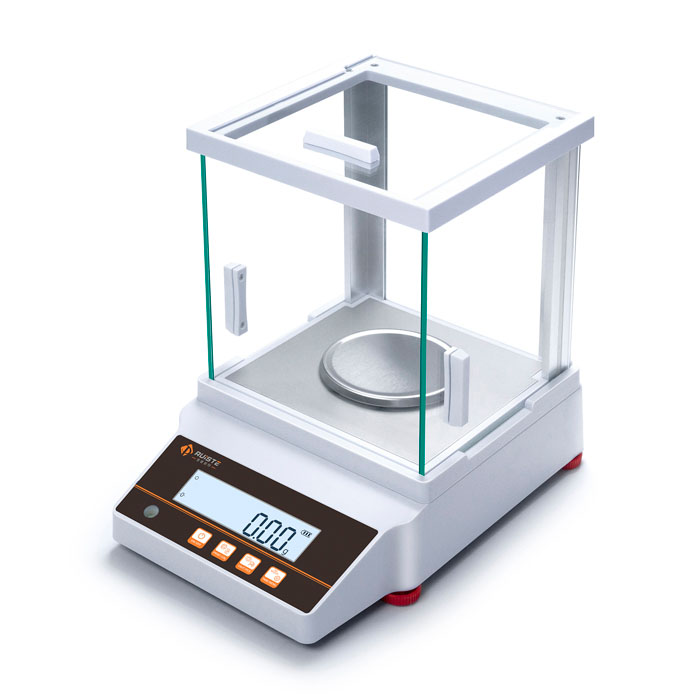
The customization of precision balance covers multiple dimensions including structural design, internal configuration, and auxiliary functions, and each customized module is formulated based on actual usage demands. In terms of structural customization, equipment designers adjust the material and structural layout of the weighing pan according to sample attributes. For corrosive chemical samples, weighing pans made of inert metal composite materials are selected to resist chemical erosion and extend service life; for powdery and granular samples prone to splashing, enclosed weighing cabins with anti-static coatings are configured to reduce sample loss caused by static adsorption. The base structure is also optimized in a targeted manner, adopting thickened shock-absorbing materials for production workshops with frequent mechanical vibration to weaken external vibration interference and ensure stable data output. In addition, the spatial size of the weighing cabin can be adjusted to adapt to samples of different volumes, solving the weighing difficulties of oversized or irregularly shaped samples that cannot be measured by standard balances.
Configuration-level customization focuses on the optimization of sensing components and data processing systems to match different accuracy requirements. For basic conventional detection scenarios, medium-sensitivity sensing components are deployed to balance measurement stability and equipment operating cost; for trace sample detection in biochemical experiments and precious material analysis, high-precision sensing modules are adopted to capture subtle mass changes. The internal data processing algorithm can also be customized. Users engaged in repetitive batch detection can be equipped with optimized statistical algorithms to automatically record, classify, and sort multiple sets of weighing data, while personnel engaged in experimental research can select high-frequency data sampling modes to capture mass fluctuation changes during sample reaction. The adjustment of environmental adaptation parameters is also a key part of configuration customization. The built-in temperature and humidity sensing modules can be matched according to the climatic conditions of the usage area, and the system automatically corrects measurement data affected by temperature drift and humidity changes to weaken the impact of environmental factors on weighing results.
Custom precision balance has extensive application coverage, penetrating multiple professional fields with differentiated usage needs. In chemical laboratories, customized balances are used for the weighing of chemical reagents, catalyst raw materials, and reaction residues. The sealed anti-corrosion structure effectively isolates volatile and corrosive substances, and the high-precision sensing performance meets the dosage control requirements of microscale chemical experiments. In the pharmaceutical production industry, such balances assist in the proportioning of pharmaceutical raw materials and the detection of finished product weight consistency. The dust-proof and sterile customized structure complies with the production environment standards of pharmaceutical workshops, avoiding sample contamination during the weighing process and ensuring the uniformity of pharmaceutical ingredient content. In new energy material research, researchers use customized balances with high-density measurement functions to test the mass and density of battery electrode materials, providing accurate data support for material ratio optimization and product performance improvement.
The industrial manufacturing sector also relies heavily on customized precision weighing equipment. In the processing of tiny electronic components such as circuit board accessories and semiconductor raw materials, miniature customized balances with ultra-small weighing pans are used to complete the quality inspection of micro-components, controlling the production error of precision parts within a reasonable range. In the food processing industry, customized balances with moisture-proof and anti-adhesion properties are applied to the weighing of powdered food raw materials and freeze-dried products. The smooth non-stick surface structure reduces sample residue, improves raw material utilization rate, and simplifies equipment cleaning steps. In the field of geological exploration, staff use customized balances with shock resistance and high temperature resistance to detect the mass and density of mineral samples. The rugged external structure adapts to complex outdoor exploration environments, maintaining stable working performance under harsh conditions such as variable temperature and uneven placement surfaces.
Compared with standardized weighing equipment, custom precision balance possesses prominent application advantages in targeted scenarios. Its personalized structural design effectively solves the measurement pain points of special samples, including easy corrosion, static adhesion, and irregular shapes, expanding the applicable range of precision weighing technology. The adjustable internal configuration enables the equipment to match diversified accuracy and data processing requirements, avoiding performance redundancy caused by excessive configuration or measurement errors caused by insufficient configuration. Moreover, customized balances can be equipped with targeted auxiliary functions according to user habits, such as external data transmission interfaces, intelligent timing weighing modes, and automatic zero-tracking systems. These functional designs simplify the operation process, lower the threshold for personnel operation, and improve the overall efficiency of weighing work. In terms of long-term use, the targeted material selection and structural optimization reduce equipment wear and failure probability, lowering the maintenance cost in the later service cycle.
To maintain the long-term stable operation of custom precision balance, standardized daily maintenance and scientific usage specifications are essential. The placement environment of the equipment needs to be strictly controlled, requiring placement on a flat and solid countertop, away from direct sunlight, strong airflow, and corrosive gas accumulation areas to prevent external environmental factors from aging internal components and interfering with measurement signals. Before formal measurement, preheating and calibration operations should be completed. Sufficient preheating can stabilize the internal circuit system and reduce data fluctuation caused by temperature changes, while regular calibration can eliminate systematic errors generated by long-term equipment operation. During the weighing process, excessive external force impact on the weighing pan should be avoided, and overloading weighing is prohibited to prevent irreversible damage to precision sensing components. After daily use, the weighing cabin and weighing pan need to be cleaned gently to remove residual samples, and the equipment should be placed in a dry and dust-proof storage state to extend its service life.
With the continuous progress of intelligent manufacturing and precision detection technology, the development direction of custom precision balance is gradually moving toward intelligent integration and environmental adaptation. The iterative upgrading of sensing components further optimizes the anti-interference performance of the equipment, enabling it to maintain stable measurement accuracy in high-dust, high-humidity, and low-temperature extreme environments. The intelligent algorithm system realizes automatic identification of sample types and adaptive adjustment of measurement modes, reducing manual intervention in the operation process. In addition, the lightweight and compact structural design makes customized balances more convenient for transportation and deployment, meeting the mobile detection needs of outdoor exploration, field sampling, and temporary experimental scenarios. The optimization of energy consumption structure also reduces the energy consumption of long-term continuous operation, which is in line with the energy-saving and environmentally friendly development concept of modern industrial production.
In the entire precision measurement industry, custom precision balance undertakes the important task of connecting universal weighing technology and specialized industry detection needs. It breaks through the usage limitations of single-functional standardized balances, provides personalized weighing solutions for different industries and scenarios, and lays a solid data foundation for material research, product production, and quality inspection. Whether it is microgram-level trace sample detection in scientific research laboratories or batch repeated weighing in industrial production lines, customized precision balances can complete measurement tasks with stable performance and reliable data. In the future, driven by material innovation and electronic technology, this type of balance will continue to optimize customized modules, enrich functional attributes, and adapt to increasingly complex measurement standards, continuously empowering the high-quality development of various professional industries with accurate and efficient weighing capabilities.
Custom Precision Balance
https://www.pruiste.com/precision-balance.html
Post Date: May 18, 2026
https://www.supplier-manufacturer.com/precision-balance/custom-precision-balance.html

![Platform Scale TCS SERIES]()
Platform Scale TCS SERIES
TCS platform scale series adopts steel strong tube double-layer carbon steel base, and the bearing base is stable and solid. The whole series platform scale adopts foot-st…![Analytical Balance FA Series]()
Analytical Balance FA Series
FA series electromagnetic force balance adopts key structure. The whole series balance adopts high-performance single-chip microprocessor to control high-speed CPU and spe…![Digital Viscometer Vender In China]()
Digital Viscometer Vender In China
The manufacturing and supply of digital viscometers in China have witnessed steady and progressive development over the past decades, forming a complete and mature industr…![High-shear Digital Viscometer]()
High-shear Digital Viscometer
Viscosity serves as one of the most fundamental physical properties of fluid materials, reflecting the internal friction and flow resistance generated during fluid deforma…![Rotational Digital Viscometer]()
Rotational Digital Viscometer
Viscosity stands as one of the most fundamental physical properties of fluid materials, reflecting the internal frictional resistance that occurs when a fluid undergoes de…