Semi-micro Precision Balance
In modern laboratory environments that pursue rigorous data accuracy, semi-micro precision balance stands as an indispensable weighing instrument for handling tiny and trace samples. This type of weighing equipment fills the performance gap between general analytical balances and ultra-high precision micro weighing devices, presenting balanced weighing capacity and subtle resolution to adapt to diverse high-precision measurement demands in scientific research, industrial detection, and material analysis. Different from ordinary weighing tools that are only suitable for rough mass measurement, semi-micro precision balance focuses on capturing minor mass changes of samples, which enables laboratory staff to obtain reliable and repeatable mass data during experimental operations. Its inherent structural design and internal working mechanism endow it with stable operating performance, making it widely applied in numerous professional scenarios that require strict mass control.
The core working principle of semi-micro precision balance relies on electromagnetic force compensation technology, a mature and efficient sensing mechanism commonly adopted by high-precision electronic weighing instruments. During the weighing process, when a sample is placed on the weighing pan, the gravity of the sample causes slight displacement of the internal mechanical structure of the balance. The built-in displacement sensing component can instantly capture this tiny positional deviation and transmit the signal to the closed-loop control circuit. The circuit system dynamically adjusts the current passing through the electromagnetic coil according to the real-time deviation signal, generating corresponding electromagnetic force to counteract the gravity of the sample. Once the electromagnetic force and the sample gravity reach a stable equilibrium state, the current value in the coil will remain relatively constant. Since there is a stable linear correlation between current intensity and sample mass, the system can convert the collected electrical signals into intuitive mass data and display it on the human-computer interaction interface. This non-mechanical weighing method effectively reduces measurement errors caused by mechanical friction, laying a solid foundation for the high stability and high consistency of repeated weighing results.
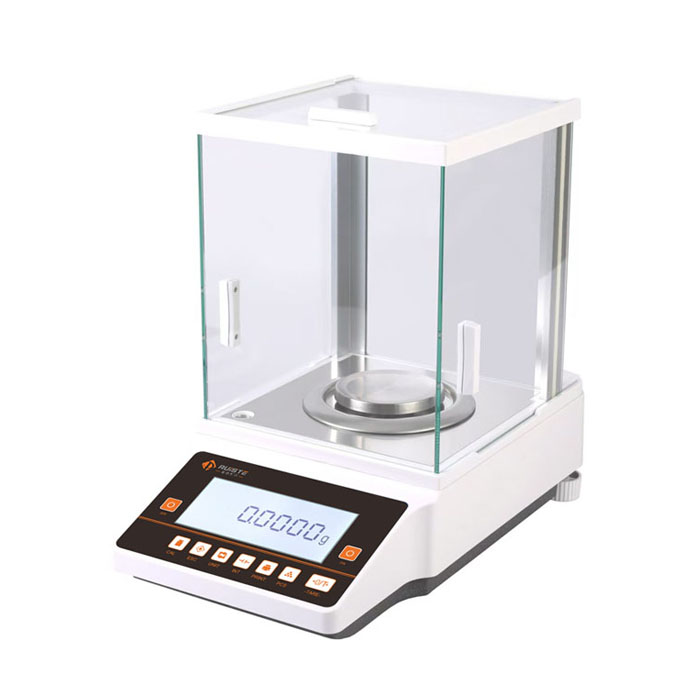
The physical structure of semi-micro precision balance is elaborately optimized to adapt to trace sample weighing scenarios, and each component is designed to reduce external interference and improve data stability. The external part is equipped with a transparent wind shielding cover, which is one of the most intuitive structural characteristics distinguishing it from ordinary balances. The flowing air in the laboratory environment can generate subtle airflow impact on tiny samples, and even slight air turbulence will cause data fluctuation during the weighing process. The closed wind shielding structure can isolate the weighing chamber from the external air circulation, minimizing the interference of airflow on sample placement and data reading. The weighing pan inside the shielding cover is usually made of corrosion-resistant and high-density metal materials, with a smooth and flat surface to ensure uniform stress on the sample and avoid mass deviation caused by sample sliding or uneven placement. The bottom of the instrument is fitted with adjustable foot pads and horizontal sensing components; the foot pads can fine-tune the horizontal angle of the balance body, while the horizontal detection structure monitors the placement state in real time. Keeping the instrument in a horizontal working state is essential, as tilting conditions will change the stress direction of internal components and disrupt the balance between electromagnetic force and gravity, resulting in inaccurate measurement data.
In addition to the basic mechanical structure, the internal electronic system of semi-micro precision balance further optimizes weighing performance through multiple auxiliary modules. The high-sensitivity weighing sensor is the core component for data acquisition, which can identify micro mass changes that are difficult for human perception. The signal processing unit filters out clutter interference in the electrical signal through built-in algorithm programs, eliminating data jitter caused by weak electromagnetic fluctuations in the external environment. Many semi-micro precision balances are equipped with static elimination components, aiming to solve the static interference problem common in trace sample weighing. Powdery, colloidal and polymer samples are prone to static charge accumulation during handling and placement; static adsorption will not only cause samples to adhere to containers but also generate tiny adsorption force between samples and instrument structures, affecting the authenticity of weighing data. The static elimination module can neutralize redundant charges around the weighing chamber within a short time, creating a stable electrostatic environment for accurate measurement. Moreover, the temperature sensing component inside the instrument can monitor ambient temperature changes. Since temperature fluctuation will affect the magnetic conductivity of the electromagnetic coil and the physical properties of internal mechanical parts, the system can make real-time parameter compensation according to temperature variation to maintain consistent weighing accuracy in different environmental conditions.
Environmental control is a crucial prerequisite to ensure the stable operation of semi-micro precision balance, and the sensitivity of the instrument determines its strict requirements for placement conditions. The suitable working environment should maintain mild and stable temperature, avoiding drastic temperature alternation between day and night. Rapid temperature change will cause thermal expansion and contraction of internal metal and electronic components, changing the structural tightness and electrical conductivity of parts, which is not conducive to data stability. In terms of humidity control, excessively humid environment will lead to moisture adhesion on the surface of internal circuits and metal structures, increasing the risk of component corrosion and circuit short circuit; while overly dry air will aggravate static generation. Keeping moderate and constant humidity can effectively extend the service life of the instrument and maintain weighing stability. Besides, the placement position of the balance should stay away from vibration sources such as mechanical equipment and walking channels. Tiny vibration transmitted through the ground will drive the weighing pan to shake slightly, making it difficult for the instrument to reach a stable equilibrium state. It is also necessary to avoid placing the instrument near ventilation openings, chemical reagent storage areas and strong magnetic field equipment to prevent airflow, volatile corrosive gas and magnetic interference from affecting internal sensing components.
Standardized operating procedures are vital to give full play to the performance advantages of semi-micro precision balance, and irregular manual operations are one of the main causes of measurement deviation. Before formal weighing, pre-operation preparation must be completed carefully. The operator needs to check the horizontal state of the instrument to ensure the bubble in the horizontal indicator is in the standard position, and wipe the surface of the weighing pan with clean non-woven fabric to remove residual dust and sample impurities. It is necessary to turn on the power supply for preheating; a certain preheating time can stabilize the operating state of the internal circuit and electromagnetic components, avoiding data drift caused by unstable current at the initial startup stage. After preheating, the blank calibration operation should be carried out to eliminate the influence of container mass and minor structural deviation, ensuring the instrument returns to the zero baseline state. During sample placement, it is advisable to use clean tweezers or special sampling tools instead of direct hand contact, as sweat and grease on the skin will contaminate the weighing pan and samples, bringing invisible mass interference. The sample should be placed in the center of the weighing pan to prevent eccentric load; eccentric placement will cause uneven stress on the sensor and produce systematic errors. After the data is stabilized and recorded, the sample should be taken out in time, and the wind shielding cover should be kept closed to reduce dust accumulation inside the weighing chamber.
Semi-micro precision balance has extensive application value in multiple professional fields, covering experimental research, industrial manufacturing and quality detection industries. In chemical laboratories, it is commonly used for the weighing of trace chemical reagents, high-purity raw materials and reaction residues. Many chemical synthesis and quantitative analysis experiments require precise proportioning of trace substances, and subtle mass errors may lead to changes in chemical reaction degree and experimental conclusion. This type of balance can provide accurate mass data to ensure the reproducibility and credibility of chemical experiments. In pharmaceutical research and production links, it undertakes the weighing work of active pharmaceutical ingredients, auxiliary materials and trace additives. The uniform content of effective components in pharmaceutical preparations directly affects product quality, and precise weighing can stabilize the proportion of raw materials and reduce product batch differences.
In material science research, semi-micro precision balance is applied to the mass detection of new materials such as ultrafine powder, nanoparticles and thin-film samples. These novel materials have small single sample mass and sensitive physical properties, requiring instruments with high resolution to complete mass measurement. It can also cooperate with thermal analysis equipment to record the mass change of samples during heating, oxidation and decomposition, providing data support for analyzing material stability and chemical characteristics. In the food detection industry, it is responsible for the weighing of trace additives, harmful residues and nutrient components in food. Relying on its accurate measurement capability, it helps detection personnel complete component content analysis and food safety assessment. In addition, it also plays an important role in environmental monitoring, which can weigh trace sediment in water bodies, atmospheric dust particles and contaminated residues, providing effective data basis for environmental pollution analysis and treatment scheme formulation.
Daily maintenance and scientific maintenance are essential to maintain the long-term stable performance of semi-micro precision balance. After daily use, the operator should clean the weighing pan and the inner wall of the wind shielding cover to remove residual samples and dust; neutral and non-corrosive cleaning agents can be used for stubborn stains, and the surface should be kept dry after cleaning to prevent liquid from penetrating into the internal structure. The instrument should be placed in a dry and dust-proof storage environment when not in use, and the power supply should be cut off for long-term standby to avoid circuit aging caused by long-term electrification. Regular professional inspection is also indispensable, including checking the sensitivity of sensors, the stability of circuit systems and the flexibility of mechanical structures. For components that are prone to aging such as electrostatic elimination modules and sensing elements, regular performance testing should be conducted to replace aging parts in a timely manner. During the handling and movement of the instrument, violent vibration and flipping should be avoided to prevent displacement and damage of precision internal parts. Good maintenance habits can not only reduce measurement errors caused by component aging but also extend the service cycle of the instrument and reduce the use cost of laboratory equipment.
With the continuous progress of laboratory technology and detection standards, the performance of semi-micro precision balance is also constantly optimized and upgraded. The intelligent operation mode gradually replaces the traditional single weighing function; the optimized data storage system can record multiple groups of weighing data, facilitating subsequent sorting, comparison and traceability. The human-computer interaction interface is more concise and intuitive, simplifying complex operation steps and lowering the use threshold for operators. Meanwhile, the anti-interference capability of the instrument is further strengthened. Through upgraded algorithm filtering and structural shielding design, it can adapt to more complex laboratory environments and maintain stable measurement accuracy under slight vibration and weak electromagnetic interference. In the future, with the deepening of micro-analysis and trace detection research, semi-micro precision balance will continue to iterate in terms of resolution, intelligence and environmental adaptability, providing more reliable technical support for high-precision experimental research and industrial detection.
As a bridge connecting macroscopic mass observation and microscopic trace detection, semi-micro precision balance has irreplaceable application significance in modern precision measurement work. Its unique structural design, stable working mechanism and flexible application scenarios make it a key piece of equipment in numerous professional laboratories. Whether it is basic scientific research, industrial quality control or public safety detection, it can complete trace sample weighing tasks with stable and reliable data performance. Standardized operation and scientific maintenance can maximize its performance advantages, ensuring the authenticity and effectiveness of each group of measurement data. In the context of increasingly stringent detection requirements, semi-micro precision balance will continue to exert its value, assisting researchers and technicians to complete various high-precision measurement work and promoting the steady development of related industries and scientific research fields.
Semi-micro Precision Balance
https://www.pruiste.com/precision-balance.html
Post Date: May 18, 2026
https://www.supplier-manufacturer.com/precision-balance/semi-micro-precision-balance.html

![Explosion-proof Balance EX Series]()
Explosion-proof Balance EX Series
EX explosion-proof balance whole is 304 stainless steel, rust and corrosion resistance. The whole series of balance adopts intrinsically safe explosion-proof battery. Expl…![Types of Digital Viscometer]()
Types of Digital Viscometer
Viscosity serves as a fundamental physical property that reflects a fluid’s internal resistance to flow and shear deformation, playing a vital role in quality control, pr…![Digital Viscometer Wholesale]()
Digital Viscometer Wholesale
Viscosity measurement stands as a fundamental part of industrial quality control, material research, and production process optimization across diverse global sectors. As …![Precision Digital Viscometer]()
Precision Digital Viscometer
Viscosity stands as one of the most fundamental physical properties of fluid substances, reflecting the internal friction and flow resistance generated during the movement…![Purposes of Moisture Analyzer]()
Purposes of Moisture Analyzer
Moisture content stands as one of the most fundamental and influential physical properties of nearly all raw materials, semi-finished goods, and finished products across i…