Rapid Moisture Analyzer
Moisture content stands as one of the most critical physical indicators that determine the quality, stability, and practical performance of various raw materials and finished products across industrial production, agricultural processing, pharmaceutical manufacturing, and daily chemical industries. Excess or insufficient moisture in materials can trigger changes in physical properties, chemical stability, and storage durability, potentially leading to product quality fluctuations, shortened shelf life, and even production safety risks in severe cases. Traditional moisture detection methods, which rely on constant-temperature oven drying and manual weighing calculation, feature stable detection accuracy but suffer from prominent drawbacks such as long testing cycles, cumbersome operation steps, and high susceptibility to human operational errors. These limitations make it difficult to adapt to the fast-paced production rhythm and real-time quality monitoring demands of modern industrial production. As a mature and efficient detection device, the rapid moisture analyzer has gradually replaced traditional detection methods in most industrial scenarios by virtue of its efficient testing speed, stable detection performance, and simple operational logic, becoming a core tool for routine moisture detection and quality control in various production and laboratory environments.
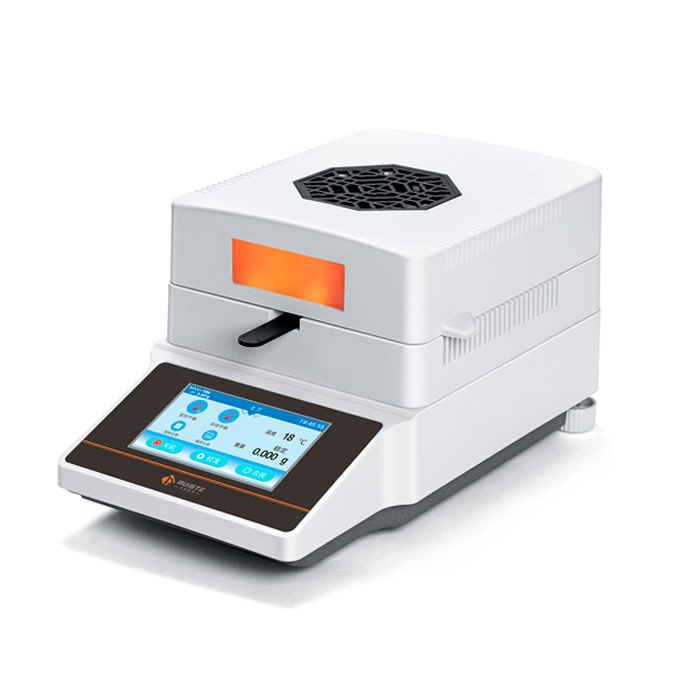
The core working logic of the rapid moisture analyzer is based on the thermogravimetric analysis principle, a scientific detection method recognized for reliable and intuitive test results. The entire detection process relies on the precise coordination of an integrated high-precision weighing system and a uniform heating system, eliminating the need for complex chemical reagents and auxiliary detection equipment. Before testing, the device automatically records the initial weight of the placed sample through the built-in precision weighing sensor, capturing original data with high sensitivity to ensure the authenticity and effectiveness of subsequent calculation benchmarks. During the testing phase, the heating unit releases stable and uniform thermal energy to act on the sample surface and interior, prompting all free water and volatile trace moisture inside the sample to evaporate completely. The high-precision weighing module continuously monitors the weight changes of the sample in real time throughout the heating and evaporation process, transmitting dynamic weight data to the internal microprocessor synchronously. After the sample weight reaches a stable state with no further significant changes, the system automatically judges the completion of drying, calculates the total weight loss generated by moisture evaporation, and converts the data into standard moisture content values through built-in algorithms, realizing one-stop completion of sampling, drying, weighing, data calculation, and result output.
Compared with traditional oven drying detection modes, the rapid moisture analyzer achieves comprehensive optimization in heating efficiency and heating uniformity. Traditional oven equipment relies on slow hot air circulation for overall heating, which requires a long preheating time and leads to uneven heat distribution in the working cavity, resulting in inconsistent drying degrees of samples at different positions and prolonged testing cycles. In contrast, the heating structure of modern rapid moisture analyzers adopts an optimized radiation heating design, which can quickly reach the set temperature and form a uniform thermal field covering the entire sample placement area. This heating mode enables synchronous heating of the sample surface and interior, effectively avoiding the common problems of local overheating, sample surface scorching, or incomplete internal drying that occur in traditional heating processes. While improving drying efficiency, it ensures the consistency and accuracy of each test result. The entire testing process, from sample placement to result output, can be completed within a short period, which greatly shortens the detection cycle compared with the several hours required by traditional methods, and effectively supports real-time quality inspection in continuous production lines.
In terms of structural design and operational performance, the rapid moisture analyzer integrates modular functional components, realizing high integration and intelligent automation of the detection process. The core components include a high-sensitivity weighing unit, a precise temperature control system, a real-time data acquisition module, and an intelligent data processing unit. The temperature control system supports flexible adjustment of drying temperature within a reasonable range, which can adapt to the heat resistance characteristics of different types of samples. For heat-sensitive materials such as food raw materials, pharmaceutical intermediates, and biological samples, low and medium temperature drying parameters can be set to prevent thermal decomposition or property changes of the sample itself caused by high temperature, ensuring that the detected moisture data truly reflects the actual state of the material. For heat-resistant industrial raw materials such as granular chemical materials and building material powders, higher temperature parameters can be adopted to accelerate moisture evaporation and further improve detection efficiency. The built-in microprocessor can automatically identify the drying state of the sample, judge the end point of the test intelligently, and avoid detection errors caused by manual judgment differences, making the test results more repeatable and stable.
The standardized and automated operation mode of the rapid moisture analyzer greatly reduces the threshold for equipment use and the impact of human factors on test results. Traditional moisture detection requires operators to master professional experimental procedures, including sample weighing, constant-temperature drying, cooling treatment, secondary weighing, and manual calculation of moisture content. Each step is accompanied by operational errors such as weighing deviation and timing deviation, which affect the final detection accuracy. The rapid moisture analyzer simplifies the entire detection process to basic steps such as sample weighing and parameter setting. After placing an appropriate amount of sample on the dedicated sample tray and setting the temperature and termination conditions according to material characteristics, the equipment can automatically complete all subsequent detection links. The device is equipped with an intuitive display interface, which can real-time display key data such as sample initial weight, real-time weight loss, drying temperature, and remaining test time. After the test is over, the final moisture content data is automatically locked and presented, and the historical test data can be stored and queried, which facilitates data sorting, archiving, and production quality traceability in industrial production and laboratory testing.
The wide application compatibility of the rapid moisture analyzer enables it to cover moisture detection demands of solid materials in multiple industries, providing reliable data support for production quality control and process optimization. In the food and agricultural product processing industry, moisture content is a key indicator affecting product taste, storage performance, and processing quality. Grain crops such as rice, wheat, and corn need strict moisture detection before warehousing and processing to prevent mildew and deterioration during storage and ensure the stability of subsequent processing procedures such as milling and granulation. Snack foods, baked products, and dried fruits need precise moisture control to maintain fixed taste and texture, while excessive moisture can lead to product softening and spoilage, and low moisture may cause brittle damage and taste degradation. The rapid detection capability of the analyzer can meet the batch and rapid detection demands of food processing enterprises, helping enterprises adjust production parameters in a timely manner and stabilize product quality.
In the chemical and new material industry, moisture content directly affects the chemical stability and application performance of raw materials and finished products. Polymer particles, resin raw materials, coating powders, and plastic additives all have strict moisture control standards. Residual moisture in chemical raw materials may cause chemical reactions such as hydrolysis and oxidation during production and processing, leading to changes in material composition, reduced product purity, and unstable product performance. For new material products such as fine chemical powders and composite materials, trace moisture will affect the bonding performance and structural stability of materials, reducing the service life of finished products. The rapid moisture analyzer can accurately detect trace moisture in fine chemical materials, helping enterprises strictly control raw material incoming quality and finished product delivery quality, and optimize production formula parameters according to detection data to improve product stability and qualification rate.
The pharmaceutical and daily chemical industries also rely heavily on precise moisture detection to ensure product safety and usability. In pharmaceutical production, raw material medicinal powders, tablet intermediates, and capsule fillers have strict moisture control requirements. Excess moisture in pharmaceutical materials is prone to breed microorganisms, trigger component degradation, and affect the efficacy and safety of drugs. In the production process of daily chemical products such as facial care powders, detergent particles, and cosmetic raw materials, moisture content affects the fluidity, uniformity, and storage stability of products. The rapid moisture analyzer can adapt to the detection standards of high-purity materials in the pharmaceutical and daily chemical industries, with stable detection precision that meets the routine quality inspection demands of production lines and laboratories, providing effective technical support for standardized production of enterprises.
In the building materials and environmental protection industry, moisture detection of raw materials is an important link to ensure engineering quality and environmental treatment effects. Building materials such as cement powder, gypsum materials, and aggregate sands have a direct impact on the bonding strength and structural stability of building components due to moisture content. Excessive moisture in building materials will cause volume expansion and shrinkage changes during the solidification process, leading to cracking and hollowing of building structures and affecting engineering durability. In environmental protection detection, soil samples and sludge materials need moisture data to support subsequent component analysis and pollution assessment. The rapid moisture analyzer can quickly complete batch detection of building material and environmental samples, providing accurate basic data for engineering construction and environmental monitoring work.
To maintain the long-term stable operation of the rapid moisture analyzer and ensure the consistency of detection data, standardized daily operation and maintenance management are essential. In the daily testing process, operators need to keep the equipment placement environment flat, dry, and free from strong air convection and electromagnetic interference, so as to avoid the impact of external environmental factors on the weighing accuracy and heating stability of the equipment. Before each test, it is necessary to check the cleanliness of the sample tray and the heating cavity to remove residual sample impurities and avoid cross-interference between different samples. For different types of samples, appropriate sample weight and drying temperature parameters should be selected according to material characteristics. Excessively thick sample laying will lead to uneven internal drying and affect detection accuracy, while unreasonable temperature setting may cause sample deterioration and distort test data.
Regular calibration and maintenance of the equipment can effectively extend the service life of the rapid moisture analyzer and maintain stable detection performance. The weighing system needs regular calibration to eliminate zero drift and weighing deviation caused by long-term use. The heating module should be inspected periodically to ensure uniform heat release and avoid local temperature deviation. After the test is completed, the equipment needs to be cooled down naturally and cleaned in time to keep the internal cavity clean and dry. Reasonable maintenance habits can not only ensure the accuracy and repeatability of each test result but also reduce equipment failure rates and reduce subsequent use and maintenance costs for enterprises.
With the continuous upgrading of modern industrial production standards and quality control systems, the demand for rapid, accurate, and intelligent moisture detection is constantly improving. The rapid moisture analyzer, as an efficient and convenient detection tool, has broken through the efficiency bottleneck of traditional detection methods and realized the integration of rapid detection and precise data output. Its flexible parameter adjustment capability, stable detection performance, and simple operation logic enable it to adapt to diversified detection scenarios from laboratory precise analysis to production line batch sampling inspection. In the future, with the continuous development of intelligent manufacturing and industrial quality refinement, the rapid moisture analyzer will be further optimized in terms of intelligent data analysis, multi-scene adaptation, and energy-saving operation, providing more comprehensive and reliable technical support for quality control in various industries, and helping enterprises realize refined production management and stable improvement of product quality.
Rapid Moisture Analyzer
https://www.pruiste.com/moisture-analyzer.html
Post Date: May 23, 2026
https://www.supplier-manufacturer.com/moisture-analyzer/rapid-moisture-analyzer.html

![Bench Weighing Scale]()
Bench Weighing Scale
Bench weighing scales stand as one of the most essential and widely used measuring instruments across diverse commercial, industrial, and daily operational environments, s…![Precision Counting Scale]()
Precision Counting Scale
In modern production operations, small batch processing, laboratory research work, and daily material management routines, the need to quantify small items with consistent…![Digital Laboratory Balance]()
Digital Laboratory Balance
In every modern scientific research laboratory, analytical testing center, and industrial quality control laboratory, accurate mass measurement stands as one of the most f…![Electronic Analytical Balance]()
Electronic Analytical Balance
In every modern laboratory setting that relies on reliable mass determination and quantitative experimental data, the electronic analytical balance stands as an indispensa…![Floor Electronic Balance]()
Floor Electronic Balance
Floor electronic balance has become an indispensable weighing equipment in modern industrial production, scientific research experiments, agricultural detection, food proc…