Halogen Moisture Analyzer
Moisture content stands as one of the most critical physical indicators for a wide range of raw materials, semi-finished goods, and finished products across modern industrial production and laboratory research. The presence of moisture directly influences the physical properties, chemical stability, storage cycle, and processing performance of materials. Excess moisture in granular materials may lead to agglomeration and poor fluidity, while trace moisture in chemical reagents can trigger chemical reactions that alter product purity, and unregulated moisture levels in food materials may affect taste, shelf life, and overall quality consistency. In response to the growing demand for efficient and stable moisture detection in various sectors, halogen moisture analyzers have become mainstream analytical instruments, relying on mature thermogravimetric measurement logic and optimized heating technology to replace traditional cumbersome detection methods and support daily quality control and experimental analysis work.
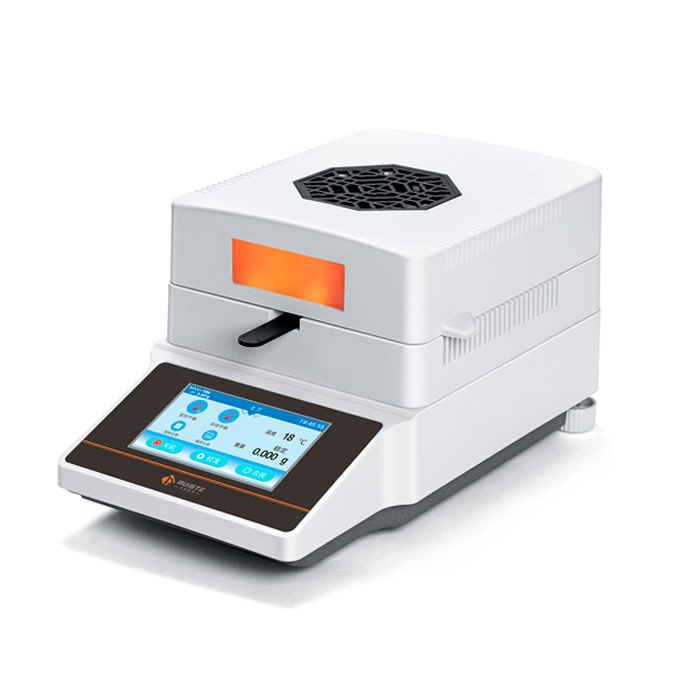
The core working logic of a halogen moisture analyzer follows the classic thermogravimetric drying principle, a scientific detection method that has long been recognized and adopted in material analysis. The entire detection process is built on accurate mass monitoring and complete moisture volatilization. Before formal testing, the instrument records the initial mass of the prepared sample placed on the weighing platform with high precision. Subsequently, the halogen heating component generates uniform infrared radiation heat, which penetrates the sample surface and accelerates the volatilization of free water and volatile moisture inside the sample. Throughout the heating and drying cycle, the built-in high-sensitivity weighing unit continuously captures real-time changes in sample mass, automatically tracking the weight loss caused by moisture evaporation. When the sample mass remains stable within a set time range, meaning almost all internal moisture has been completely evaporated, the instrument terminates the heating process and calculates the sample moisture content based on the difference between initial and final stable mass. This working mode effectively aligns with the basic standard of moisture detection, ensuring the rationality and credibility of detection results.
Compared with traditional constant-temperature oven drying methods, halogen heating technology brings significant improvements in detection efficiency and operational simplicity. Traditional oven drying usually requires several hours of constant-temperature baking, paired with repeated cooling and weighing steps, which consumes substantial time and human resources and cannot meet the needs of rapid batch detection in industrial production. The halogen heating element adopted by the analyzer features low thermal inertia and fast temperature response, enabling rapid heating to the preset temperature and forming a uniform thermal radiation field around the sample. This uniform heating mode avoids local overheating or uneven drying of the sample, preventing sample carbonization, decomposition, or volatile loss of effective components that may occur in traditional high-temperature drying. For most conventional solid and viscous liquid samples, the complete detection cycle of a halogen moisture analyzer can be controlled within a short period, greatly improving the efficiency of single-batch detection and supporting continuous sampling and testing in production lines.
The structural design of halogen moisture analyzers focuses on the integration of precision, stability, and operability, constituting a complete and independent detection system. The core components include a halogen heating module, a high-precision weighing sensor, a temperature control system, a data processing unit, and a sealed detection cavity. The halogen heating module serves as the heat source for sample drying, converting electric energy into stable infrared heat radiation with uniform heat distribution and gentle heating performance, which adapts to the drying requirements of most heat-sensitive materials. The internal weighing sensor maintains high sensitivity and stability during continuous heating, effectively resisting slight interference from thermal airflow and ambient temperature changes to ensure real-time weight data accuracy. The intelligent temperature control system supports flexible adjustment of drying temperature according to sample characteristics, covering a reasonable temperature range to meet the drying needs of different types of materials, from low-temperature drying of heat-sensitive samples to medium-temperature rapid drying of stable granular and powdery samples.
The standardized operation process is the key to ensuring consistent and reliable detection results of halogen moisture analyzers. The entire testing workflow follows rigorous logical steps, starting with instrument preheating and calibration. Before each batch of testing, the instrument needs a certain preheating period to stabilize internal temperature and weighing components, eliminating data deviation caused by instrument startup instability. Level calibration and zero resetting are also essential pre-test steps to offset the influence of external environment and placement state on weighing accuracy. In the sample preparation stage, operators need to ensure the representativeness of the sample, select an appropriate sample dosage according to material density and particle size, and spread the sample evenly on the weighing dish. Thin and uniform sample laying helps accelerate internal moisture volatilization and avoid incomplete drying caused by excessive sample accumulation or local thick stacking.
After completing sample placement, operators set targeted drying parameters based on material properties, including drying temperature, constant weight judgment standard, and testing termination conditions. For heat-sensitive materials such as food powders, pharmaceutical intermediates, and biological samples, low-temperature gradient drying is required to prevent sample deterioration and ensure that only moisture and volatile water are evaporated without damaging the sample’s effective components. For stable inorganic particles, chemical raw materials, and mineral samples, medium-temperature constant drying can be adopted to improve detection efficiency. Once the parameters are confirmed, the instrument automatically starts the heating and testing process, with real-time changes in sample weight, drying temperature, and moisture content displayed on the interactive interface throughout the process, allowing operators to observe the testing state in real time.
When the system detects that the sample mass change per unit time is lower than the preset threshold, it judges the sample to reach a constant weight state, automatically stops heating, and locks the final detection data. The data processing unit calculates multiple core indicators including moisture mass loss rate, wet basis moisture content, and dry basis moisture content according to built-in algorithms, and retains complete testing data records for subsequent query, sorting, and analysis. After the test, operators need to clean the weighing dish and detection cavity in time to remove residual sample debris, avoid cross-contamination affecting subsequent test results, and maintain the long-term stability of the instrument’s internal components.
Halogen moisture analyzers have extensive application scenarios covering multiple core industries, providing reliable technical support for production quality control and material research. In the food processing industry, moisture content is a key indicator restricting product quality and shelf life. Baked goods, grain raw materials, dairy products, and snack foods all require strict moisture detection. Reasonable moisture control can prevent food mildew, deterioration, and texture hardening or softening, maintaining stable product taste and quality. The rapid detection feature of the analyzer is suitable for real-time sampling inspection on food production lines, helping production personnel adjust processing parameters in a timely manner and reduce unqualified product output.
In the pharmaceutical and chemical industry, moisture detection is closely related to product purity, chemical stability, and production safety. Pharmaceutical raw materials, auxiliary materials, and granular preparations have strict moisture control standards, as excessive moisture may cause drug component hydrolysis, reduce drug efficacy, or trigger microbial growth. In fine chemical production, moisture in powder reagents, coating materials, and plastic particles will affect chemical reaction efficiency and product molding performance. Halogen moisture analyzers can complete accurate detection of trace and conventional moisture in chemical and pharmaceutical samples, providing effective data support for raw material incoming inspection, production process monitoring, and finished product quality verification.
The plastic and new material industry also relies heavily on halogen moisture detection technology. Polymer materials such as plastic particles, resin raw materials, and fiber materials are highly sensitive to moisture. Residual moisture inside the materials will cause bubbles, cracks, and uneven surface texture during injection molding and extrusion processing, reducing product yield and structural stability. Through rapid moisture detection of raw materials before production, enterprises can eliminate unqualified raw materials with excessive moisture and optimize raw material drying processes, ensuring the smooth progress of subsequent processing and production. In environmental detection and agricultural research fields, the instrument can also be used for moisture analysis of soil samples, crop grains, and organic fertilizers, providing basic data support for agricultural planting guidance and environmental soil condition monitoring.
In actual application scenarios, standardized use and daily maintenance are crucial to extending the service life of halogen moisture analyzers and maintaining detection accuracy. The instrument should be placed in a stable indoor environment, avoiding direct sunlight, strong airflow, and severe temperature and humidity fluctuations, as external environmental interference may affect heating uniformity and weighing stability. Operators need to avoid placing excessive samples during testing, as overloaded samples will lead to incomplete drying and increase the burden on the weighing sensor. For samples containing volatile organic components, targeted parameter adjustment is required to distinguish moisture from other volatile substances and ensure accurate moisture data.
Daily maintenance work includes regular cleaning of the heating cavity and weighing components, regular inspection of the working state of the halogen heating element, and periodic calibration of the weighing system. Long-term accumulation of sample residues will affect heat conduction and weighing accuracy, while aging heating components will lead to insufficient heating efficiency and uneven temperature distribution. Regular maintenance can effectively reduce instrument failure rates and ensure the stability and repeatability of detection data in long-term use. In addition, operators need to master differentiated parameter setting methods for different materials, summarize testing rules for conventional samples, and form standardized operating specifications suitable for enterprise production and laboratory research scenarios.
With the continuous upgrading of industrial intelligence and analytical detection technology, halogen moisture analyzers are also evolving toward more intelligent, humanized, and refined detection directions. Modern instruments are equipped with more flexible data management functions, which can store massive test data, generate statistical reports automatically, and support data export and remote viewing, facilitating enterprise production data archiving and quality traceability. The optimized temperature control algorithm realizes more precise gradient temperature adjustment and constant temperature control, further adapting to the detection needs of various complex and heat-sensitive special materials. At the same time, the lightweight and integrated structural design reduces instrument placement space and simplifies daily operation and maintenance thresholds, making the equipment more suitable for large-scale industrial production lines and small laboratory daily use.
In summary, halogen moisture analyzers have become indispensable basic analytical equipment in modern industrial production and scientific research by virtue of their reasonable working principle, efficient detection speed, stable detection performance, and wide material adaptability. Different from traditional detection methods that rely on lengthy manual operation and time-consuming waiting, it balances detection accuracy and work efficiency, simplifies the moisture detection process, and realizes rapid and stable quantitative analysis of sample moisture. With the continuous improvement of industry quality standards and the increasing demand for refined material detection, the application value of halogen moisture analyzers will be further highlighted, providing continuous and reliable technical support for quality control, process optimization, and material performance research in various industries.
Halogen Moisture Analyzer
https://www.pruiste.com/moisture-analyzer.html
Post Date: May 23, 2026
https://www.supplier-manufacturer.com/moisture-analyzer/halogen-moisture-analyzer.html

![Digital Viscometer NDJ SERIES]()
Digital Viscometer NDJ SERIES
NDJ series viscometer has 2 optional keys and touch screen. The whole series balance adopts high precision sensor, microcomputer control and one key fast measurement. The …![Electronic Balance JA SERIES]()
Electronic Balance JA SERIES
The JA series uses high-definition buttons, and the entire series of balances uses Nuosheng sensors and brand sensors to ensure high accuracy and stability of weighing res…![Online Digital Viscometer]()
Online Digital Viscometer
Viscosity stands as one of the most fundamental physical properties of fluid substances, reflecting the internal frictional resistance that occurs when a fluid flows and d…![Digital Viscometer Supplier]()
Digital Viscometer Supplier
Viscosity stands as one of the most fundamental physical properties of fluid materials, reflecting the internal frictional resistance that occurs when a fluid flows or und…![Portable Digital Viscometer]()
Portable Digital Viscometer
Viscosity stands as one of the most fundamental physical properties of fluid substances, reflecting the internal friction and flow resistance that occurs when liquids move…