Material of Precision Balance
A precision balance stands as an essential measuring instrument widely applied in laboratory analysis, industrial production, pharmaceutical research, and chemical testing. Its capability to deliver stable and accurate mass measurement results relies heavily on carefully selected raw materials, as material properties directly affect measurement repeatability, environmental adaptability, and long-term service performance. Every structural component of a precision balance, ranging from external protective shells and weighing pans to internal sensing units and connecting accessories, requires tailored material selection based on functional demands. The rational combination of diverse materials ensures that the instrument maintains steady working conditions under fluctuations in temperature, humidity, and external mechanical interference, thereby meeting stringent measurement standards in sophisticated application scenarios.

The external shell of a precision balance primarily undertakes protective and structural supporting functions. It serves to isolate internal precision components from external dust, corrosive gases, and accidental physical collisions, while also providing a stable mounting foundation for internal parts. Common shell materials include high-strength engineering plastics and processed metal alloys. Engineering plastics adopted for this component feature low thermal conductivity and excellent molding performance. These materials can effectively slow down the heat exchange between the external environment and internal precision structures, reducing the impact of ambient temperature changes on measurement accuracy. Additionally, engineering plastics possess satisfactory chemical inertness, resisting erosion from mild chemical vapors generated in laboratory environments. Their moderate hardness and good toughness prevent surface cracking caused by minor external impacts, and the smooth molded surface simplifies daily cleaning and maintenance procedures. For precision balances designed for rigorous industrial environments, metal alloy shells are more commonly utilized. These alloy materials exhibit higher structural rigidity and anti-deformation capability, maintaining the overall structural stability of the instrument under long-term static placement and slight mechanical vibration. Surface treatment processes such as matte coating further enhance scratch resistance and anti-oxidation performance, extending the service life of the shell under complex environmental conditions.
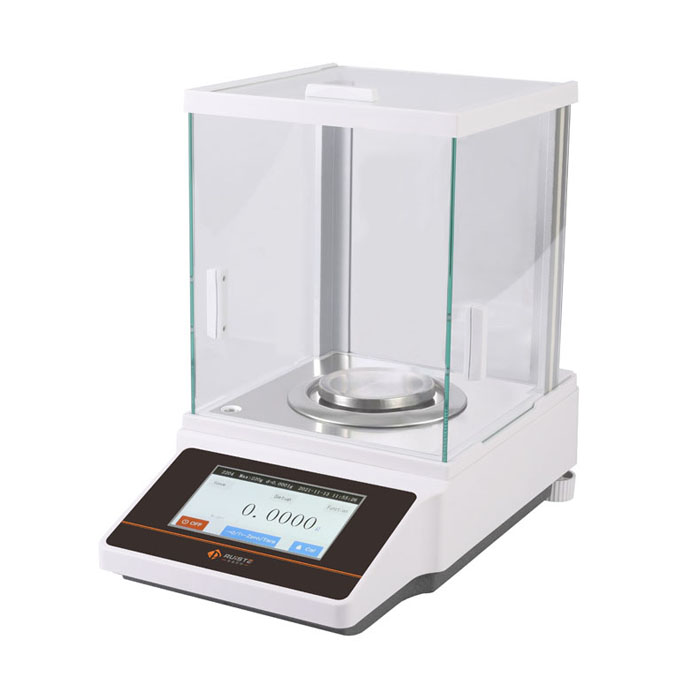
As the direct bearing component for measured samples, the weighing pan has extremely strict material requirements. The surface of the weighing pan must remain flat and smooth to ensure uniform force bearing of samples, while the material needs outstanding corrosion resistance, wear resistance, and temperature stability. Polished stainless steel stands out as a prevalent material for weighing pans. This type of steel contains balanced metal element components, presenting stable physical and chemical properties. It does not easily react with common chemical reagents, preventing surface corrosion or discoloration after contact with liquid samples, powder reagents, and acidic or weak alkaline substances. The high hardness of stainless steel avoids permanent indentation caused by sample extrusion, and its polished smooth surface reduces sample residue, facilitating quick wiping and cleaning. For some lightweight high-precision weighing pans, refined aluminum alloys are adopted. After special surface anodization treatment, aluminum alloys form a dense protective oxide film that isolates air and moisture. These alloys feature low density and light weight, which effectively reduces the load on internal sensing components and improves the sensitivity of tiny mass detection. Moreover, aluminum alloys have favorable thermal conductivity, enabling the temperature of the weighing pan to quickly synchronize with the ambient temperature and minimizing measurement errors induced by temperature differences between samples and the instrument.
Internal sensing components constitute the core functional part of a precision balance, and their material selection determines the fundamental measurement performance of the equipment. The high-precision sensing structure usually adopts integral processed aluminum alloy materials. Through integral carving and molding technology, the aluminum alloy forms a compact and stable elastic deformation structure. This material has uniform internal texture with no obvious structural defects, ensuring linear and reversible tiny elastic deformation under force. Such deformation characteristics enable the sensor to accurately convert subtle mass changes into detectable physical signals. In addition, aluminum alloys have low thermal expansion coefficients, which can restrain structural deformation caused by ambient temperature fluctuations and maintain consistent sensing accuracy within a conventional temperature variation range. Some high-end sensing units introduce tungsten-based composite alloys. These composites are mainly composed of tungsten with nickel-iron or nickel-copper as bonding components. The high density and stable mechanical properties of tungsten-based composites enhance the anti-interference ability of sensors against external vibration and magnetic field interference, adapting to highly sophisticated measurement environments with strict stability requirements.
Damping and balancing auxiliary materials play an indispensable role in optimizing the operating state of precision balances. During the weighing process, slight vibration generated by sample placement or environmental movement can affect data reading stability. Therefore, specific damping materials are installed at the bottom and internal connection positions of the instrument. High-molecular polymer damping materials are widely used for this purpose. These materials have appropriate elasticity and toughness, which can absorb vibration energy from the ground and internal component movement, weakening vibration transmission. Their stable physical properties prevent aging and hardening after long-term use, ensuring persistent damping effects. Leveling foot pads at the bottom of the balance also apply composite rubber materials. The non-slip and compression-resistant characteristics of these materials increase the friction between the instrument and the placement platform, avoiding subtle displacement during operation. Meanwhile, the soft contact structure buffers mechanical pressure, protecting the placement platform and the instrument shell from abrasion.
Counterweight components inside precision balances require materials with high density, low magnetism, and stable chemical properties to provide accurate reference mass. Common counterweight materials include refined brass and non-magnetic stainless steel. Polished brass has uniform density and excellent machinability, allowing it to be processed into counterweight parts with precise dimensions and smooth surfaces. Its weak magnetic property avoids interference from external magnetic fields on mass signals. Non-magnetic stainless steel undergoes special smelting processes to reduce ferromagnetic elements, maintaining low magnetic susceptibility in complex electromagnetic environments. For ultra-high precision counterweights, tungsten heavy alloy materials are applied. With high density, these alloys can create compact counterweight structures, saving internal space of the instrument while maintaining stable mass attributes. They are less affected by humidity and temperature, avoiding mass deviation caused by environmental changes.
Transparent protective baffles on precision balances are primarily made of high-transparency polymer materials. These materials have high light transmittance without optical distortion, enabling operators to clearly observe the weighing state of internal samples. Their compact molecular structure effectively blocks fine dust, water mist, and flowing air in the external environment, preventing airflow disturbance from affecting high-precision weighing data. In terms of physical performance, these transparent materials have moderate impact resistance, resisting slight collisions without brittle cracking. Their stable chemical properties prevent yellowing and aging under long-term light exposure, maintaining transparent and smooth surface conditions. The edge parts of the baffles are fitted with soft sealing materials, which fill assembly gaps to reduce air convection inside and outside the weighing chamber and further enhance the stability of the internal weighing environment.
Circuit connection and electronic bearing materials ensure the stable operation of the internal electronic system of precision balances. Insulating base plates for circuit structures adopt high-temperature resistant ceramic materials. These ceramics have excellent insulation performance and low dielectric loss, effectively isolating current signals and avoiding short-circuit risks caused by circuit overlap. Their high-temperature resistance prevents structural deformation under local heat generation of electronic components, maintaining the stability of circuit layout. Metal conductive connectors use copper-based alloy materials with high conductivity. These alloys have low resistivity, ensuring efficient and stable transmission of electrical signals between components. After surface anti-oxidation treatment, the connectors remain free from oxidation and corrosion in long-term humid environments, avoiding signal attenuation or transmission interruption. External electronic fixing brackets are made of lightweight and rigid magnesium alloys, which reduce the overall weight of electronic modules while providing stable clamping force to prevent component displacement caused by vibration.
The selection of precision balance materials needs to comply with the matching logic of functional requirements and environmental adaptability, and different application scenarios impose differentiated material standards. Balances used in conventional chemical laboratories prioritize corrosion resistance, requiring weighing pans and internal exposed metal parts to adopt anti-corrosion alloy materials to cope with frequent contact with chemical reagents. Balances applied in dust-prone industrial workshops focus on shell sealing and wear resistance, with thickened metal shells and enhanced surface anti-wear coatings. Instruments used in constant-temperature and constant-humidity precision laboratories pay more attention to the thermal stability and low magnetism of internal sensing materials to eliminate subtle interference from environmental changes. Every material selection decision needs to balance manufacturing cost, structural performance, and service life, avoiding performance redundancy or functional deficiency caused by unreasonable material matching.
In the production and processing process of precision balance materials, fine processing technologies are essential to exert material advantages. Metal structural components need precision cutting, polishing, and deburring to eliminate surface burrs and internal stress, ensuring flat assembly surfaces and stable structural coordination. Alloy materials for sensing and counterweight parts require strict impurity control during smelting to reduce trace element interference on physical properties. Non-metallic materials such as engineering plastics and polymers need constant-temperature molding processes to maintain uniform molecular structure and avoid performance differences caused by molding defects. Surface treatment technologies including electroplating, anodization, and matte coating further optimize material surface characteristics, improving anti-corrosion, anti-scratch, and anti-oxidation capabilities.
With the continuous advancement of material science, the material application of precision balances is also undergoing iterative optimization. New composite alloy materials with lower thermal expansion coefficients are being developed to further reduce the impact of ambient temperature on measurement accuracy. Modified high-molecular damping materials achieve more sensitive vibration absorption effects, adapting to higher stability measurement requirements in complex vibration environments. Environmentally friendly and durable transparent polymer materials gradually replace traditional transparent components, possessing stronger anti-aging and anti-ultraviolet capabilities. The continuous upgrading of materials not only improves the comprehensive performance of precision balances but also expands their applicable boundaries in emerging fields such as new energy material testing and biomedical research.
In conclusion, the material composition of a precision balance is a systematic and scientific matching system covering metals, polymers, ceramics, and composite materials. Each component adopts targeted material selection according to its functional attributes, and the coordinated cooperation of various materials realizes the accurate, stable, and durable working state of the instrument. Understanding the characteristics and application logic of precision balance materials helps users grasp the environmental adaptability and usage taboos of the equipment, providing reasonable maintenance methods for daily use. In the future, with the continuous breakthrough of material preparation and processing technologies, the material performance of precision balances will be further optimized, laying a solid material foundation for improving measurement accuracy and expanding application scenarios in various industries.
Material of Precision Balance
https://www.pruiste.com/precision-balance.html
Post Date: May 18, 2026
https://www.supplier-manufacturer.com/precision-balance/material-of-precision-balance.html

![Compact Moisture Analyzer]()
Compact Moisture Analyzer
Moisture content detection stands as a fundamental analytical procedure across industrial production, laboratory research, and quality inspection workflows, as the proport…![Moisture Analyzer For Sale]()
Moisture Analyzer For Sale
Moisture content stands as one of the most critical physical indicators that determine the quality, stability, and usability of various raw materials and finished products…![Laboratory Moisture Analyzer]()
Laboratory Moisture Analyzer
Moisture content stands as one of the most critical physical indicators for evaluating the quality, stability, and usability of various materials across scientific researc…![Analytical Laboratory Balance]()
Analytical Laboratory Balance
Analytical laboratory balances stand as foundational precision instruments in scientific research, industrial testing, and academic laboratory environments, designed to de…![High-capacity Laboratory Balance]()
High-capacity Laboratory Balance
In modern scientific research, industrial production, and quality inspection workflows, accurate mass measurement serves as a fundamental foundation for reliable experimen…