Coaxial Cylinder Digital Viscometer
The coaxial cylinder digital viscometer is a sophisticated laboratory and industrial testing instrument designed to quantify the viscous properties of various fluid materials, serving as a core tool for rheological analysis in multiple industrial and scientific fields. Rooted in the classic Couette flow principle, this instrument adopts a precise coaxial cylinder structural layout, abandoning traditional manual reading modes and integrating modern digital sensing and microprocessing technology to achieve stable, repeatable, and intuitive viscosity detection. Its unique structural design and intelligent testing mode make it adaptable to the viscosity measurement needs of Newtonian and non-Newtonian fluids, filling the technical gap between basic viscometer equipment and professional rheological testing devices, and providing reliable data support for material research, production quality control, and process parameter optimization.
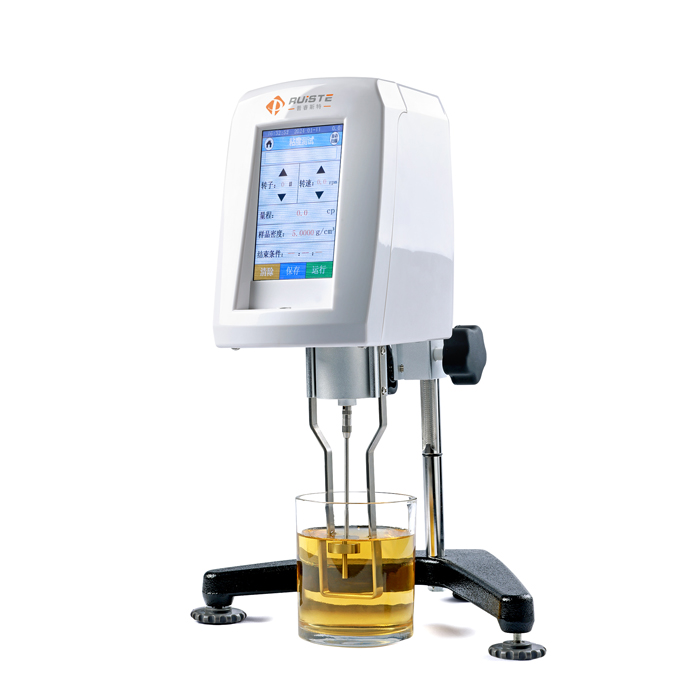
The core working mechanism of the coaxial cylinder digital viscometer revolves around the viscous drag effect of fluids under uniform shear conditions. The instrument consists of two precisely machined cylindrical components arranged in strict coaxial alignment: an outer fixed cup and an inner rotating bob, forming a uniform annular gap with controllable width. During testing, a quantitative sample fluid is injected into the annular gap to ensure full contact between the fluid and the cylindrical working surfaces. When the driving system activates the inner bob to rotate at a preset constant angular velocity, the fluid in the gap is driven to produce layered shear flow. Viscous resistance inherent to the fluid generates a reverse torque on the rotating bob, and the magnitude of this torque is positively correlated with the fluid’s viscosity under fixed structural parameters and rotational speed conditions. High-precision torque sensors embedded in the instrument capture real-time torque signals, which are then converted into digital electrical signals and processed by a built-in microprocessor. After algorithm calibration and data compensation, accurate viscosity values are output in standard physical units, realizing the automated digital measurement of fluid viscosity.
Compared with other types of rotational viscometers, the coaxial cylinder structure endows the equipment with distinct structural and testing advantages. The uniform annular shear gap ensures that the fluid inside the testing area bears consistent shear force, avoiding the uneven shear distribution common in cone-plate viscometers during the testing process. This uniform shear environment enables the instrument to simulate the actual flow state of fluids in industrial pipelines, mixing equipment, and coating processes more accurately, making the measured data more consistent with practical application scenarios. In addition, the coaxial cylinder configuration allows flexible adjustment of shear rate by changing the rotational speed of the inner bob, enabling continuous testing of fluid viscosity changes under different shear conditions. This feature is particularly critical for the analysis of non-Newtonian fluids such as shear-thinning and shear-thickening materials, whose viscosity characteristics vary significantly with shear rate changes. The digital transformation of the instrument further optimizes the testing experience and data accuracy, replacing traditional mechanical pointer reading with high-resolution digital display, effectively eliminating visual reading errors caused by human factors.
In terms of structural design details, the coaxial cylinder digital viscometer adopts modular and precision-machined components to ensure long-term stable operation. The cylindrical testing components are made of high-hardness, corrosion-resistant materials, which can maintain stable geometric accuracy after long-term contact with various chemical fluids, including oily liquids, aqueous solutions, and colloidal suspensions. The gap between the coaxial cylinders is strictly calibrated during production, with tiny dimensional tolerances that guarantee the consistency of each testing condition. The driving system uses a stable speed-regulating motor to achieve stepless speed adjustment within a reasonable range, ensuring the stability of rotational speed during testing and avoiding data fluctuations caused by speed jitter. The built-in temperature sensing module can monitor the real-time temperature of the sample fluid throughout the testing process, as fluid viscosity is highly sensitive to temperature changes. The system can record temperature data synchronously with viscosity data, facilitating subsequent data correction and comparative analysis, and greatly improving the comprehensiveness and reference value of test results.
The functional characteristics of the coaxial cylinder digital viscometer determine its wide applicability in diverse industries and research fields. In the chemical industry, it is commonly used to test the viscosity of chemical solvents, polymer solutions, and industrial slurries, helping researchers analyze the polymerization degree and solution stability of polymer materials, and guiding the formulation adjustment of chemical products. In the coating and ink industry, the instrument detects the viscosity of paint, printing ink, and adhesive materials, effectively controlling the fluidity and leveling performance of products. Stable viscosity parameters ensure uniform coating thickness in construction and consistent color and texture of printed products, reducing product defects caused by inconsistent fluid viscosity.
In the food processing industry, the viscometer provides accurate viscosity detection for sauces, dairy products, beverage concentrates, and food colloids. The viscosity of food materials directly affects taste, processing efficiency, and shelf stability. By monitoring viscosity changes in real time during production, enterprises can stabilize product formula parameters and ensure consistent product quality in batch production. The pharmaceutical industry also relies on this equipment to test the fluidity of pharmaceutical solutions, ointments, and biological reagents, providing basic data for pharmaceutical formula development and production process standardization, which helps maintain the uniformity and effectiveness of pharmaceutical products.
In scientific research and laboratory scenarios, the coaxial cylinder digital viscometer serves as a basic rheological testing device for material mechanism research. Researchers can explore the viscosity variation rules of new fluid materials under different temperatures, shear rates, and standing times, summarize the rheological characteristics of materials, and provide experimental basis for the development and performance optimization of new materials. In petroleum and lubricant industries, the instrument tests the viscosity of various lubricating oils, crude oil, and hydraulic fluids. The viscosity of lubricating materials is a key indicator of their lubricating and wear-resisting properties, and accurate viscosity testing can guide the selection and application of lubricants in different mechanical operating environments.
In terms of operational performance, the coaxial cylinder digital viscometer features simple and efficient operation procedures, suitable for both professional laboratory researchers and on-site quality control personnel. The equipment is equipped with a humanized operation interface, allowing users to set testing parameters such as rotational speed and testing duration according to sample characteristics. After the sample placement and parameter setting are completed, the instrument can automatically complete the testing process, data collection, and result calculation. Most models support real-time data display, data storage, and historical record query, which is convenient for users to sort out experimental data and track product quality changes over a long period. Some optimized designs also support micro-sample testing, requiring only a small amount of sample liquid to complete accurate detection, which is very suitable for the testing of rare, high-value, or difficult-to-obtain samples, reducing sample waste and testing costs.
To maintain the long-term accuracy and stable operation of the coaxial cylinder digital viscometer, standardized daily operation and maintenance are essential. Before each test, users need to clean the coaxial cylinder components thoroughly to remove residual samples from previous tests, avoiding cross-contamination that may affect test accuracy. It is necessary to check the coaxiality of the cylinder components and the stability of the rotating system to ensure no friction or jitter during operation. During the testing process, the sample liquid should be injected in strict accordance with the specified volume to avoid errors caused by insufficient or excessive sample dosage. After the test is completed, the testing cavity and cylinder components need to be cleaned and dried in a timely manner, and the equipment should be placed in a dry, dust-free, and constant-temperature environment for storage to prevent component corrosion and dust accumulation from affecting structural accuracy.
Regular calibration and performance verification are also key links to ensure the reliability of test data. With the extension of service time, slight wear of mechanical components and drift of sensor parameters may occur. Regular calibration with standard viscosity fluids can correct system errors and maintain the detection accuracy of the instrument. In addition, users should avoid overloading the equipment for a long time and avoid testing corrosive or particulate impurities-containing fluids that do not meet the equipment’s applicable conditions, so as to prevent damage to the precision cylinder structure and sensing system.
With the continuous development of industrial upgrading and material science research, the performance requirements for fluid viscosity testing are constantly improving. The coaxial cylinder digital viscometer is also evolving in the direction of higher precision, stronger anti-interference ability, and more intelligent data processing. Modern optimized models realize more precise temperature compensation algorithms, which can automatically correct viscosity data affected by temperature fluctuations, further improving the accuracy of test results. At the same time, the data transmission function is continuously upgraded, which can realize real-time transmission of test data to terminal equipment, facilitating centralized data management and remote monitoring. These technological improvements enable the instrument to better adapt to the refined production and high-precision scientific research needs of various industries.
In summary, the coaxial cylinder digital viscometer has become an indispensable testing device in the field of fluid rheology due to its reasonable structural design, stable testing performance, and wide application range. It bridges the gap between basic fluid performance detection and industrial quality control, providing accurate and repeatable viscosity data support for product formula optimization, production process adjustment, and new material research and development. With its unique technical advantages and reliable operational performance, this instrument will continue to play an important role in industrial production, scientific research experiments, and quality inspection work, continuously supporting the standardized and refined development of various material-related industries.
Coaxial Cylinder Digital Viscometer
https://www.pruiste.com/digital-viscometer.html
Post Date: May 23, 2026
https://www.supplier-manufacturer.com/digital-viscometer/coaxial-cylinder-digital-viscometer.html

![Explosion Proof Weighing Scale]()
Explosion Proof Weighing Scale
In modern industrial production, many operational scenarios involve flammable and combustible substances, including volatile chemical liquids, suspended organic dust, and …![Counting Scale Supplier]()
Counting Scale Supplier
In modern industrial manufacturing, commercial circulation and daily material management, accurate quantity statistics of small parts and bulk granular materials have beco…![Multi-unit Counting Scale]()
Multi-unit Counting Scale
In modern industrial production, commercial circulation and daily material management processes, accurate quantification and efficient counting of bulk small items have be…![Digital Weighing Scale]()
Digital Weighing Scale
For centuries, people have relied on various mechanical tools to measure weight, from simple balance beams with counterweights to spring-loaded mechanical scales that reli…![Bench Top Counting Scale]()
Bench Top Counting Scale
In modern manufacturing, warehousing management, small batch production processing, and daily enterprise material inventory management work, accurate counting of small par…