High-precision Moisture Analyzer
Moisture content stands as one of the most critical physical indicators for evaluating the quality, stability, and usability of various materials across industrial production, laboratory research, and daily manufacturing processes. Even subtle variations in moisture levels can trigger noticeable changes in material properties, affecting product stability, processing efficiency, and long-term storage performance. In modern analytical testing and quality control workflows, high-precision moisture analyzers have become essential analytical devices, delivering stable and repeatable moisture detection results for diverse solid, paste, and liquid materials through standardized thermogravimetric measurement principles. Unlike traditional manual moisture detection methods that rely on cumbersome drying ovens and manual weighing calculations, this type of integrated testing equipment automates the entire process of sample weighing, constant-temperature drying, real-time weight monitoring, and data calculation, effectively reducing manual operational errors and improving the consistency of detection results in routine testing scenarios.
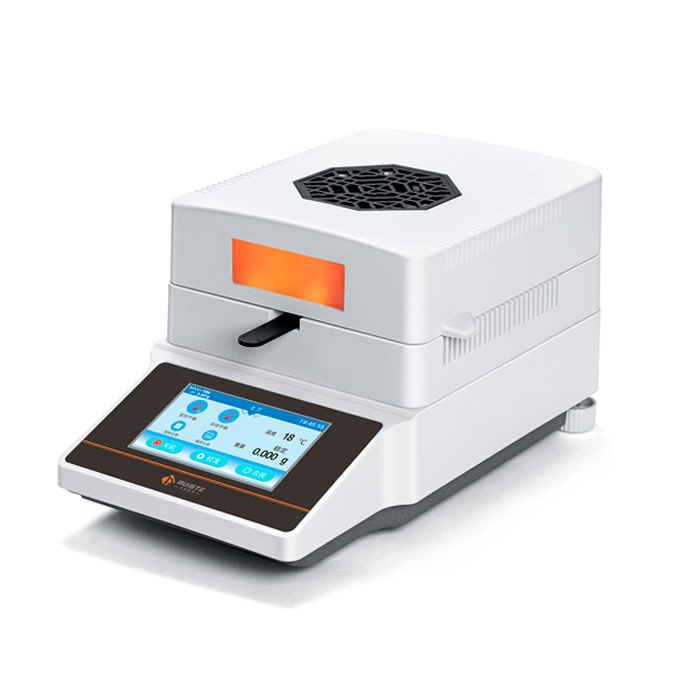
The core working mechanism of high-precision moisture analyzers follows the classic loss-on-drying thermogravimetric principle, a scientific detection logic widely recognized and applied in material analysis. The complete testing process follows a standardized and rigorous operational flow. Before formal detection, the built-in high-sensitivity weighing unit of the instrument first completes zero calibration to eliminate interference from ambient weight factors. After calibration, a quantitative sample is placed evenly in the dedicated sample tray, and the instrument accurately records the initial weight of the sample as the baseline data for subsequent moisture calculation. Once the testing program starts, the precision heating system activates to deliver uniform and stable thermal radiation to the sample inside the sealed testing chamber. This controlled heating process gently raises the sample temperature to a preset constant value, prompting all free water and surface-bound water inside the sample to evaporate fully without causing thermal decomposition or structural damage to the sample’s inherent components.
Throughout the drying cycle, the high-precision weighing sensor continuously captures real-time weight changes of the sample at a high frequency, feeding dynamic data back to the internal microprocessor for real-time analysis and judgment. The system monitors the rate of sample weight loss continuously; when the sample weight remains stable within a set time interval with no obvious attenuation, it indicates that all evaporable moisture in the sample has been completely removed, and the drying process is automatically terminated. The instrument then calculates the sample’s moisture content based on the numerical difference between the initial sample weight and the final constant weight, generating intuitive and traceable detection data. This automated closed-loop testing mode avoids the data deviation caused by manual timing, repeated weighing, and subjective judgment in traditional detection methods, laying a solid foundation for high-precision moisture measurement.
The superior detection performance of high-precision moisture analyzers stems from the optimized design of core structural components, which work in synergy to ensure accuracy, stability, and repeatability of test results. The precision weighing module serves as the core data acquisition unit, adopting high-resolution sensor technology to capture tiny weight fluctuations of samples during drying. This module features stable anti-interference performance, effectively resisting the impact of subtle air flow and temperature changes in the testing environment on weighing data, ensuring that every weight recording is accurate and reliable. Paired with the weighing system is the optimized heating unit, which typically uses uniform thermal radiation heating methods. This heating structure avoids local overheating problems common in traditional heating equipment, ensuring consistent temperature distribution in the entire testing chamber. Uniform heating enables synchronous and steady moisture evaporation across all parts of the sample, preventing incomplete drying caused by uneven temperature or excessive heating that alters sample properties, thus ensuring the authenticity and effectiveness of test data.
In addition to core weighing and heating components, the intelligent control system further enhances the practicality and accuracy of the instrument. The built-in microprocessor can store multiple sets of preset temperature and timing programs, allowing users to select or customize testing parameters according to the physical characteristics of different samples. For heat-sensitive materials that are prone to decomposition at high temperatures, users can set low-temperature constant-speed drying programs to ensure complete moisture evaporation while protecting the sample’s effective components. For materials with stable physical and chemical properties, efficient heating programs can be adopted to shorten testing cycles and improve detection efficiency. The system also features real-time data display and dynamic curve tracking functions, enabling users to observe the entire process of sample weight change and moisture evaporation intuitively, which facilitates real-time monitoring of test status and timely judgment of abnormal test conditions.
High-precision moisture analyzers exhibit extremely high application versatility, covering quality detection and process control needs in multiple industries and material types. In the food processing industry, moisture content directly affects the taste, texture, and shelf life of products. Grain, flour, nuts, dried fruits, and various snack foods require strict moisture monitoring during production and storage. Excess moisture in grain materials can easily lead to mildew and insect infestation during storage, while insufficient moisture in baked foods may cause dry texture and poor taste. By applying high-precision moisture detection, food production enterprises can adjust production processes in real time, control product moisture within a reasonable range, and ensure product taste stability and storage safety. For dairy products, condiments, and paste food materials, the instrument can also accurately detect trace moisture, providing reliable data support for food formula optimization and quality consistency control.
In the chemical and new material industries, moisture content is a key indicator affecting material performance and product stability. Polymer particles, resin raw materials, coating materials, ink products, and chemical auxiliary agents all have strict moisture control requirements. Excessive moisture in plastic particles will affect the fluidity and molding effect of materials during processing, leading to defective products such as bubbles and cracks in finished plastic products. Moisture fluctuations in coatings and inks will cause uneven coloring, poor adhesion, and shortened service life of coated layers. High-precision moisture analyzers can complete rapid and accurate detection of chemical raw materials and finished products, helping enterprises strictly control raw material incoming quality and finished product qualification rate, and maintain the stability of material processing performance and product quality.
The agricultural and feed industries also rely heavily on precise moisture detection technology. In agricultural production, soil moisture detection provides an important basis for scientific irrigation and crop growth condition judgment, helping growers formulate targeted planting management plans. For grain crops and feed products, moisture content is a core indicator of trading measurement and storage safety. Feed materials with unqualified moisture content are prone to deterioration and nutrient loss during storage, affecting the feeding effect and livestock growth health. High-precision moisture detection equipment can adapt to the detection needs of large batches of agricultural and feed samples, providing stable and accurate data support for agricultural product trading pricing, storage management, and feed formula improvement.
In the pharmaceutical and building materials industries, the application value of high-precision moisture analyzers is equally prominent. Pharmaceutical raw materials, tablet preparations, capsule fillers, and herbal medicinal materials have extremely strict moisture control standards, as moisture changes will affect the purity, stability, and efficacy of pharmaceutical products, and even cause qualitative changes in active pharmaceutical ingredients. Precision moisture detection ensures the safety and effectiveness of pharmaceutical products and meets the strict quality control requirements of pharmaceutical production. In the building materials field, raw materials such as cement, gypsum, mortar, and inorganic aggregates are closely related to moisture content in terms of bonding performance and structural stability. Excessive moisture in building materials will affect the solidification speed and structural strength of building components, bringing hidden dangers to engineering quality. Through accurate moisture detection of building materials, construction quality can be effectively controlled and the safety and durability of engineering structures can be guaranteed.
Compared with traditional moisture detection methods, high-precision moisture analyzers show comprehensive advantages in detection efficiency, data accuracy, and operational convenience. Traditional oven drying methods require long-time constant-temperature baking, manual repeated weighing and recording, and the whole process takes several hours with cumbersome operations and low efficiency. In contrast, high-precision moisture analyzers integrate heating, weighing, and calculation functions, completing the entire test process in a short time and greatly improving detection efficiency while ensuring accuracy. In terms of data stability, the automated testing process of the instrument avoids human errors such as reading deviation and timing error in manual operation, making test results more repeatable and comparable. In addition, the instrument features a compact structural design and simple operational logic, requiring no professional chemical reagents and complex pretreatment processes, reducing detection costs and operational difficulty, and being suitable for both laboratory precise analysis and on-site rapid detection in production workshops.
To maintain the long-term stable operation and continuous detection accuracy of high-precision moisture analyzers, standardized daily operation and scientific maintenance management are essential. During daily testing, users need to place the instrument in a flat, dry, and dust-free working environment, avoiding vibration, direct sunlight, and strong air flow interference that may affect weighing and heating stability. Before each test, it is necessary to check the cleanliness of the sample tray and the drying chamber to prevent residual samples from previous tests from interfering with new detection results. For different types of samples, reasonable sample dosage and testing temperature parameters should be set according to material characteristics; excessive sample thickness will lead to incomplete internal moisture evaporation, while too little sample dosage may affect the representativeness of test data.
Regular maintenance and calibration work can effectively extend the service life of the instrument and maintain detection accuracy. Users need to clean the internal heating components and weighing sensors regularly to avoid dust and sample residue accumulation affecting thermal efficiency and weighing sensitivity. Periodic calibration of the weighing system is required to ensure the long-term stability of weighing accuracy. In addition, after long-term high-intensity operation, the heating uniformity and response sensitivity of the instrument will be slightly attenuated, so regular performance inspection and parameter debugging are needed to ensure that the instrument always maintains a good working state. Standardized operation and maintenance not only ensure the accuracy and reliability of each detection result but also reduce equipment failure rates and improve the overall efficiency of quality control work.
With the continuous upgrading of industrial manufacturing standards and laboratory analytical testing requirements, the market demand for high-precision moisture analyzers is gradually improving, and related technological development is also moving toward higher intelligence, stronger adaptability, and more efficient detection. Modern high-precision moisture analyzers are gradually integrating data storage, data export, and remote parameter management functions, which can store a large number of test data and curves, facilitate subsequent data traceability, statistical analysis, and quality report generation, and better meet the standardized management needs of enterprise quality control and laboratory testing. At the same time, the continuous optimization of heating technology and weighing sensing technology enables the instrument to adapt to more special materials, including viscous pastes, porous granular materials, and heat-sensitive fine materials, further expanding the application scope of moisture detection.
In practical industrial and laboratory applications, high-precision moisture analyzers have become an indispensable basic testing device, running through the entire link from raw material incoming inspection, production process monitoring to finished product quality inspection. Stable and accurate moisture detection data provides a reliable basis for enterprises to optimize production processes, control product quality, reduce production costs, and improve market competitiveness. In scientific research experiments, precise moisture measurement data also supports the research and development of new materials, formula optimization, and material performance analysis, providing accurate basic data for the progress of material science and industrial technology. As quality control requirements in various industries continue to become refined, the application value of high-precision moisture analyzers will be further highlighted, becoming an important technical support for standardized production and precise scientific research in multiple fields.
High-precision Moisture Analyzer
https://www.pruiste.com/moisture-analyzer.html
Post Date: May 23, 2026
https://www.supplier-manufacturer.com/moisture-analyzer/high-precision-moisture-analyzer.html

![Weighing Balance RSB-W SERIES]()
Weighing Balance RSB-W SERIES
The RSB-W series adopts high-definition keys, which is economical. The entire series of balances adopt Nuosheng sensors, brand sensors, and aluminum alloy structure to ens…![Specifications of Digital Viscometer]()
Specifications of Digital Viscometer
Digital viscometers are essential analytical instruments designed to quantify the viscosity characteristics of various liquid substances, serving as core testing equipment…![Automatic Digital Viscometer]()
Automatic Digital Viscometer
Viscosity stands as one of the most fundamental physical properties of fluid substances, reflecting the internal friction and flow resistance generated between molecular l…![Coaxial Cylinder Digital Viscometer]()
Coaxial Cylinder Digital Viscometer
The coaxial cylinder digital viscometer is a sophisticated laboratory and industrial testing instrument designed to quantify the viscous properties of various fluid materi…![Halogen Moisture Analyzer]()
Halogen Moisture Analyzer
Moisture content stands as one of the most critical physical indicators for a wide range of raw materials, semi-finished goods, and finished products across modern industr…