Working Principle of Stainless Steel Weight
Stainless steel weights are essential standard measuring objects widely applied in industrial detection, laboratory measurement, instrument calibration, and daily weighing verification. Their core working logic revolves around the basic physical laws of mass conservation and gravitational force, while the unique physical and chemical properties of stainless steel endow these weights with stable and reliable working performance in diverse environments. Different from ordinary metal counterweights, stainless steel weights achieve long-term accurate mass output through precise structural design, stable material characteristics, and standardized physical force conduction, serving as a stable reference benchmark for various weighing equipment and measurement scenarios. To fully understand their working principle, it is necessary to integrate basic mechanical theories, material properties of stainless steel, and the structural operation logic of standard weights, clarifying how they maintain mass stability and realize measurement reference functions in complex application environments.

The fundamental physical principle that supports the operation of stainless steel weights is the universal gravitational force and the equivalence of mass and gravitational load. In a fixed gravitational field on the earth’s surface, the gravitational force borne by an object is directly related to its inherent mass. As a fixed-mass standard component, the stainless steel weight relies on its stable mass value to generate a constant gravitational load under specific environmental conditions. When acting on mechanical or electronic weighing equipment, this load can produce corresponding mechanical displacement or electrical signal changes, so as to complete the comparison, calibration and verification of weighing data. Mass is an inherent attribute of an object, which will not change with external environmental changes such as temperature, humidity and air pressure, while weight is the reaction of mass under gravitational action. The core working goal of stainless steel weights is to maintain the long-term stability of inherent mass, ensuring that the gravitational force generated in the same gravitational field remains consistent, thereby providing a unified and accurate reference standard for weighing measurement.
The material characteristics of stainless steel are the core foundation for its stable working performance, and also the key difference between stainless steel weights and weights made of cast iron, brass and other materials. Stainless steel is an alloy material with a compact internal metal structure, composed of iron, chromium, nickel and other metal elements in a specific proportion. Its internal molecular arrangement is uniform and dense, with low internal porosity and no loose structural gaps. This dense structural feature enables stainless steel weights to maintain stable volume and mass for a long time, avoiding the quality deviation caused by internal structural changes. In terms of physical properties, stainless steel has a moderate and stable density, ranging from 7.9g/cm³ to 8.1g/cm³ in conventional environmental conditions. The uniform density distribution ensures that the mass of each part of the weight is balanced, and the center of gravity is stable, which prevents measurement errors caused by unbalanced force bearing during weighing and calibration processes.
More importantly, the chemical stability of stainless steel guarantees the long-term effective operation of the weight. Ordinary metal materials are prone to oxidation, rust and corrosion when exposed to air, humid environment or weak chemical mediums. Rust and corrosion will cause continuous loss or adhesion of substances on the surface of the weight, leading to changes in overall mass and further affecting measurement accuracy. However, the chromium element contained in stainless steel can form a dense and inert oxide protective film on the material surface. This film can isolate the contact between the internal metal matrix and the external air, moisture and corrosive substances, effectively inhibiting oxidation reaction and electrochemical corrosion. This anti-corrosion and anti-oxidation property enables stainless steel weights to avoid mass attenuation or increase caused by environmental erosion during long-term storage and use, and always maintain the fixed mass state required by measurement work, which is the key to ensure the continuous and stable working state of the weights.
From the perspective of mechanical operation logic, the working process of stainless steel weights is a stable conversion and transmission process of gravitational force. In the calibration and verification scenario of weighing equipment, the stainless steel weight is stably placed on the bearing surface of the weighing instrument. The gravity generated by its inherent mass acts vertically downward on the stress structure of the instrument. For mechanical weighing equipment such as mechanical balances and platform scales, the gravity of the weight will be transmitted to the internal elastic elements or lever structures of the equipment, causing tiny elastic deformation or lever displacement. According to the mechanical equilibrium principle, when the torque generated by the weight’s gravity is balanced with the internal elastic restoring force or counterweight torque of the instrument, the equipment will output stable and accurate weighing data. The high structural hardness and good mechanical stability of stainless steel ensure that the weight itself will not produce elastic deformation or plastic deformation under normal bearing conditions. If the weight deforms under force, its volume and stress area will change, which will directly affect the accuracy of gravity transmission and lead to measurement deviation. The excellent mechanical properties of stainless steel make the weight maintain a complete and stable shape during force bearing, ensuring the accuracy of force transmission process.
In electronic weighing equipment matching scenarios, the working principle of stainless steel weights is combined with sensor signal conversion. Modern electronic scales and high-precision weighing instruments are equipped with strain gauge load cells. When a stainless steel weight is placed on the weighing platform, the gravity load acts on the elastic body of the load cell, causing micro elastic deformation of the elastic body. The strain gauges attached to the elastic body will deform synchronously with the elastic body, resulting in regular changes in internal resistance values. These resistance changes are converted into continuous and stable voltage signals through the Wheatstone bridge circuit inside the sensor. The signal intensity is in direct proportion to the gravity load of the weight, that is, in direct proportion to the mass of the weight. The instrument circuit collects and processes these electrical signals, and finally converts them into intuitive digital weighing results. In this process, the mass stability of the stainless steel weight determines the stability of the load output, and the consistent material performance ensures that each use can provide standard and controllable load stimulation for the sensor, so as to complete the calibration of sensor sensitivity, linearity and measurement accuracy.
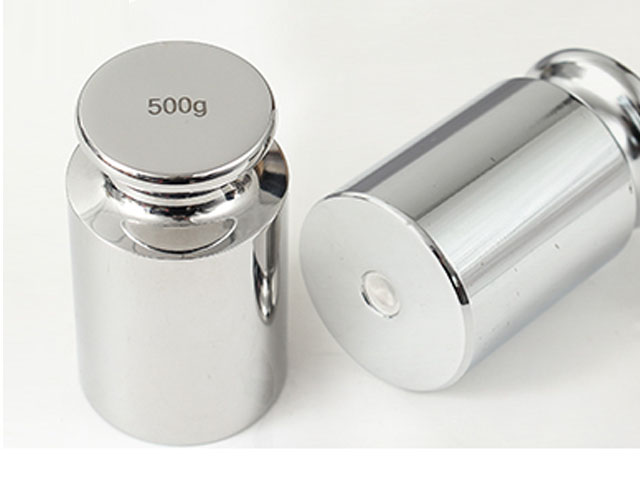
Structural design further optimizes the working performance of stainless steel weights and standardizes their force transmission mode. Conventional stainless steel weights adopt integral forming process, with smooth and flat surface, regular shape and uniform wall thickness. The integral structure avoids the quality deviation caused by loose assembly or falling off of accessories, and ensures the overall structural integrity of the weight. The smooth surface design reduces the adhesion of dust, water stains and impurities in the use process. Floating impurities attached to the surface of the weight will increase the overall mass temporarily, while surface wear and peeling will reduce the mass, both of which will interfere with the measurement benchmark. The smooth and corrosion-resistant surface of stainless steel can effectively reduce the adhesion of foreign substances, and is convenient for daily cleaning and maintenance, so that the weight can always maintain a standard mass state. In addition, the standardized shape design enables the weight to have a fixed stress area and center of gravity position, ensuring that the gravity acts vertically downward during use, avoiding lateral force or eccentric force caused by placement deviation, and reducing system errors in the force transmission and signal conversion process.
Environmental adaptability is an important part of the working principle of stainless steel weights, and also an important reason why they can be used in diverse measurement scenarios. In actual measurement work, environmental factors such as temperature change, air humidity and air buoyancy will interfere with the weighing result. Stainless steel has a low thermal expansion coefficient, which means that its volume change is extremely small when the ambient temperature fluctuates. When the temperature rises or falls slightly, the volume expansion or contraction of the stainless steel weight is negligible, and the mass remains basically unchanged, avoiding measurement errors caused by volume changes. In high humidity environments, stainless steel will not absorb moisture and deliquesce like partial non-metallic materials, nor will it rust and change quality like ordinary steel materials, maintaining stable mass and structural state. Meanwhile, the compact structure and stable density of stainless steel make the weight less affected by air buoyancy. In high-precision measurement scenarios, the influence of air buoyancy on objects with different densities is different. Stainless steel with stable density can form a fixed buoyancy interference rule, which is convenient for subsequent data correction and improves the overall measurement accuracy.
The long-term working stability of stainless steel weights is also reflected in their anti-fatigue and anti-wear properties. In frequent calibration and detection work, weights need to be repeatedly placed, taken and stressed. Long-term repeated mechanical action will cause wear and fatigue damage to the surface and structure of ordinary weights, leading to mass changes and structural deformation. Stainless steel has high surface hardness and good wear resistance, which can resist micro wear caused by frequent friction and collision. Its excellent structural fatigue resistance enables it to maintain stable mechanical properties after thousands of times of stress, without structural relaxation or performance attenuation. This durable performance ensures that the weight can maintain consistent working accuracy during long-term repeated use, and will not produce cumulative errors with the increase of service time, meeting the long-term and high-frequency use requirements of industrial production and laboratory measurement.
In terms of measurement traceability principle, stainless steel weights act as intermediate standard measuring objects, realizing the transmission of measurement accuracy. The basic mass unit of the measurement system is transmitted layer by layer through standard weights of different grades. As a common intermediate standard, stainless steel weights can accept the accuracy calibration of higher-level standard measuring equipment, and then use their own stable mass characteristics to calibrate and detect various conventional weighing equipment. This traceability working mode is based on the absolute stability of stainless steel weight quality and performance. Only when the weight itself has no quality drift and performance fluctuation can it undertake the task of accuracy transmission, ensure the unity and consistency of weighing measurement data in different scenarios, and provide a reliable basis for industrial quality inspection, experimental data recording and commodity weighing measurement.
It is worth noting that the working accuracy of stainless steel weights is based on the coordination of material performance, structural stability and environmental adaptation, rather than single factor action. The dense material structure ensures mass stability, corrosion resistance ensures no quality change in complex environments, stable mechanical properties ensure accurate force transmission, and standardized structure ensures consistent stress state. These performance advantages complement and promote each other, forming a complete working system of stainless steel weights. In actual use, although stainless steel weights have strong stability, their working state will still be affected by extreme environments and improper operation. Excessively high temperature will cause slight thermal expansion of the material, violent collision will cause local deformation of the weight, and long-term accumulation of dirt will cause temporary mass deviation. Therefore, maintaining the working accuracy of stainless steel weights requires matching standardized use and maintenance methods, so that their inherent physical and material advantages can be fully exerted.
In conclusion, the working principle of stainless steel weights is a comprehensive application system based on basic physical laws and relying on the excellent material characteristics of stainless steel. Taking mass stability as the core, it realizes accurate gravity output and stable force transmission through compact metal structure, excellent corrosion resistance, stable mechanical properties and standardized structural design. It effectively resists the interference of external environmental factors and human operation factors, and provides a stable, accurate and durable mass reference standard for various weighing and calibration scenarios. Compared with other traditional weight materials, stainless steel’s unique physical and chemical properties make the weight have more reliable working performance in long-term use, wider environmental adaptability and lower performance attenuation rate, which is why stainless steel weights are widely used in modern precision measurement and industrial weighing fields. With the continuous improvement of measurement accuracy requirements, the material advantages and working mechanism of stainless steel weights will further play a role, providing solid technical support for standardized and accurate weighing measurement work.
Working Principle of Stainless Steel Weight
https://www.veidtweighing.com/ssweight/StainlessSteelWeight
Post Date: May 23, 2026

![Oiml Laboratory Weight]()
Oiml Laboratory Weight
In every modern laboratory that relies on consistent and dependable mass measurement work, Oiml laboratory weight stands as an indispensable foundational tool that underpi…![50g Stainless Steel Weight]()
50g Stainless Steel Weight
In the intricate landscape of measurement and weighing work that permeates every corner of daily life, industrial production, experimental research, and daily household ma…![Complete Stainless Steel Calibration Weight Full Set]()
Complete Stainless Steel Calibration Weight Full Set
Precision measurement serves as the fundamental foundation of industrial production, laboratory research, quality inspection, and daily metering operations, and calibratio…![E2 Grade Stainless Steel Weight]()
E2 Grade Stainless Steel Weight
E2 Grade Stainless Steel Weight stands as a foundational component in the realm of precision mass measurement, serving as a reliable and steady reference point for countle…![304 Stainless Steel Weight For Scale Calibration]()
304 Stainless Steel Weight For Scale Calibration
Scale calibration serves as a foundational step in maintaining consistent and reliable weighing results across industrial, commercial, and laboratory environments. Every m…