Floor Weighing Scale
Floor weighing scales stand as fundamental measuring instruments widely applied across diverse industrial, commercial, and daily operational environments, serving the core purpose of determining the weight of objects placed on their flat load-bearing surfaces. Different from small desktop weighing devices that are designed for lightweight items, this type of weighing equipment features a relatively expansive platform and robust structural design, enabling it to handle objects with larger volumes and heavier mass. Its practicality and stable operating performance make it an indispensable auxiliary tool in modern material circulation, production processing, and quality inspection workflows, adapting to complex usage conditions that many compact weighing tools cannot withstand. The basic working logic of floor weighing scales follows mature mechanical and electronic sensing principles, where external pressure generated by placed objects is converted into identifiable digital signals, and these signals are further processed and calculated to generate accurate weight data for users’ reference and recording.
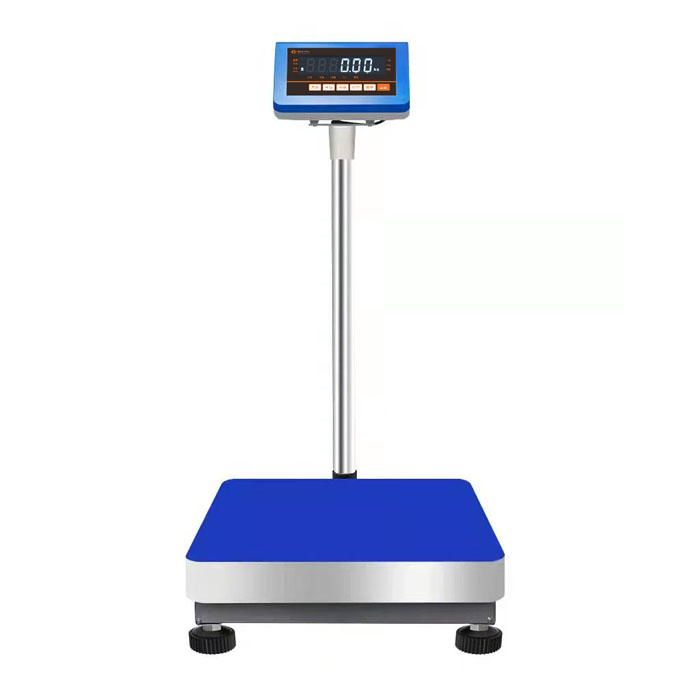
The structural composition of a floor weighing scale is concise yet highly scientific, with each component undertaking an irreplaceable functional role to ensure overall operational stability. The flat weighing platform constitutes the outer bearing part, which is usually made of high-strength metal materials with excellent compression resistance and deformation resistance. The surface of the platform is treated with smooth polishing or anti-slip textured processing; the smooth design facilitates the movement of pallet goods and container items, while the textured surface increases friction to prevent heavy objects from sliding during the weighing process. Beneath the platform lies the core force-bearing framework, which adopts an optimized beam structure to evenly disperse the pressure transmitted from the platform. This structural design effectively reduces local stress concentration, avoiding permanent structural deformation caused by long-term concentrated pressure and extending the service life of the equipment. At the bottom of the framework, multiple sensing components are evenly distributed, which are key elements for capturing weight changes. These sensing components can sensitively perceive tiny pressure variations and convert mechanical deformation into continuous electrical signals, laying a solid foundation for subsequent data conversion. In addition, adjustable supporting feet are installed at the bottom of the entire equipment, which can adapt to uneven ground surfaces by fine-tuning the height, ensuring the horizontal placement of the weighing platform and eliminating weighing errors caused by inclined placement.
In terms of working principles, most modern floor weighing scale rely on strain sensing technology to complete weight measurement. When an object is stably placed on the weighing platform, the gravity of the object acts on the internal sensing components, causing slight elastic deformation of the sensitive strain structures inside the sensors. The built-in resistance strain gauges will change their resistance values synchronously with the deformation, and the internal circuit system converts such resistance changes into linear electrical signal fluctuations. After the weak electrical signals are amplified, filtered, and digitally converted by the built-in data processing module, clear and intuitive weight values are finally presented on the display screen. The whole signal conversion process is completed in a short time, realizing rapid reading of weighing data. Moreover, the internal data processing system is equipped with anti-interference algorithms, which can shield minor interference from ambient temperature changes, weak vibration, and electromagnetic signals in the working environment, maintaining the stability of weighing data and reducing data fluctuation within a reasonable range. For some improved models, the internal system also retains data storage space, which can record multiple sets of weighing data continuously, facilitating subsequent data sorting and statistical analysis.
Floor weighing scales exhibit outstanding environmental adaptability, allowing them to operate normally in various complex working spaces. In warehousing and logistics scenarios, they are commonly used for weighing packaged goods, stacked cargo pallets, and turnover containers. Staff can complete weight detection of bulk goods without cumbersome carrying steps, improving the efficiency of cargo inbound and outbound registration. In manufacturing workshops, the equipment is applied to link detection in the production process; for example, it is used to weigh semi-finished products and finished parts to judge whether the product quality meets the preset standard range, providing effective data support for quality control. In agricultural circulation links, floor weighing scales can weigh bulk grains, bagged feeds, and agricultural supplies, solving the weighing demand of large-volume agricultural materials. In addition, some specially optimized floor weighing scales can adapt to humid, dusty, and slightly corrosive working environments; the sealed structural design can block dust and moisture from entering the interior, protecting internal precision sensors and circuit systems from environmental erosion and ensuring continuous and stable operation of the equipment.
Reasonable installation and daily debugging are crucial to maintain the weighing accuracy and service state of floor weighing scales. Before installation, users need to select a flat and solid placement position, avoiding soft ground such as loose soil and carpets that are prone to subsidence. The placement area should reserve sufficient operating space to ensure that goods can be smoothly transported to and removed from the weighing platform without collision. During the installation process, it is necessary to repeatedly adjust the height of the supporting feet, and judge the horizontal state of the platform through the built-in level detection device until the platform is completely balanced. After the installation is completed, static zero calibration is required. Under the condition of no load on the platform, the data display is reset to zero to eliminate the influence of the self-weight of the equipment and residual pressure. In daily use, regular calibration is also essential. With the extension of service time, subtle aging of internal components and accumulated external pressure may cause slight deviation of weighing data. Regular calibration with standard weights can correct data errors and keep the weighing accuracy within a stable range.
Daily maintenance and upkeep directly affect the service cycle and operating stability of floor weighing scales, and standardized maintenance can effectively reduce equipment failure rates. In terms of daily cleaning, the surface of the weighing platform should be wiped regularly to remove accumulated dust, debris, and residual stains. For stubborn dirt on the surface, a damp soft cloth can be used for cleaning; it is necessary to avoid using corrosive chemical solvents to prevent damage to the surface anti-rust and wear-resistant coating. During the use process, violent impact and sudden heavy pressure on the platform should be avoided. Although the equipment has strong compression resistance, instantaneous impact force may cause irreversible damage to internal sensors and fixed structures. It is also necessary to regularly check the connecting parts of the equipment, including the tightness of the bottom support feet and the firmness of the internal sensor connections, to prevent data delay or deviation caused by loose parts. When the equipment is not in use for a long time, the surface should be covered with dust-proof materials, and the power supply should be cut off to avoid component aging caused by long-term standby.
In terms of usage limitations and applicable specifications, floor weighing scales have diverse size and load-bearing configurations to meet differentiated usage demands. Small-sized floor weighing scales are suitable for indoor lightweight cargo detection in small warehouses and processing workshops, featuring flexible placement and small space occupation. Medium-sized models are widely used in mainstream logistics and manufacturing links, balancing bearing capacity and space applicability to meet the daily weighing demand of most bulk goods. Large-sized floor weighing scales adopt an enhanced thickened structure, which can bear heavier loads and is suitable for heavy cargo detection in large industrial yards and freight transfer stations. It is worth noting that any floor weighing scale has a rated load-bearing range. Overloading the equipment for a long time will not only cause data deviation but also lead to fatigue deformation of internal structures and permanent damage to sensors. Therefore, users need to select appropriate models according to actual weighing needs and strictly follow the load-bearing standards during use.
With the continuous upgrading of industrial production and logistics circulation systems, the functional design of floor weighing scales is also constantly optimized and upgraded. Traditional floor weighing scales only have basic weight display functions, while modern optimized products are equipped with richer auxiliary functions. Some models are embedded with data transmission interfaces, which can synchronize weighing data to terminal management equipment, realizing automatic data recording and remote viewing, which is convenient for enterprise personnel to carry out material inventory and cargo management. Some equipment is equipped with alarm prompt structures; when the weighed object exceeds the preset weight range, the system will send out prompt signals to assist staff in screening unqualified goods. In addition, the humanized operation panel simplifies the functional keys, realizing one-key zero clearing, data locking, and unit switching, reducing the operation difficulty for users and enabling novice operators to master the usage method in a short time.
From the perspective of industrial application value, floor weighing scales play an important role in optimizing resource allocation and standardizing measurement management. In the commercial circulation industry, accurate weighing data serves as an important basis for cargo transaction settlement, avoiding economic losses caused by measurement deviations for both suppliers and demanders. In the production and processing industry, real-time weighing monitoring helps enterprises control raw material consumption, optimize production batching ratios, and reduce material waste. In warehousing and storage links, unified weighing statistics facilitate the sorting and classification of goods, improving the utilization efficiency of storage space. Compared with other large-scale heavy-duty weighing equipment, floor weighing scales have lower space occupation requirements and simpler operation and maintenance costs, which can meet the weighing needs of most medium and small-scale scenarios, making them widely popular in various industry chains. Their stable performance and moderate application threshold make them a reliable basic measuring device in modern industrial and commercial systems.
In conclusion, floor weighing scales, as practical and stable weighing equipment, rely on scientific structural design and mature sensing technology to complete efficient and accurate weight measurement work. From basic structural composition to internal working principles, from daily usage scenarios to standardized maintenance methods, every link reflects humanized design and rigorous mechanical logic. With the continuous development of industrial intelligence, floor weighing scales will gradually integrate more intelligent management functions to adapt to increasingly complex production and circulation demands. For users, correct selection, standardized operation, and regular maintenance are important prerequisites to give full play to the performance of the equipment. Reasonable utilization of floor weighing scales can not only improve the efficiency of material weighing work but also provide accurate and reliable data support for enterprise production management, cargo circulation, and quality inspection, bringing stable practical value to various application fields.
Floor Weighing Scale
https://www.pruiste.com/weighing-scale.html
Post Date: May 7, 2026
https://www.supplier-manufacturer.com/weighing-scale/floor-weighing-scale.html

![Types of Precision Balance]()
Types of Precision Balance
Precision balances stand as indispensable measuring instruments in modern quantitative analysis, serving as foundational tools for obtaining reliable mass data across dive…![Electronic Balance Manufacturer]()
Electronic Balance Manufacturer
In the modern industrial and scientific landscape, precise weight measurement serves as an indispensable foundation for countless production, research, and quality control…![Waterproof Electronic Balance]()
Waterproof Electronic Balance
In modern industrial production, laboratory research, food processing and daily commercial measurement scenarios, environmental interference has always been a key factor a…![Stainless Steel Weighing Scale]()
Stainless Steel Weighing Scale
In modern industrial production, daily commercial transactions, and laboratory research environments, weighing equipment serves as a fundamental auxiliary tool to quantify…![Weighing Scale Supplier]()
Weighing Scale Supplier
In the global circulation of commodities and industrial production chains, weighing scales stand as indispensable measuring instruments that underpin the basic operation o…