Benchtop Analytical Balance
In modern experimental research, industrial production and quality inspection industries, precise mass measurement serves as an indispensable basic technical link. The benchtop analytical balance stands out among various mass measuring instruments for its moderate placement space, stable operating performance and high measurement accuracy, becoming a common precision weighing device in laboratory environments. Different from ordinary weighing tools that are only suitable for rough mass judgment, this type of balance is designed for micro and trace sample weighing scenarios, focusing on capturing tiny mass changes of substances, and it maintains stable working performance under conventional indoor environmental conditions. With the continuous upgrading of measurement technology, the structural design and internal control system of benchtop analytical balances have been continuously optimized, gradually adapting to diversified weighing demands in multiple industries, and laying a solid technical foundation for experimental data recording, product component detection and material performance research.
The core working principle of modern benchtop analytical balances relies on the electromagnetic force balance mechanism, which abandons the traditional mechanical lever weight stacking structure of early weighing equipment. When no sample is placed on the weighing pan, the internal circuit of the balance inputs a standard steady current into the electromagnetic coil, and the electromagnetic force generated by the coil keeps the mechanical structure in a horizontal balanced state, maintaining the zero calibration state of the instrument. After a sample is placed on the weighing pan, the downward gravity generated by the sample causes a slight displacement of the internal load-bearing structure. The high-sensitivity displacement sensing component can instantly capture this tiny position deviation and convert the mechanical displacement signal into an electrical signal. The intelligent control circuit dynamically adjusts the current intensity in the electromagnetic coil according to the feedback electrical signal, so that the electromagnetic force generated by the coil can counteract the gravity of the sample, and the internal mechanical structure returns to the initial balanced position. In this working system, the current intensity required to restore the balance state presents a stable proportional relationship with the mass of the loaded sample. The internal data processing module converts the current change data into intuitive mass values and displays them on the digital screen, realizing efficient and accurate mass measurement. This electromagnetic balance working mode effectively reduces mechanical friction loss, improves the response sensitivity of the instrument, and ensures the stability of measurement data in repeated weighing operations.
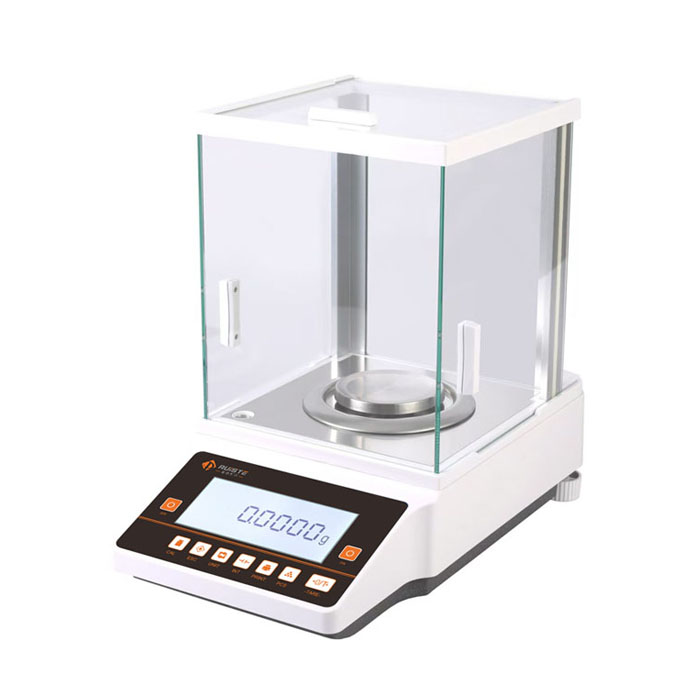
The overall structural design of the benchtop analytical balance follows the design concept of compact layout and anti-interference optimization, and each component has clear functional division to jointly complete high-precision weighing work. The external shell is made of high-density durable materials, which can isolate fine dust in the air and reduce the erosion of internal precision components by humid gas. The transparent windshield is a vital external component, which is composed of detachable transparent plates. It can effectively block the interference of indoor air convection, human breathing airflow and surface breeze on tiny samples during the weighing process. The enclosed space formed by the windshield provides a relatively stable microenvironment for sample weighing, avoiding data fluctuation caused by slight airflow disturbance. The weighing pan is usually made of smooth corrosion-resistant metal materials, with a flat and neat surface to ensure uniform stress on the sample. The bottom of the weighing pan is connected with the internal force transmission structure, and the structural connection gap is minimized to reduce mechanical transmission errors. The bottom of the instrument is equipped with adjustable horizontal foot pads. Operators can observe the built-in level bubble to adjust the height of the foot pads, so that the balance is always kept in a horizontal placement state, preventing measurement deviation caused by inclined placement. In addition, the external operation panel is equipped with simple and intuitive functional keys, which can realize basic functions such as zero clearing, tare weighing and data locking, simplifying the daily operation process.
The internal precision components determine the core measurement performance of the benchtop analytical balance. The electromagnetic coil and permanent magnet group constitute the force generation system, which is the key to realizing electromagnetic force balance. The high-precision displacement sensor is responsible for capturing subtle structural displacements, and its signal induction accuracy directly affects the sensitivity of the balance. The intelligent circuit control module undertakes the tasks of signal reception, data calculation and current adjustment. It can complete high-frequency signal collection and rapid current feedback adjustment in a short time, ensuring that the instrument can respond quickly after sample placement. The internal damping structure can effectively weaken the mechanical vibration generated during the placement process, shorten the jitter time of data fluctuation, and enable the displayed mass data to reach a stable state in a short time. Moreover, the internal temperature compensation component can perceive the ambient temperature change. Since temperature fluctuation will affect the magnetic field stability of electromagnetic components and the physical properties of mechanical structures, the temperature compensation system can dynamically correct the measurement parameters according to the temperature change, reducing the measurement error caused by environmental temperature difference.
The benchtop analytical balance has distinct performance characteristics in actual use, which make it suitable for high-precision weighing scenarios. In terms of measurement accuracy, the instrument can capture tiny mass changes, meeting the weighing requirements of trace samples in experimental research. In terms of weighing range, it is adapted to small and medium-sized samples, covering the conventional sample mass demand in chemical analysis, biological research and material detection. The repeated weighing stability of the instrument is excellent. When the same sample is weighed multiple times under the same environmental conditions, the data difference is controlled within a tiny range, which provides reliable data support for experimental repeatability verification. Compared with large-scale analytical weighing equipment, the benchtop structure occupies less space, can be flexibly placed on laboratory countertops, and is convenient for daily movement and position adjustment. The operation difficulty of the instrument is low. After simple parameter setting and zero calibration, operators can complete sample weighing. The digital display mode avoids the reading deviation of traditional pointer scales, and the data presentation is more intuitive and accurate. In addition, most benchtop analytical balances have a self-diagnosis function. The internal system can detect abnormal states such as unstable placement and excessive environmental interference, and remind operators to adjust the working conditions through data prompts.
Environmental control is a key link to maintain the measurement accuracy and service life of the benchtop analytical balance. The instrument is suitable for use in a dry and clean indoor environment. Excessively humid air will cause moisture to adhere to the internal metal components, inducing oxidation and corrosion and affecting the sensitivity of precision structures. Dust floating in the air is easy to accumulate on the weighing pan and internal gaps. Long-term accumulation of dust will increase the dead weight of the structure and interfere with the force transmission effect. The ambient temperature should be kept within a moderate stable range. Sharp temperature rise and fall will cause thermal expansion and contraction of internal components, changing the matching gap between mechanical structures and the magnetic field strength of electromagnetic parts. It is necessary to avoid placing the balance in direct sunlight or near heating and cooling equipment. In terms of placement conditions, the placement countertop must have sufficient hardness and flatness to avoid vibration and deformation. It is necessary to keep a safe distance from mechanical equipment with strong vibration to prevent vibration from being transmitted to the balance and causing data jitter. In addition, strong electromagnetic interference will affect the operation of the internal circuit module, so the instrument should be kept away from high-power electrical equipment to ensure the stability of the internal magnetic field.
Standardized operation steps help to give full play to the performance of the benchtop analytical balance and reduce human-induced measurement errors. Before formal weighing, operators need to check the horizontal state of the instrument, adjust the foot pads according to the level bubble, and wipe the surface of the weighing pan with clean soft tools to remove residual dust and impurities. Then turn on the power supply, preheat the instrument for a period of time, so that the internal circuit and electromagnetic components reach a stable working state, and complete manual zero calibration after preheating to eliminate the influence of the dead weight of the empty weighing pan. During the sample placement process, it is necessary to gently place the sample in the center of the weighing pan to avoid eccentric placement causing uneven stress on the internal structure. For samples that are easy to absorb moisture, volatilize or corrode, sealed containers should be used for holding to prevent sample mass loss and corrosion of the weighing pan. After the data is stable, record the mass information completely. Do not touch the countertop or the instrument shell at will during the weighing process to avoid slight vibration affecting the data stability. After the weighing work is completed, take out the sample, clean the surface of the weighing pan again, turn off the power supply, and cover the instrument with a dust cover to isolate dust.
Daily maintenance and maintenance are essential to prolong the service life of the benchtop analytical balance and maintain long-term measurement accuracy. In daily cleaning, use dry soft cotton cloth to wipe the shell and weighing pan. It is forbidden to use corrosive chemical solvents to avoid damaging the surface material and internal coating. The internal gap of the windshield should be cleaned regularly to prevent dust from accumulating and affecting the air isolation effect. The power supply circuit should be kept dry and clean. Avoid liquid splashing on the power interface to prevent short circuit failure. The instrument should be placed in a fixed position for a long time as far as possible, and violent collision and extrusion should be avoided during handling to prevent displacement and damage of internal precision components. It is necessary to conduct regular calibration inspection. By using standard weighing samples, the measurement accuracy of the balance is verified, and the parameter deviation is corrected in time to ensure that the instrument is always in a good working state. When the instrument is not used for a long time, it should be powered off and stored in a dry and dust-proof environment, and the power supply should be disconnected to avoid circuit aging caused by long-term standby.
Benchtop analytical balances are widely used in multiple professional fields, showing strong practical application value. In chemical analysis laboratories, researchers use this instrument to weigh trace chemical reagents, prepare standard solutions with accurate concentration, and complete titration analysis and component content detection of chemical samples. Accurate reagent weighing ensures the controllability of chemical reaction conditions and improves the authenticity and validity of experimental data. In the food industry, the instrument is applied to food ingredient proportioning, trace additive detection and raw material component analysis. By accurately weighing food samples, technicians can analyze the content of micro-components in food, which provides data support for food quality control and formula optimization. In biological research, it is used for weighing biological samples such as tissue fragments and microbial cultures. The high-precision measurement characteristics meet the quality detection requirements of tiny biological samples, and provide basic data for biological activity research and sample characteristic analysis.
In pharmaceutical research and production links, benchtop analytical balances undertake the weighing work of pharmaceutical raw materials and trace auxiliary materials. Accurate material proportioning is the premise to ensure the stability of pharmaceutical composition and efficacy, and the instrument provides reliable measurement guarantee for pharmaceutical compounding and drug component testing. In material science research, it is used to detect the mass change of new materials before and after physical and chemical reactions, analyze the material loss rate and component change rule, and provide data basis for the performance improvement and structural optimization of new materials. In environmental monitoring work, technicians weigh environmental samples such as dust particles and water sediment, detect the content of trace pollutants in the samples, and provide accurate mass data for environmental pollution assessment and governance scheme formulation. Relying on its stable performance and convenient operation, the instrument has become a common basic equipment in scientific research, production and detection industries.
With the continuous progress of precision manufacturing technology and intelligent control technology, the comprehensive performance of benchtop analytical balances is still in the process of continuous optimization. The miniaturization of internal components will further reduce the structural volume of the instrument and save placement space. The intelligent data processing system will realize more efficient data recording, sorting and transmission functions, which is convenient for operators to carry out batch data management. The anti-interference performance of the instrument will be further improved, adapting to more complex indoor use environments and reducing the impact of environmental factors on measurement results. In addition, the humanized operation design will be continuously upgraded, optimizing the operation logic and display interface, reducing the operation threshold, and enabling the instrument to be better applied to basic teaching, conventional detection and scientific research experiments. As a basic precision measuring instrument, the benchtop analytical balance will always rely on stable mechanical structure and accurate sensing technology to provide reliable mass measurement services for various industries, and continuously promote the standardized development and technological progress of related industries.
Benchtop Analytical Balance
https://www.pruiste.com/analytical-balance.html
Post Date: May 19, 2026
https://www.supplier-manufacturer.com/analytical-balance/benchtop-analytical-balance.html

![Platform Scale TCS SERIES]()
Platform Scale TCS SERIES
TCS platform scale series adopts steel strong tube double-layer carbon steel base, and the bearing base is stable and solid. The whole series platform scale adopts foot-st…![Analytical Balance FA Series]()
Analytical Balance FA Series
FA series electromagnetic force balance adopts key structure. The whole series balance adopts high-performance single-chip microprocessor to control high-speed CPU and spe…![Digital Viscometer Vender In China]()
Digital Viscometer Vender In China
The manufacturing and supply of digital viscometers in China have witnessed steady and progressive development over the past decades, forming a complete and mature industr…![High-shear Digital Viscometer]()
High-shear Digital Viscometer
Viscosity serves as one of the most fundamental physical properties of fluid materials, reflecting the internal friction and flow resistance generated during fluid deforma…![Rotational Digital Viscometer]()
Rotational Digital Viscometer
Viscosity stands as one of the most fundamental physical properties of fluid materials, reflecting the internal frictional resistance that occurs when a fluid undergoes de…