Digital Viscometer NDJ SERIES
NDJ series viscometer has 2 optional keys and touch screen. The whole series balance adopts high precision sensor, microcomputer control and one key fast measurement. The working principle of the viscometer is to measure the blocking force of the rotor at a certain speed, and reduce this force and the speed of the rotor. In this way, the rotational speed of the rotor and the changes in the perceived torque are analyzed. At this time, the signal is output to the microcomputer processor for data processing through the photoelectric sensor, and finally the liquid viscosity value is directly displayed on the screen. Viscometer is widely used in textile processing, chemical industry, petroleum, pharmaceutical, light industry, electromechanical, food processing, construction and other industries.
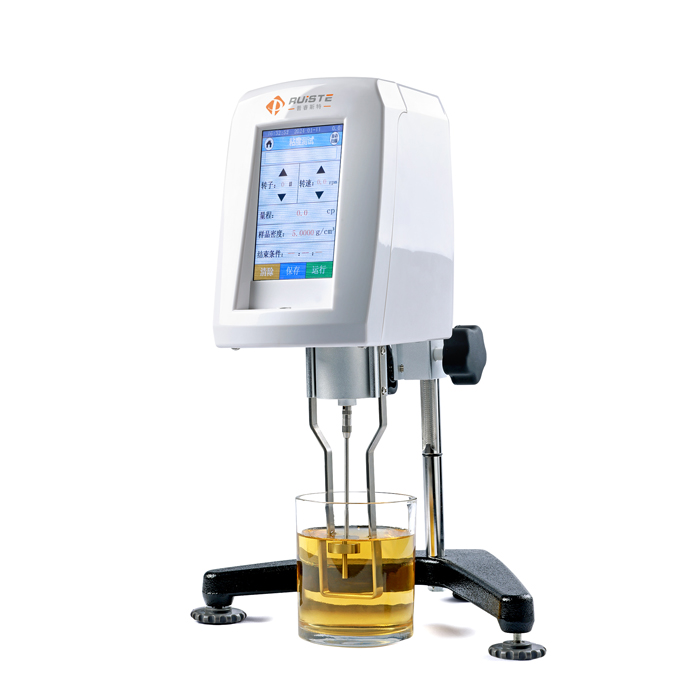
Viscosity stands as one of the most fundamental physical properties of fluid substances, reflecting the internal friction and flow resistance generated when a fluid undergoes relative motion. It serves as a critical indicator for evaluating the fluidity, stability, and processing performance of various liquid materials, covering diverse substances from low-viscosity aqueous solutions and solvents to high-viscosity greases, polymer melts, and colloidal suspensions. In traditional fluid detection practices, mechanical viscometers were widely adopted, yet they suffer from obvious limitations including cumbersome operation, manual reading errors, unstable data repeatability, and insufficient adaptability to complex fluid testing environments. With the continuous advancement of microelectronic technology, sensor technology, and intelligent control systems, digital viscometers have gradually replaced traditional mechanical testing equipment and become mainstream tools for fluid viscosity detection in modern laboratories, industrial production lines, and scientific research institutions. These devices integrate electronic sensing, data processing, and digital display functions, realizing automated, standardized, and high-stability viscosity measurement, and providing reliable data support for material research, production process control, and product quality inspection across multiple industries.
The core working logic of digital viscometer is based on the correlation between fluid flow resistance and viscosity, with different structural designs corresponding to distinct measurement principles suitable for various fluid types and viscosity ranges. Rotational digital viscometers represent the most widely used type in practical scenarios. This type of equipment relies on a precision drive system to push a customized spindle or rotor to rotate at a constant and stable speed inside the tested fluid. When the spindle rotates, it is subjected to viscous resistance from the fluid, and the magnitude of the torque required to maintain the constant rotating state is closely linked to the fluid’s viscosity. Fluids with higher viscosity produce greater rotational resistance, which in turn increases the torque load on the spindle. High-sensitivity sensors built into the equipment can capture real-time torque change signals, which are then transmitted to the internal microprocessor for algorithm conversion and data calibration. After correcting interference factors such as mechanical friction and environmental fluctuations, the equipment converts the physical torque signal into intuitive viscosity numerical values, completing the quantitative detection of fluid viscosity. Beyond rotational structures, vibrating digital viscometers constitute another common technical form. Such devices utilize a precision tuning fork or vibration probe that oscillates at a fixed natural frequency when immersed in fluid. The viscous damping effect of the fluid will attenuate the oscillation amplitude and change the oscillation decay cycle. The internal electronic system monitors the real-time vibration state, calculates the damping coefficient through professional algorithms, and further converts it into accurate viscosity data, offering unique advantages in low-viscosity fluid testing and real-time dynamic monitoring scenarios.
Different from fully mechanical viscometers that rely on dial pointer reading and manual calculation, digital viscometers adopt a highly integrated modular structural design, which optimizes both operating experience and measurement accuracy. The main components include a precision drive module, high-sensitivity sensing unit, intelligent data processing chip, digital display module, and auxiliary temperature monitoring component. The drive module usually adopts stepper motor drive technology, which can output stable and adjustable rotating or vibrating power, effectively avoiding the speed deviation and operation instability caused by manual adjustment of mechanical structures. The sensing unit is responsible for capturing subtle physical changes in the measurement process, including torque changes, vibration attenuation, and stress fluctuations, with high signal acquisition accuracy and low delay, ensuring that the collected original data can truly reflect the fluid’s viscosity characteristics. The core data processing chip undertakes signal filtering, data correction, algorithm calculation, and result sorting work, automatically eliminating invalid interference signals generated by environmental vibration, minor temperature changes, and mechanical micro-friction, greatly improving the stability and repeatability of test data. The digital display module directly presents viscosity values, test time, and real-time temperature parameters in digital form, avoiding visual errors and reading deviations caused by manual observation of dial scales. The matching temperature monitoring component can track the sample temperature in real time during the test process, which is crucial for viscosity detection, as the viscosity characteristics of most fluids change significantly with temperature fluctuations. Real-time temperature monitoring and compensation enable the equipment to output more accurate and standardized test results.
The technical advantages of digital viscometers are fully reflected in measurement performance, operational convenience, and scenario adaptability, making them far more applicable than traditional testing equipment. In terms of measurement performance, this type of equipment supports continuous and stable data collection, with good linearity and stability in the conventional measurement range, and can adapt to both Newtonian fluids with stable viscosity characteristics and non-Newtonian fluids with variable viscosity under different shear forces. For non-Newtonian fluids such as coatings, adhesives, and polymer solutions, digital viscometers can measure apparent viscosity under different rotational speeds and shear conditions, effectively reflecting the actual flow performance of materials in different processing scenarios. In terms of operation, the equipment simplifies the complex debugging and calculation steps of traditional instruments. Users only need to select the appropriate spindle or probe according to the sample state, set basic test parameters, and start the equipment to complete automated testing and data recording. The whole process reduces manual intervention links, lowers the technical threshold for operators, and avoids data errors caused by human operation differences. In terms of functional expansion, most digital viscometers support data storage and real-time data output, which can record multiple groups of test data for subsequent sorting, comparison, and analysis. Some optimized structural designs also add over-range prompt functions, which can timely remind users when the sample viscosity exceeds the current measurement range, effectively protecting the equipment and ensuring the rationality of test data.
Digital viscometers have broad application value covering industrial production, scientific research experiments, and quality detection fields, providing standardized technical support for the process optimization and quality control of various industries. In the coating and paint industry, the viscosity of paint and coating materials directly affects spraying uniformity, film forming effect, and product surface quality. Too high viscosity will lead to uneven spraying and easy sagging of the coating layer, while too low viscosity will cause insufficient coating thickness and poor coverage. Digital viscometers can conduct real-time sampling detection of production line materials, helping production personnel adjust material formula and processing parameters in a timely manner to ensure the consistency of coating product quality. In the chemical and new material industry, polymer solutions, resin materials, and colloidal suspensions have strict viscosity standards in synthesis, processing, and molding links. Viscosity data is an important basis for judging material polymerization degree and solution uniformity, and digital testing equipment can provide accurate data for material formula optimization and process parameter adjustment, promoting the stable performance of new material products.
In the food and daily chemical industry, viscosity detection is closely related to product texture, taste, and use experience. Food materials such as syrup, jam, yogurt, and beverage thickeners have fixed viscosity ranges to ensure stable taste and uniform texture. Daily chemical products including shampoo, body wash, facial cream, and adhesive gels also rely on viscosity control to maintain good ductility and use effect. Digital viscometers can efficiently detect the viscosity of such semi-fluid and colloidal materials, helping enterprises control product stability in batch production and avoid product quality differences caused by raw material fluctuations or process deviations. In the petroleum and lubricant industry, the viscosity of lubricating oil, hydraulic oil, and crude oil is a key index for evaluating fluid lubrication performance and fluidity. Viscosity changes will affect the operating efficiency and wear resistance of mechanical equipment. Long-term real-time monitoring of oil viscosity through digital viscometers can provide effective reference for equipment maintenance and oil replacement, ensuring the stable operation of mechanical systems.
In scientific research and laboratory scenarios, digital viscometers are indispensable basic testing equipment for fluid mechanics research, material performance analysis, and chemical experiment verification. Scientific research experiments often require high-precision, repeatable, and traceable viscosity data to support experimental conclusion verification and theoretical research. The automated testing and accurate data output capabilities of digital viscometers meet the rigorous data requirements of scientific research work. Meanwhile, the equipment’s adjustable speed and adaptable testing range can meet the experimental needs of different types of fluid samples, from low-viscosity organic solvents to high-viscosity polymer melts, realizing multi-scene testing coverage.
To maintain the long-term stable operation and accurate measurement performance of digital viscometers, standardized daily operation and scientific maintenance management are essential. In the daily test preparation stage, operators need to place the equipment on a horizontal and stable working platform to avoid equipment tilt and environmental vibration affecting the rotation or vibration state of the testing component, so as to ensure the stability of data collection. Before formal testing, preheating and zero calibration operations should be carried out according to the equipment operating specifications to eliminate residual interference from the last test and ensure the accuracy of the initial state of the equipment. For different test samples, it is necessary to select matching spindles or probes according to the approximate viscosity range of the fluid. Using inappropriate testing components will lead to excessive data errors or failure to complete effective testing. During the test process, the sample liquid volume must meet the equipment requirements, and the spindle or probe must be completely immersed in the fluid without touching the container wall and bottom, so as to avoid additional resistance affecting the test results.
In terms of daily maintenance, the testing components that contact the sample need to be cleaned thoroughly and timely after each test to prevent residual fluid from solidifying and adhering, which may affect the sensitivity and accuracy of subsequent tests. The equipment should be placed in a dry, dust-free, and constant-temperature environment for storage and use, avoiding long-term exposure to humid, high-temperature, or corrosive gas environments to prevent damage to internal electronic components and precision transmission structures. Regular functional inspection and calibration are also required during long-term use. By verifying with standard viscosity samples, the measurement accuracy of the equipment can be ensured, and minor performance deviations can be adjusted in a timely manner to maintain the long-term stable working state of the equipment. In addition, operators need to avoid over-range testing during use. Long-term over-load operation will cause fatigue loss of the drive system and sensing components, shortening the service life of the equipment and reducing measurement stability.
With the continuous development of industrial intelligence and precise manufacturing concepts, the performance of digital viscometers is also undergoing continuous optimization and upgrading. The current development trend of such equipment focuses on higher data accuracy, stronger environmental adaptability, more intelligent operation logic, and richer data expansion functions. On the basis of maintaining stable measurement performance, modern digital viscometers are developing towards miniaturization and portability, making it possible to conduct rapid detection on production sites, outdoor sampling, and mobile detection scenarios, breaking the limitation that traditional laboratory equipment can only be used in fixed scenarios. Meanwhile, the combination of data networking technology enables test data to be uploaded and stored in real time, facilitating enterprise centralized data management, production process traceability, and experimental data accumulation, which provides more powerful technical support for standardized production and intelligent research and development in various industries.
As a key intelligent testing device in the field of fluid performance detection, digital viscometers have completely changed the traditional manual testing mode with their excellent structural design, stable measurement performance, and convenient operation experience. They solve many pain points of traditional mechanical viscometers such as large manual errors, low efficiency, and poor data repeatability. By accurately capturing the viscosity characteristics of different fluids, the equipment provides objective and reliable data basis for product quality control, production process optimization, and scientific research innovation in multiple industries. In the future, with the continuous innovation of electronic technology and sensing technology, digital viscometers will achieve further breakthroughs in detection accuracy, scenario adaptability, and intelligent level, and will be more widely applied in more professional and refined industrial and scientific research fields, becoming an important basic guarantee for promoting the high-quality development of fluid material processing and testing industries.
Digital Viscometer NDJ SERIES
https://www.pruiste.com/qtxl/zdjndj
Post Date: Jun 7, 2026
https://www.supplier-manufacturer.com/counting-weighing-balance/digital-viscometer-ndj-series.html

![Moisture Analyzer DHS Series]()
Moisture Analyzer DHS Series
DHS series adopts the Internet of Things 5 inch color TFT control system integrated touch HD screen, and the whole series moisture meter adopts German HBM sensor and brand…![Counting Scale Manufacturer]()
Counting Scale Manufacturer
Counting scales have become indispensable measuring equipment in modern industrial production, commercial circulation, and material management, serving as a reliable tool …![Dual-range Counting Scale]()
Dual-range Counting Scale
In modern industrial production, inventory management, and material sorting processes, the demand for accurate and efficient quantitative measurement continues to grow ste…![Tabletop Counting Scale]()
Tabletop Counting Scale
In modern industrial production, small commodity processing, inventory management and daily commercial sorting work, the demand for accurate and efficient part counting ha…![Laboratory Counting Scale]()
Laboratory Counting Scale
In modern scientific research, industrial quality control, pharmaceutical formulation development, agricultural material testing, and chemical analysis laboratories, the a…