Types of Digital Viscometer
Viscosity serves as a fundamental physical property that reflects a fluid’s internal resistance to flow and shear deformation, playing a vital role in quality control, process optimization, and material research across chemical, pharmaceutical, food, and industrial manufacturing fields. Traditional viscometers rely on manual observation and data recording, which are prone to human error, low testing efficiency, and limited data accuracy. With the advancement of electronic sensing technology and intelligent data processing systems, digital viscometers have gradually replaced traditional mechanical equipment, realizing automatic measurement, real-time data display, and accurate data analysis. Based on different working principles, structural designs, and measurement modes, digital viscometers can be divided into several mainstream categories, each with unique performance characteristics and applicable application scenarios. Understanding the core differences and functional attributes of each type helps professionals select suitable testing equipment according to fluid properties and testing requirements, so as to ensure the validity and stability of viscosity detection results.
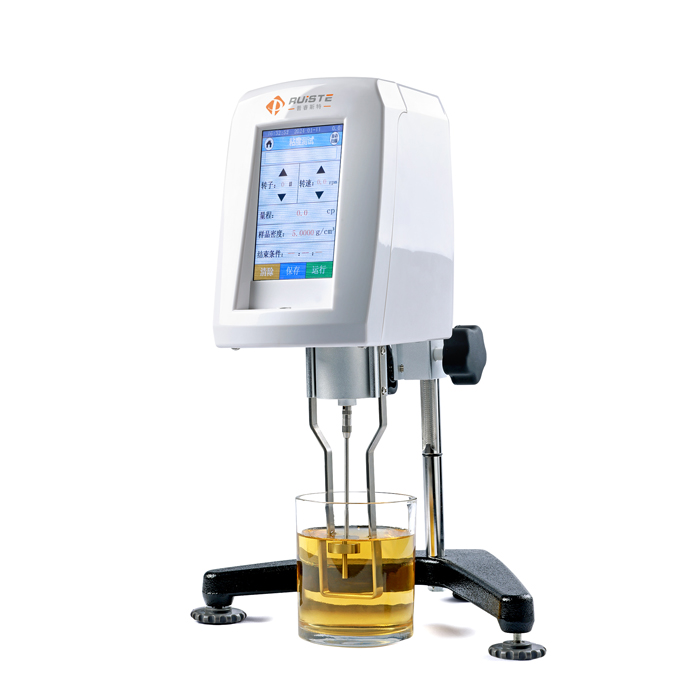
Digital rotational viscometers represent one of the most widely adopted viscosity testing devices in modern laboratories and industrial production environments, designed based on the torque shear principle of fluid mechanics. The core working mechanism of this type of instrument is to drive a precision spindle or rotor to rotate at a stable and controllable constant speed in the fluid sample to be tested. When the spindle rotates, it drives the surrounding fluid to generate layered shear movement, and the viscous resistance of the fluid will form a reverse torque acting on the spindle. The internal high-precision sensing module of the instrument can capture the torque change in real time, and convert the torque signal into specific viscosity data through built-in algorithm calculation, completing the quantitative detection of fluid viscosity. Most digital rotational viscometers support the switching of multiple spindle specifications and rotational speeds, which can form different shear rate conditions, enabling them to adapt to both Newtonian fluids with stable viscosity and non-Newtonian fluids whose viscosity changes with shear rate.
In terms of structural design, digital rotational viscometers are mainly composed of a stable drive system, replaceable spindle components, high-sensitivity torque sensors, and digital data processing and display modules. The drive system adopts a constant-speed motor structure to ensure the stability of rotational speed during long-term testing, avoiding data deviation caused by speed fluctuation. Replaceable spindles with different sizes and shapes can match fluids with different viscosity ranges; small-sized spindles are suitable for low-viscosity fluids with weak flow resistance, while large-sized spindles can effectively capture the shear torque of high-viscosity fluids such as thick coatings and glue solutions. This flexible structural design endows the equipment with strong versatility, allowing it to complete viscosity detection of various fluid samples in a single device. In practical applications, digital rotational viscometers are commonly used for testing paint, ink, lubricating oil, syrup, and polymer solution samples, and can also monitor the viscosity change of materials during production processes to guide the adjustment of production parameters.
Digital capillary viscometers are designed based on the Poiseuille’s law of fluid flow, which defines the linear relationship between fluid flow rate and viscosity under fixed capillary conditions. The basic working mode of this type of instrument is to make the fluid sample pass through a tiny and uniform capillary tube under constant temperature and fixed pressure difference conditions, and the built-in photoelectric sensing system automatically records the time required for the fluid to flow through the specified capillary length. According to the flow time, combined with the inner diameter and length parameters of the standard capillary, the instrument can automatically calculate the kinematic viscosity and dynamic viscosity of the fluid. Different from rotational viscometers that rely on shear torque measurement, digital capillary viscometers focus on detecting the natural flow characteristics of fluids, with higher sensitivity for low-viscosity transparent fluids.
The core advantage of digital capillary viscometers lies in their stable measurement repeatability and high data consistency, as the capillary tube processed by precision technology has fixed and uniform structural parameters, and the constant temperature control system can eliminate the interference of temperature fluctuation on fluid viscosity. Most equipment is equipped with an automatic sample injection and cleaning structure, which reduces manual operation intervention and improves testing efficiency. This type of viscometer is mostly used for detecting low-viscosity homogeneous fluids, including petroleum products, solvent solutions, edible oils, and dilute chemical reagents. It is worth noting that digital capillary viscometers have certain limitations in application; they are not suitable for testing turbid, particulate-containing or high-viscosity fluids, as impurities or excessive fluid viscosity may cause capillary blockage and affect the normal progress of testing. In industrial detection scenarios such as petroleum refining and fine chemical industry, capillary digital viscometers have become conventional testing equipment for routine quality inspection of low-viscosity materials.
Digital vibrational viscometers are emerging high-efficiency testing instruments developed based on the fluid damping vibration principle, which have been widely used in online real-time monitoring and rapid batch detection in recent years. The core component of the equipment is a precision vibrating probe with a fixed natural frequency. During measurement, the probe is immersed in the fluid sample, and the driving system makes the probe produce continuous and stable micro-vibration at the natural frequency. The viscous resistance of the fluid will consume the vibration energy of the probe, resulting in changes in vibration amplitude, resonance frequency and damping coefficient. The high-precision sensing module captures these vibration parameter changes in real time, and the intelligent algorithm converts the damping variation data into accurate viscosity values.
Compared with rotational and capillary viscometers, digital vibrational viscometers have prominent advantages in testing speed and adaptability. The vibration detection mode does not require large-scale shear movement of the fluid, and the probe structure is compact, enabling rapid viscosity measurement within a short time. The equipment has good adaptability to both low-viscosity and medium-high-viscosity fluids, and can also stably detect fluids containing fine suspended particles without causing blockage or detection failure. In terms of structural operation, digital vibrational viscometers have simple operation steps, no need to replace probes frequently, and support continuous online monitoring of fluid viscosity in production pipelines, which can track the dynamic viscosity changes of materials in real time during continuous production. They are widely applied in food processing, daily chemical production, and industrial fluid pipeline monitoring, providing real-time data support for dynamic process adjustment.
Digital ultrasonic viscometers are non-contact viscosity testing devices based on sound wave propagation and attenuation principles, belonging to a special type of digital viscosity detection equipment. The internal ultrasonic transducer of the instrument can emit high-frequency ultrasonic waves into the fluid medium. During the propagation process of ultrasonic waves, the viscous force of the fluid will cause energy attenuation and wave velocity change. The built-in signal receiving module captures the attenuated ultrasonic signals, and analyzes the viscosity characteristics of the fluid through the change of signal attenuation coefficient. This non-contact measurement mode completely avoids the contact interference between the detection component and the fluid sample, eliminating the detection error caused by component adhesion, sample contamination or fluid disturbance.
Digital ultrasonic viscometers are particularly suitable for testing corrosive, high-purity, easily contaminated and special dangerous fluids, which cannot be detected by traditional contact viscometers. At the same time, this type of equipment can realize non-invasive real-time detection of sealed containers and pipeline fluids, without destroying the fluid storage environment and affecting the continuous production process. Its testing range covers low to medium viscosity fluids, and it has stable detection performance for homogeneous and fine mixed fluids. In the fields of high-purity chemical preparation, aerospace fluid detection, and special industrial material processing, digital ultrasonic viscometers have irreplaceable application value, providing accurate and safe viscosity detection solutions for special working conditions.
In addition to the above four mainstream types, digital falling ball viscometers are also commonly used in laboratory precision viscosity testing, which are improved and upgraded from traditional falling ball viscometers with digital intelligent technology. The working principle is based on Stokes’ law, which means that a standard ball with fixed density and size falls freely in a static fluid, and the viscosity of the fluid is calculated by detecting the uniform falling speed of the ball. The digital transformation of this equipment is reflected in the automatic timing of the falling process through photoelectric sensors, automatic collection and processing of falling time data, and direct output of viscosity results, abandoning the manual timing and visual observation mode of traditional equipment.
Digital falling ball viscometers feature high testing accuracy and good data stability, and are especially suitable for precision detection of transparent Newtonian fluids. They are widely used in scientific research laboratories and high-precision material testing scenarios, such as the viscosity calibration of standard fluids and the performance detection of high-purity chemical solutions. Due to the long testing cycle and the requirement for static fluid environment, this type of equipment is mostly used for offline sampling detection in laboratories, and is less applied in high-efficiency online industrial production monitoring scenarios.
Each type of digital viscometer has distinct functional characteristics and application boundaries, and the selection of equipment needs to comprehensively consider the fluid’s viscosity range, transparency, uniformity, corrosiveness, and testing scenarios including offline laboratory detection and online production monitoring. Rotational digital viscometers stand out for their strong versatility and adaptability to non-Newtonian fluids, suitable for most conventional industrial and laboratory testing scenarios. Capillary digital viscometers focus on high-precision detection of low-viscosity transparent homogeneous fluids, with excellent repeatability in routine detection. Vibrational digital viscometers take advantage of rapid testing and online monitoring capability, adapting to continuous production process monitoring. Ultrasonic digital viscometers solve the detection pain points of special fluids and sealed environments, realizing safe and non-contact testing. Falling ball digital viscometers meet the demand for high-precision laboratory precision detection of standard transparent fluids.
With the continuous progress of intelligent manufacturing and detection technology, digital viscometers are gradually developing towards higher precision, intelligent integration, multi-parameter simultaneous detection and remote data transmission. Different types of digital viscometers are also constantly optimizing their structural designs and algorithm systems, breaking through their original application limitations and expanding their applicable fluid ranges and testing scenarios. In actual production and scientific research work, reasonable matching of viscometer types according to testing object characteristics and technical requirements can effectively improve the accuracy and efficiency of viscosity detection, provide reliable basic data for material performance research, product quality control and production process optimization, and lay a solid foundation for the standardized and intelligent development of fluid performance detection industry.Viscosity serves as a fundamental physical property that reflects a fluid’s internal resistance to flow and shear deformation, playing a vital role in quality control, process optimization, and material research across chemical, pharmaceutical, food, and industrial manufacturing fields. Traditional viscometers rely on manual observation and data recording, which are prone to human error, low testing efficiency, and limited data accuracy. With the advancement of electronic sensing technology and intelligent data processing systems, digital viscometers have gradually replaced traditional mechanical equipment, realizing automatic measurement, real-time data display, and accurate data analysis. Based on different working principles, structural designs, and measurement modes, digital viscometers can be divided into several mainstream categories, each with unique performance characteristics and applicable application scenarios. Understanding the core differences and functional attributes of each type helps professionals select suitable testing equipment according to fluid properties and testing requirements, so as to ensure the validity and stability of viscosity detection results.
Digital rotational viscometers represent one of the most widely adopted viscosity testing devices in modern laboratories and industrial production environments, designed based on the torque shear principle of fluid mechanics. The core working mechanism of this type of instrument is to drive a precision spindle or rotor to rotate at a stable and controllable constant speed in the fluid sample to be tested. When the spindle rotates, it drives the surrounding fluid to generate layered shear movement, and the viscous resistance of the fluid will form a reverse torque acting on the spindle. The internal high-precision sensing module of the instrument can capture the torque change in real time, and convert the torque signal into specific viscosity data through built-in algorithm calculation, completing the quantitative detection of fluid viscosity. Most digital rotational viscometers support the switching of multiple spindle specifications and rotational speeds, which can form different shear rate conditions, enabling them to adapt to both Newtonian fluids with stable viscosity and non-Newtonian fluids whose viscosity changes with shear rate.
In terms of structural design, digital rotational viscometers are mainly composed of a stable drive system, replaceable spindle components, high-sensitivity torque sensors, and digital data processing and display modules. The drive system adopts a constant-speed motor structure to ensure the stability of rotational speed during long-term testing, avoiding data deviation caused by speed fluctuation. Replaceable spindles with different sizes and shapes can match fluids with different viscosity ranges; small-sized spindles are suitable for low-viscosity fluids with weak flow resistance, while large-sized spindles can effectively capture the shear torque of high-viscosity fluids such as thick coatings and glue solutions. This flexible structural design endows the equipment with strong versatility, allowing it to complete viscosity detection of various fluid samples in a single device. In practical applications, digital rotational viscometers are commonly used for testing paint, ink, lubricating oil, syrup, and polymer solution samples, and can also monitor the viscosity change of materials during production processes to guide the adjustment of production parameters.
Digital capillary viscometers are designed based on the Poiseuille’s law of fluid flow, which defines the linear relationship between fluid flow rate and viscosity under fixed capillary conditions. The basic working mode of this type of instrument is to make the fluid sample pass through a tiny and uniform capillary tube under constant temperature and fixed pressure difference conditions, and the built-in photoelectric sensing system automatically records the time required for the fluid to flow through the specified capillary length. According to the flow time, combined with the inner diameter and length parameters of the standard capillary, the instrument can automatically calculate the kinematic viscosity and dynamic viscosity of the fluid. Different from rotational viscometers that rely on shear torque measurement, digital capillary viscometers focus on detecting the natural flow characteristics of fluids, with higher sensitivity for low-viscosity transparent fluids.
The core advantage of digital capillary viscometers lies in their stable measurement repeatability and high data consistency, as the capillary tube processed by precision technology has fixed and uniform structural parameters, and the constant temperature control system can eliminate the interference of temperature fluctuation on fluid viscosity. Most equipment is equipped with an automatic sample injection and cleaning structure, which reduces manual operation intervention and improves testing efficiency. This type of viscometer is mostly used for detecting low-viscosity homogeneous fluids, including petroleum products, solvent solutions, edible oils, and dilute chemical reagents. It is worth noting that digital capillary viscometers have certain limitations in application; they are not suitable for testing turbid, particulate-containing or high-viscosity fluids, as impurities or excessive fluid viscosity may cause capillary blockage and affect the normal progress of testing. In industrial detection scenarios such as petroleum refining and fine chemical industry, capillary digital viscometers have become conventional testing equipment for routine quality inspection of low-viscosity materials.
Digital vibrational viscometers are emerging high-efficiency testing instruments developed based on the fluid damping vibration principle, which have been widely used in online real-time monitoring and rapid batch detection in recent years. The core component of the equipment is a precision vibrating probe with a fixed natural frequency. During measurement, the probe is immersed in the fluid sample, and the driving system makes the probe produce continuous and stable micro-vibration at the natural frequency. The viscous resistance of the fluid will consume the vibration energy of the probe, resulting in changes in vibration amplitude, resonance frequency and damping coefficient. The high-precision sensing module captures these vibration parameter changes in real time, and the intelligent algorithm converts the damping variation data into accurate viscosity values.
Compared with rotational and capillary viscometers, digital vibrational viscometers have prominent advantages in testing speed and adaptability. The vibration detection mode does not require large-scale shear movement of the fluid, and the probe structure is compact, enabling rapid viscosity measurement within a short time. The equipment has good adaptability to both low-viscosity and medium-high-viscosity fluids, and can also stably detect fluids containing fine suspended particles without causing blockage or detection failure. In terms of structural operation, digital vibrational viscometers have simple operation steps, no need to replace probes frequently, and support continuous online monitoring of fluid viscosity in production pipelines, which can track the dynamic viscosity changes of materials in real time during continuous production. They are widely applied in food processing, daily chemical production, and industrial fluid pipeline monitoring, providing real-time data support for dynamic process adjustment.
Digital ultrasonic viscometers are non-contact viscosity testing devices based on sound wave propagation and attenuation principles, belonging to a special type of digital viscosity detection equipment. The internal ultrasonic transducer of the instrument can emit high-frequency ultrasonic waves into the fluid medium. During the propagation process of ultrasonic waves, the viscous force of the fluid will cause energy attenuation and wave velocity change. The built-in signal receiving module captures the attenuated ultrasonic signals, and analyzes the viscosity characteristics of the fluid through the change of signal attenuation coefficient. This non-contact measurement mode completely avoids the contact interference between the detection component and the fluid sample, eliminating the detection error caused by component adhesion, sample contamination or fluid disturbance.
Digital ultrasonic viscometers are particularly suitable for testing corrosive, high-purity, easily contaminated and special dangerous fluids, which cannot be detected by traditional contact viscometers. At the same time, this type of equipment can realize non-invasive real-time detection of sealed containers and pipeline fluids, without destroying the fluid storage environment and affecting the continuous production process. Its testing range covers low to medium viscosity fluids, and it has stable detection performance for homogeneous and fine mixed fluids. In the fields of high-purity chemical preparation, aerospace fluid detection, and special industrial material processing, digital ultrasonic viscometers have irreplaceable application value, providing accurate and safe viscosity detection solutions for special working conditions.
In addition to the above four mainstream types, digital falling ball viscometers are also commonly used in laboratory precision viscosity testing, which are improved and upgraded from traditional falling ball viscometers with digital intelligent technology. The working principle is based on Stokes’ law, which means that a standard ball with fixed density and size falls freely in a static fluid, and the viscosity of the fluid is calculated by detecting the uniform falling speed of the ball. The digital transformation of this equipment is reflected in the automatic timing of the falling process through photoelectric sensors, automatic collection and processing of falling time data, and direct output of viscosity results, abandoning the manual timing and visual observation mode of traditional equipment.
Digital falling ball viscometers feature high testing accuracy and good data stability, and are especially suitable for precision detection of transparent Newtonian fluids. They are widely used in scientific research laboratories and high-precision material testing scenarios, such as the viscosity calibration of standard fluids and the performance detection of high-purity chemical solutions. Due to the long testing cycle and the requirement for static fluid environment, this type of equipment is mostly used for offline sampling detection in laboratories, and is less applied in high-efficiency online industrial production monitoring scenarios.
Each type of digital viscometer has distinct functional characteristics and application boundaries, and the selection of equipment needs to comprehensively consider the fluid’s viscosity range, transparency, uniformity, corrosiveness, and testing scenarios including offline laboratory detection and online production monitoring. Rotational digital viscometers stand out for their strong versatility and adaptability to non-Newtonian fluids, suitable for most conventional industrial and laboratory testing scenarios. Capillary digital viscometers focus on high-precision detection of low-viscosity transparent homogeneous fluids, with excellent repeatability in routine detection. Vibrational digital viscometers take advantage of rapid testing and online monitoring capability, adapting to continuous production process monitoring. Ultrasonic digital viscometers solve the detection pain points of special fluids and sealed environments, realizing safe and non-contact testing. Falling ball digital viscometers meet the demand for high-precision laboratory precision detection of standard transparent fluids.
With the continuous progress of intelligent manufacturing and detection technology, digital viscometers are gradually developing towards higher precision, intelligent integration, multi-parameter simultaneous detection and remote data transmission. Different types of digital viscometers are also constantly optimizing their structural designs and algorithm systems, breaking through their original application limitations and expanding their applicable fluid ranges and testing scenarios. In actual production and scientific research work, reasonable matching of viscometer types according to testing object characteristics and technical requirements can effectively improve the accuracy and efficiency of viscosity detection, provide reliable basic data for material performance research, product quality control and production process optimization, and lay a solid foundation for the standardized and intelligent development of fluid performance detection industry.
Types of Digital Viscometer
https://www.pruiste.com/digital-viscometer.html
Post Date: May 23, 2026
https://www.supplier-manufacturer.com/digital-viscometer/types-of-digital-viscometer.html

![Laboratory Digital Viscometer]()
Laboratory Digital Viscometer
Viscosity stands as one of the most fundamental physical properties of fluid substances, reflecting the internal friction and flow resistance that occurs when a liquid or …![Compact Moisture Analyzer]()
Compact Moisture Analyzer
Moisture content detection stands as a fundamental analytical procedure across industrial production, laboratory research, and quality inspection workflows, as the proport…![Moisture Analyzer For Sale]()
Moisture Analyzer For Sale
Moisture content stands as one of the most critical physical indicators that determine the quality, stability, and usability of various raw materials and finished products…![Laboratory Moisture Analyzer]()
Laboratory Moisture Analyzer
Moisture content stands as one of the most critical physical indicators for evaluating the quality, stability, and usability of various materials across scientific researc…![Analytical Laboratory Balance]()
Analytical Laboratory Balance
Analytical laboratory balances stand as foundational precision instruments in scientific research, industrial testing, and academic laboratory environments, designed to de…