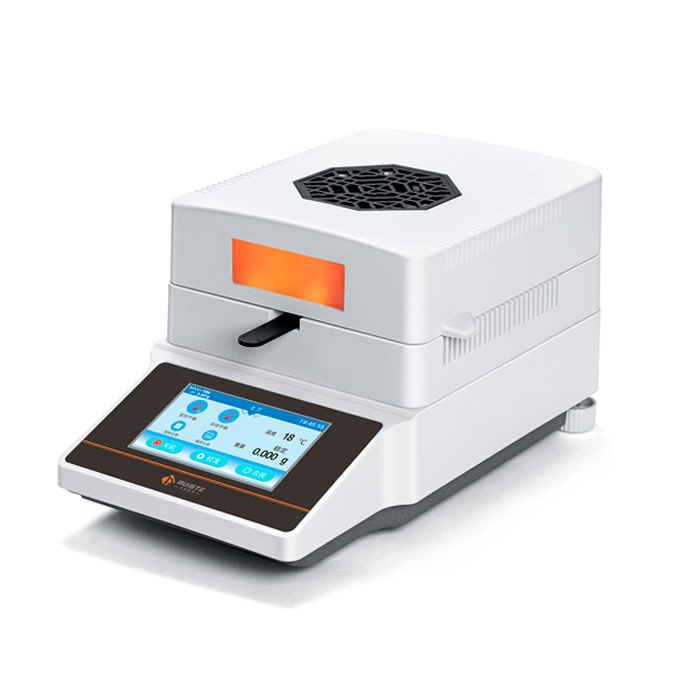
Textile Moisture Analyzer
Moisture content stands as one of the most fundamental and influential physical indicators in the entire textile industry chain, exerting a profound impact on the processing performance, structural stability, and final usability of all textile materials and finished products. Natural textile fibers such as cotton, wool, silk, and linen possess inherent hygroscopic properties, while synthetic fibers and blended textiles also absorb trace moisture from the surrounding environment during production, storage, and transportation. Even subtle fluctuations in internal moisture levels can trigger noticeable changes in textile physical attributes, including tensile strength, flexibility, dyeing affinity, and dimensional stability. Unregulated moisture content in textile raw materials and semi-finished products often leads to inconsistent processing effects, flawed finished products, and unstable batch quality, creating hidden risks for large-scale industrial production and standardized quality output. As a professional precision testing device tailored for the textile industry, the textile moisture analyzer has become a core piece of testing equipment in modern textile production and laboratory quality inspection systems, delivering reliable data support for standardized production, quality consistency control, and optimal process adjustment across the industry.
The functional logic of textile moisture analyzers revolves around the accurate quantification of moisture mass proportion within textile samples, scientifically defining the moisture state of fibers, yarns, fabrics, and finished textile products. Unlike conventional ambient humidity detection devices that only monitor external environmental conditions, this professional equipment focuses on internal bound water and free water inside textile structures, achieving targeted measurement of effective moisture content that directly affects textile performance. In traditional textile production, moisture judgment relied heavily on workers’ empirical observation, such as tactile perception and visual inspection, a subjective evaluation method with obvious limitations. Empirical judgment cannot capture subtle moisture differences between batches, nor can it provide standardized numerical data, resulting in inconsistent processing parameters and unstable product quality in subsequent spinning, weaving, dyeing, and finishing procedures. The emergence of textile moisture analyzers completely eliminates the uncertainty of manual empirical detection, realizing digital, standardized, and repeatable moisture testing for textile materials.
Modern textile moisture analyzers adopt multiple mature and efficient testing principles, adapting to diverse testing scenarios and material types in the textile industry. The drying weight loss method serves as a classic and fundamental testing principle, widely recognized for stable and intuitive testing results. This principle operates by weighing the initial mass of a standardized textile sample, then placing the sample in a constant-temperature drying environment to completely evaporate internal free water and unstable bound water. After full drying, the sample is weighed again after cooling to a constant temperature, and the moisture content or moisture regain is calculated through the mass difference before and after drying. This testing logic aligns closely with the physical definition of textile moisture, delivering stable and credible data that is highly compatible with basic quality inspection standards in the textile industry. It is particularly suitable for laboratory precise detection and batch sampling inspection of raw textile materials.
To meet the demands of rapid online detection in industrial production, most mainstream textile moisture analyzers also integrate high-frequency dielectric testing technology, optimizing testing efficiency while ensuring basic accuracy. This technology leverages the distinct dielectric property differences between water molecules and textile fiber molecules. When high-frequency signals penetrate textile samples, the dielectric constant of the material changes correspondingly with variations in internal moisture content. The device’s precision sensing system captures real-time signal changes, converts them into intuitive moisture data through built-in algorithm analysis, and completes testing in a short time. Compared with the traditional drying method that requires long-term constant-temperature treatment, high-frequency testing achieves non-destructive and rapid detection, avoiding sample damage and long waiting cycles. Moreover, high-frequency signals can penetrate deep into dense textile structures, effectively avoiding interference from surface moisture and accurately reflecting the true internal moisture state of materials, making it applicable for rapid detection of loose fibers, compact yarn bundles, thick fabrics, and various blended textile materials.
Resistive and capacitive sensing technologies are also commonly applied in textile moisture analysis, complementing diverse testing needs. The resistive method relies on the positive correlation between textile conductivity and moisture content; water molecules enhance the electrical conductivity of fiber materials, and the device calculates moisture levels by measuring resistance changes in textile samples. The capacitive method detects subtle changes in the material’s dielectric capacitance caused by moisture fluctuations, realizing stable monitoring of low-concentration moisture in synthetic textiles. Different testing principles cater to varied material characteristics and scenario requirements, forming a multi-dimensional testing system that balances accuracy, efficiency, and applicability, enabling textile moisture analyzers to adapt to the full-process detection of raw material warehousing, semi-finished product processing, and finished product inspection.
The internal structural design of textile moisture analyzers fully considers the structural characteristics and testing requirements of textile materials, ensuring the stability and practicability of detection. High-precision sensing modules and data processing units constitute the core of the equipment, with sensitive signal capture capabilities that can identify tiny moisture-induced physical changes in textile samples. The precision weighing unit equipped in drying-type analyzers features high resolution, accurately capturing subtle mass changes caused by moisture evaporation to guarantee the accuracy of final calculation results. The constant-temperature control system adopts uniform heating design, ensuring stable and consistent temperature distribution in the testing cavity, preventing local overheating that may damage textile fiber structures or cause incomplete moisture evaporation. For rapid testing equipment, optimized probe and signal transmission structures improve the fitting degree with different textile forms, effectively adapting to fluffy raw fibers, tight yarns, and textured fabrics without affecting the integrity and structure of test samples.
Reasonable operation specifications and standardized sample processing are key prerequisites for ensuring consistent and reliable test results from textile moisture analyzers. Before testing, the equipment needs to complete preheating and self-calibration to eliminate system errors caused by ambient temperature and equipment standby state. Textile samples require standardized pretreatment to remove surface floating dust and external attachments that may affect testing data, while ensuring sample representativeness by selecting multiple sampling points for batch materials. In formal testing, operators need to place samples flat and fixed according to equipment requirements, avoiding overlapping, extrusion, or uneven placement that may block signal penetration or affect drying uniformity. For different textile materials, targeted parameter adjustment is required; natural fibers with strong hygroscopicity need adapted testing duration and signal sensitivity, while synthetic fibers with low moisture content require improved detection precision to capture trace moisture changes. After testing, timely data recording and equipment resetting can maintain long-term stable operating performance of the analyzer and ensure the repeatability of batch testing data.
The application value of textile moisture analyzers runs through the entire textile production and quality control chain, solving multiple pain points in traditional production processes. In the raw material procurement and warehousing stage, different batches of cotton, wool, chemical fibers, and other textile raw materials have varying moisture levels due to different origin environments, transportation conditions, and storage cycles. Excessively high moisture in raw materials can easily trigger mildew, adhesion, and bacterial growth during long-term storage, reducing fiber activity and causing raw material deterioration. Excessively low moisture will increase fiber brittleness, raising the breakage rate in spinning and weaving processes and reducing production yield. Through systematic moisture detection of incoming raw materials, enterprises can classify and store materials according to moisture indicators, formulate targeted moisture preservation or dehumidification plans, and fundamentally stabilize the quality foundation of raw materials.
In the intermediate processing stage of textiles, moisture status directly determines the smooth progress of spinning, weaving, dyeing, and finishing processes. Moderate moisture content can enhance fiber flexibility and cohesion, reducing yarn breakage and fabric fracture during mechanical processing, and improving production continuity and processing efficiency. In the dyeing and finishing process, uniform moisture distribution ensures consistent dye absorption capacity of fibers, avoiding color difference, color unevenness, and poor color fastness of finished fabrics. Textile moisture analyzers can conduct real-time spot checks and continuous monitoring of semi-finished products in the production process, helping production personnel adjust process parameters such as workshop humidity, drying temperature, and processing speed in a timely manner, eliminating batch quality fluctuations caused by unstable moisture and improving the yield rate of semi-finished products.
In the finished product inspection and factory inspection stage, moisture detection is an important link to ensure the usability and storage stability of textile products. For daily textiles such as clothing fabrics, bedding textiles, and home textile products, standard moisture content helps maintain soft hand feel, stable size, and good air permeability. Products with unqualified moisture levels are prone to dimensional shrinkage, surface wrinkling, and mildew during subsequent sales and user use, affecting product experience and service life. For industrial textiles, technical textiles, and special functional textile materials, moisture indicators are closely related to their functional performance, structural stability, and service safety. Accurate moisture detection through professional analyzers can screen out unqualified products, ensure that all factory products meet industry quality standards, and maintain consistent product quality levels.
In addition to production quality control, textile moisture analyzers also play an important role in textile research and development and process optimization. Textile material research and new product development require systematic exploration of the correlation between fiber moisture characteristics and material properties. Researchers use moisture analyzers to test the moisture absorption and desorption rules of different fibers, blended proportions, and modified textile materials, summarize the influence of moisture changes on textile strength, elasticity, air permeability, and functional properties, and provide data support for the development of new textile materials and innovative processing technologies. At the same time, by analyzing long-term moisture detection data in the production process, enterprises can optimize production processes, formulate standardized production parameter systems suitable for their own product characteristics, realize refined production management, and reduce resource waste and quality loss caused by unregulated moisture control.
With the continuous upgrading of textile industrial technology and the increasing refinement of quality control requirements, textile moisture analyzers are also evolving toward intelligent, efficient, and integrated development. Modern equipment is equipped with intelligent data processing systems that can automatically record, sort, and analyze test data, form continuous detection data curves, and track the moisture change rule of textile materials in different links. Some optimized models support data export and remote viewing, facilitating enterprise centralized quality management and production data traceability. In terms of detection efficiency, upgraded algorithms and sensing structures further shorten detection time while maintaining high accuracy, better adapting to the fast-paced operation requirements of modern automated textile production lines. In terms of applicability, the equipment continuously optimizes adaptive parameters for new functional textiles, blended materials, and special industrial textiles, expanding the coverage of detection scenarios and meeting the diversified quality control needs of the upgraded textile industry.
In the context of the textile industry’s continuous advancement toward standardization, refinement, and intelligence, professional moisture detection technology has become an indispensable part of modern textile quality management. The textile moisture analyzer, as a key carrier of moisture detection technology, solves the problems of low efficiency, poor accuracy, and lack of standardization in traditional manual detection, provides stable and reliable technical support for full-process quality control of textile products, and promotes the overall improvement of textile product quality and industrial production level. In future industrial development, with the continuous innovation of sensing technology, algorithm technology, and intelligent control technology, textile moisture analyzers will achieve more accurate detection, more efficient operation, and more comprehensive scenario adaptation, further empowering the high-quality and sustainable development of the global textile industry.Moisture content stands as one of the most fundamental and influential physical indicators in the entire textile industry chain, exerting a profound impact on the processing performance, structural stability, and final usability of all textile materials and finished products. Natural textile fibers such as cotton, wool, silk, and linen possess inherent hygroscopic properties, while synthetic fibers and blended textiles also absorb trace moisture from the surrounding environment during production, storage, and transportation. Even subtle fluctuations in internal moisture levels can trigger noticeable changes in textile physical attributes, including tensile strength, flexibility, dyeing affinity, and dimensional stability. Unregulated moisture content in textile raw materials and semi-finished products often leads to inconsistent processing effects, flawed finished products, and unstable batch quality, creating hidden risks for large-scale industrial production and standardized quality output. As a professional precision testing device tailored for the textile industry, the textile moisture analyzer has become a core piece of testing equipment in modern textile production and laboratory quality inspection systems, delivering reliable data support for standardized production, quality consistency control, and optimal process adjustment across the industry.
The functional logic of textile moisture analyzers revolves around the accurate quantification of moisture mass proportion within textile samples, scientifically defining the moisture state of fibers, yarns, fabrics, and finished textile products. Unlike conventional ambient humidity detection devices that only monitor external environmental conditions, this professional equipment focuses on internal bound water and free water inside textile structures, achieving targeted measurement of effective moisture content that directly affects textile performance. In traditional textile production, moisture judgment relied heavily on workers’ empirical observation, such as tactile perception and visual inspection, a subjective evaluation method with obvious limitations. Empirical judgment cannot capture subtle moisture differences between batches, nor can it provide standardized numerical data, resulting in inconsistent processing parameters and unstable product quality in subsequent spinning, weaving, dyeing, and finishing procedures. The emergence of textile moisture analyzers completely eliminates the uncertainty of manual empirical detection, realizing digital, standardized, and repeatable moisture testing for textile materials.
Modern textile moisture analyzers adopt multiple mature and efficient testing principles, adapting to diverse testing scenarios and material types in the textile industry. The drying weight loss method serves as a classic and fundamental testing principle, widely recognized for stable and intuitive testing results. This principle operates by weighing the initial mass of a standardized textile sample, then placing the sample in a constant-temperature drying environment to completely evaporate internal free water and unstable bound water. After full drying, the sample is weighed again after cooling to a constant temperature, and the moisture content or moisture regain is calculated through the mass difference before and after drying. This testing logic aligns closely with the physical definition of textile moisture, delivering stable and credible data that is highly compatible with basic quality inspection standards in the textile industry. It is particularly suitable for laboratory precise detection and batch sampling inspection of raw textile materials.
To meet the demands of rapid online detection in industrial production, most mainstream textile moisture analyzers also integrate high-frequency dielectric testing technology, optimizing testing efficiency while ensuring basic accuracy. This technology leverages the distinct dielectric property differences between water molecules and textile fiber molecules. When high-frequency signals penetrate textile samples, the dielectric constant of the material changes correspondingly with variations in internal moisture content. The device’s precision sensing system captures real-time signal changes, converts them into intuitive moisture data through built-in algorithm analysis, and completes testing in a short time. Compared with the traditional drying method that requires long-term constant-temperature treatment, high-frequency testing achieves non-destructive and rapid detection, avoiding sample damage and long waiting cycles. Moreover, high-frequency signals can penetrate deep into dense textile structures, effectively avoiding interference from surface moisture and accurately reflecting the true internal moisture state of materials, making it applicable for rapid detection of loose fibers, compact yarn bundles, thick fabrics, and various blended textile materials.
Resistive and capacitive sensing technologies are also commonly applied in textile moisture analysis, complementing diverse testing needs. The resistive method relies on the positive correlation between textile conductivity and moisture content; water molecules enhance the electrical conductivity of fiber materials, and the device calculates moisture levels by measuring resistance changes in textile samples. The capacitive method detects subtle changes in the material’s dielectric capacitance caused by moisture fluctuations, realizing stable monitoring of low-concentration moisture in synthetic textiles. Different testing principles cater to varied material characteristics and scenario requirements, forming a multi-dimensional testing system that balances accuracy, efficiency, and applicability, enabling textile moisture analyzers to adapt to the full-process detection of raw material warehousing, semi-finished product processing, and finished product inspection.
The internal structural design of textile moisture analyzers fully considers the structural characteristics and testing requirements of textile materials, ensuring the stability and practicability of detection. High-precision sensing modules and data processing units constitute the core of the equipment, with sensitive signal capture capabilities that can identify tiny moisture-induced physical changes in textile samples. The precision weighing unit equipped in drying-type analyzers features high resolution, accurately capturing subtle mass changes caused by moisture evaporation to guarantee the accuracy of final calculation results. The constant-temperature control system adopts uniform heating design, ensuring stable and consistent temperature distribution in the testing cavity, preventing local overheating that may damage textile fiber structures or cause incomplete moisture evaporation. For rapid testing equipment, optimized probe and signal transmission structures improve the fitting degree with different textile forms, effectively adapting to fluffy raw fibers, tight yarns, and textured fabrics without affecting the integrity and structure of test samples.
Reasonable operation specifications and standardized sample processing are key prerequisites for ensuring consistent and reliable test results from textile moisture analyzers. Before testing, the equipment needs to complete preheating and self-calibration to eliminate system errors caused by ambient temperature and equipment standby state. Textile samples require standardized pretreatment to remove surface floating dust and external attachments that may affect testing data, while ensuring sample representativeness by selecting multiple sampling points for batch materials. In formal testing, operators need to place samples flat and fixed according to equipment requirements, avoiding overlapping, extrusion, or uneven placement that may block signal penetration or affect drying uniformity. For different textile materials, targeted parameter adjustment is required; natural fibers with strong hygroscopicity need adapted testing duration and signal sensitivity, while synthetic fibers with low moisture content require improved detection precision to capture trace moisture changes. After testing, timely data recording and equipment resetting can maintain long-term stable operating performance of the analyzer and ensure the repeatability of batch testing data.
The application value of textile moisture analyzers runs through the entire textile production and quality control chain, solving multiple pain points in traditional production processes. In the raw material procurement and warehousing stage, different batches of cotton, wool, chemical fibers, and other textile raw materials have varying moisture levels due to different origin environments, transportation conditions, and storage cycles. Excessively high moisture in raw materials can easily trigger mildew, adhesion, and bacterial growth during long-term storage, reducing fiber activity and causing raw material deterioration. Excessively low moisture will increase fiber brittleness, raising the breakage rate in spinning and weaving processes and reducing production yield. Through systematic moisture detection of incoming raw materials, enterprises can classify and store materials according to moisture indicators, formulate targeted moisture preservation or dehumidification plans, and fundamentally stabilize the quality foundation of raw materials.
In the intermediate processing stage of textiles, moisture status directly determines the smooth progress of spinning, weaving, dyeing, and finishing processes. Moderate moisture content can enhance fiber flexibility and cohesion, reducing yarn breakage and fabric fracture during mechanical processing, and improving production continuity and processing efficiency. In the dyeing and finishing process, uniform moisture distribution ensures consistent dye absorption capacity of fibers, avoiding color difference, color unevenness, and poor color fastness of finished fabrics. Textile moisture analyzers can conduct real-time spot checks and continuous monitoring of semi-finished products in the production process, helping production personnel adjust process parameters such as workshop humidity, drying temperature, and processing speed in a timely manner, eliminating batch quality fluctuations caused by unstable moisture and improving the yield rate of semi-finished products.
In the finished product inspection and factory inspection stage, moisture detection is an important link to ensure the usability and storage stability of textile products. For daily textiles such as clothing fabrics, bedding textiles, and home textile products, standard moisture content helps maintain soft hand feel, stable size, and good air permeability. Products with unqualified moisture levels are prone to dimensional shrinkage, surface wrinkling, and mildew during subsequent sales and user use, affecting product experience and service life. For industrial textiles, technical textiles, and special functional textile materials, moisture indicators are closely related to their functional performance, structural stability, and service safety. Accurate moisture detection through professional analyzers can screen out unqualified products, ensure that all factory products meet industry quality standards, and maintain consistent product quality levels.
In addition to production quality control, textile moisture analyzers also play an important role in textile research and development and process optimization. Textile material research and new product development require systematic exploration of the correlation between fiber moisture characteristics and material properties. Researchers use moisture analyzers to test the moisture absorption and desorption rules of different fibers, blended proportions, and modified textile materials, summarize the influence of moisture changes on textile strength, elasticity, air permeability, and functional properties, and provide data support for the development of new textile materials and innovative processing technologies. At the same time, by analyzing long-term moisture detection data in the production process, enterprises can optimize production processes, formulate standardized production parameter systems suitable for their own product characteristics, realize refined production management, and reduce resource waste and quality loss caused by unregulated moisture control.
With the continuous upgrading of textile industrial technology and the increasing refinement of quality control requirements, textile moisture analyzers are also evolving toward intelligent, efficient, and integrated development. Modern equipment is equipped with intelligent data processing systems that can automatically record, sort, and analyze test data, form continuous detection data curves, and track the moisture change rule of textile materials in different links. Some optimized models support data export and remote viewing, facilitating enterprise centralized quality management and production data traceability. In terms of detection efficiency, upgraded algorithms and sensing structures further shorten detection time while maintaining high accuracy, better adapting to the fast-paced operation requirements of modern automated textile production lines. In terms of applicability, the equipment continuously optimizes adaptive parameters for new functional textiles, blended materials, and special industrial textiles, expanding the coverage of detection scenarios and meeting the diversified quality control needs of the upgraded textile industry.
In the context of the textile industry’s continuous advancement toward standardization, refinement, and intelligence, professional moisture detection technology has become an indispensable part of modern textile quality management. The textile moisture analyzer, as a key carrier of moisture detection technology, solves the problems of low efficiency, poor accuracy, and lack of standardization in traditional manual detection, provides stable and reliable technical support for full-process quality control of textile products, and promotes the overall improvement of textile product quality and industrial production level. In future industrial development, with the continuous innovation of sensing technology, algorithm technology, and intelligent control technology, textile moisture analyzers will achieve more accurate detection, more efficient operation, and more comprehensive scenario adaptation, further empowering the high-quality and sustainable development of the global textile industry.
Textile Moisture Analyzer
https://www.pruiste.com/moisture-analyzer.html
Post Date: May 23, 2026
https://www.supplier-manufacturer.com/moisture-analyzer/textile-moisture-analyzer.html

![Weighing Balance RSB-W SERIES]()
Weighing Balance RSB-W SERIES
The RSB-W series adopts high-definition keys, which is economical. The entire series of balances adopt Nuosheng sensors, brand sensors, and aluminum alloy structure to ens…![Specifications of Digital Viscometer]()
Specifications of Digital Viscometer
Digital viscometers are essential analytical instruments designed to quantify the viscosity characteristics of various liquid substances, serving as core testing equipment…![Automatic Digital Viscometer]()
Automatic Digital Viscometer
Viscosity stands as one of the most fundamental physical properties of fluid substances, reflecting the internal friction and flow resistance generated between molecular l…![Coaxial Cylinder Digital Viscometer]()
Coaxial Cylinder Digital Viscometer
The coaxial cylinder digital viscometer is a sophisticated laboratory and industrial testing instrument designed to quantify the viscous properties of various fluid materi…![Halogen Moisture Analyzer]()
Halogen Moisture Analyzer
Moisture content stands as one of the most critical physical indicators for a wide range of raw materials, semi-finished goods, and finished products across modern industr…