Compact Digital Viscometer
Viscosity stands as one of the most fundamental physical properties of fluid materials, reflecting the internal friction and flow resistance that occur when a substance undergoes deformation and movement. In industrial production, material research, and daily product development, accurate viscosity measurement serves as a core basis for judging material stability, controlling product quality, and optimizing production processes. Traditional viscosity testing equipment often features bulky structures, complicated operation procedures, and limited environmental adaptability, making it difficult to meet the growing demand for on-site testing, portable detection, and rapid sample analysis in modern industrial scenarios. The compact digital viscometer has emerged as a practical and efficient testing instrument by integrating miniaturized mechanical structures, intelligent sensing technology, and digital data processing systems, balancing accurate measurement performance with flexible application scenarios to adapt to diversified viscosity testing needs across multiple industries.
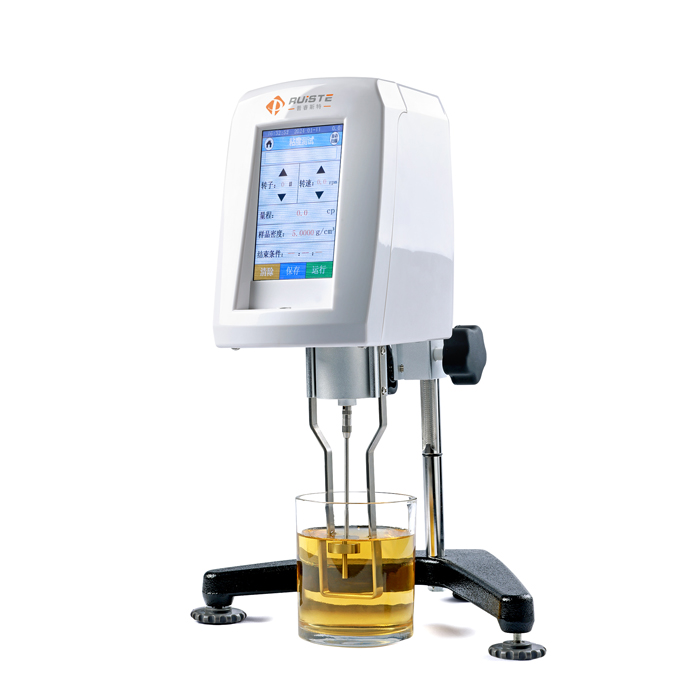
The working mechanism of the compact digital viscometer follows the basic laws of fluid mechanics, relying on the rotational viscosity measurement principle that conforms to Newton’s law of viscosity. During operation, the built-in precision drive system stabilizes the rotating spindle at a preset constant speed, and the spindle is immersed in the fluid sample to be tested. When the spindle rotates uniformly in the fluid, it is subjected to viscous resistance generated by the internal molecular friction of the sample fluid. This resistance acts on the spindle and is converted into torque signals, which are captured in real time by high-sensitivity sensors installed inside the instrument. The internal microprocessor processes the collected torque data, matches it with the preset spindle parameters and rotation speed parameters, and calculates the accurate viscosity value of the fluid through standardized algorithm conversion. For non-Newtonian fluids whose viscosity changes with shear rate, the instrument can adjust the rotation speed of the spindle to generate different shear conditions, effectively recording the dynamic viscosity changes of the sample and realizing comprehensive characterization of fluid flow characteristics.
Different from conventional large-scale viscometers designed for laboratory fixed-point testing, the compact digital viscometer adopts a highly integrated structural design. The overall mechanical components, sensing modules, data processing chips, and power supply units are compactly arranged and optimized for miniaturization, greatly reducing the overall volume and weight of the equipment. This structural optimization does not compromise the stability of core performance; instead, it avoids the mechanical vibration and signal deviation that may occur in oversized structural operation through precise structural calibration. The equipped spindles of different specifications are designed with standardized geometric dimensions, including cylindrical, disc, and cone-shaped structures, which can be replaced freely according to the viscosity range of different samples. Small-range spindles are suitable for low-viscosity fluids such as aqueous solutions and dilute solvents, while large-range spindles adapt to high-viscosity materials including grease, thick coatings, and polymer colloids, realizing wide-range coverage of fluid viscosity testing.
In terms of operational experience and data processing capabilities, the compact digital viscometer fully embodies the advantages of digital intelligent equipment. It cancels the traditional manual reading mode that relies on visual observation and pointer scale judgment, which effectively eliminates visual errors and manual recording deviations in the testing process. All measurement data is automatically collected, calculated, and presented on a high-definition digital display screen in real time, with clear and intuitive data presentation. The built-in temperature sensing module can synchronously monitor the ambient temperature and sample temperature during testing. Since fluid viscosity is highly sensitive to temperature changes, real-time temperature data recording provides effective reference for subsequent data analysis and experimental result verification, ensuring the comparability and repeatability of test data under different environmental conditions. The instrument also supports basic data storage and query functions, which can retain multiple groups of historical test data, facilitating staff to sort out test records, track material performance changes, and conduct data trend analysis in subsequent work.
The portable and compact features make this type of viscometer break the spatial limitations of traditional laboratory testing equipment. It can not only be placed in a fixed laboratory platform for standard sample testing but also carried to production workshops, construction sites, and field sampling locations for on-site rapid detection. In the production and processing process of many fluid materials, the viscosity state of raw materials and semi-finished products directly affects the processing effect and final product quality. Taking the coating and ink industry as an example, the viscosity of coating materials determines the smoothness of spraying, brushing and rolling construction, as well as the thickness uniformity and surface flatness of the finished coating film. Real-time testing of material viscosity during on-site construction can help construction personnel adjust material dilution ratio and construction parameters in a timely manner, avoiding quality problems such as uneven coating, sagging, and rough surface caused by inappropriate viscosity.
In the adhesive and glue product industry, viscosity parameters are key indicators affecting product bonding performance and construction efficiency. Too high viscosity will lead to poor fluidity of the adhesive, difficult uniform coating, and insufficient contact between the adhesive and the bonded substrate, reducing bonding stability; too low viscosity will cause the adhesive to flow excessively, resulting in glue shortage and weak bonding. The compact digital viscometer can complete rapid viscosity detection of adhesive samples before and during production, helping enterprises stabilize product formula parameters, maintain consistent product performance in different production batches, and reduce defective product rates caused by viscosity fluctuations.
The petrochemical and lubricant industries are also important application scenarios for compact digital viscometers. Various lubricating oils, hydraulic oils, and industrial greases need to maintain stable viscosity within a specific working temperature range to ensure the normal operation of mechanical equipment. Excessively high viscosity of lubricating oil will increase mechanical operation resistance and energy consumption, while excessively low viscosity will weaken the lubricating and protective effect, leading to increased equipment wear. Staff can carry the compact viscometer to conduct regular viscosity testing of operating oil samples of mechanical equipment, judge the aging degree and performance attenuation of lubricating materials through data changes, formulate reasonable oil replacement cycles, and provide effective technical support for equipment daily maintenance and safe operation.
In the daily chemical and food processing industries, viscosity testing is closely related to product texture and user experience. Cosmetic products such as facial cream, body lotion, and hair conditioner, as well as food materials including syrup, jam, and dairy emulsions, all have strict viscosity standards. Moderate viscosity ensures stable product texture, uniform component distribution, and good use and taste effects. The compact digital viscometer can adapt to the testing environment of daily chemical and food production workshops, complete rapid sampling and testing of production materials, help enterprises control product texture stability, and ensure the consistency of product quality in mass production. Meanwhile, the miniaturized equipment design is more in line with the clean production requirements of the daily chemical and food industries, with simple structure and convenient cleaning, which can effectively avoid cross-contamination between different samples.
In terms of operation threshold and applicability, the compact digital viscometer is designed for universal operation. The equipment operation logic is simplified and optimized, with clear functional keys and simple operation steps. Operators can master the testing process after simple training, without requiring professional fluid mechanics knowledge and complex instrument operation skills. Before testing, it is only necessary to select the matching spindle according to the estimated viscosity range of the sample, install the equipment stably, inject a sufficient amount of sample liquid to submerge the spindle test area, set the appropriate rotation speed, and start the test. The instrument will automatically complete data collection and calculation, and the whole testing process takes a short time, which greatly improves the efficiency of batch sample testing. For laboratory researchers, this instrument can also be used for preliminary sample screening and routine performance detection, reducing the working pressure of large precision testing equipment and improving the overall efficiency of experimental research.
Daily maintenance and calibration of the compact digital viscometer are relatively simple, which is another important advantage suitable for wide popularization. After each test, the residual sample liquid on the spindle and test tank only needs to be cleaned with a corresponding clean solvent and dried to avoid sample residue affecting the accuracy of subsequent tests. The equipment has stable internal structural performance, low failure rate in long-term use, and does not require complex regular maintenance procedures. In order to ensure long-term testing accuracy, regular parameter calibration can be carried out with standard viscosity liquids. The calibration process is simple and fast, which can effectively eliminate minor data deviations caused by long-term operation of the equipment and maintain stable and reliable testing performance.
With the continuous upgrading of industrial production precision and the continuous improvement of material research requirements, the demand for viscosity testing is developing towards rapidization, on-site, and high-frequency direction. Traditional large-scale laboratory viscometers are limited by volume, operation complexity and testing efficiency, and cannot fully adapt to the flexible testing needs in production links and field scenarios. The compact digital viscometer makes up for the deficiencies of traditional equipment with its miniaturized structure, intelligent data processing, simple operation and wide scene adaptability. It not only meets the high-precision testing requirements of conventional laboratory samples but also provides convenient and efficient testing solutions for on-site quality control and daily equipment maintenance in industrial production.
In the future, with the continuous progress of sensing technology and micro-processing technology, the performance of compact digital viscometers will be further optimized. The equipment will achieve more accurate micro-signal capture, broader viscosity testing range, and more diverse shear mode adjustment functions, which can better adapt to the testing and characterization of complex non-Newtonian fluid materials. At the same time, with the development of intelligent industrial systems, compact digital viscometers will gradually realize data interconnection and remote transmission, which can synchronize test data to production management systems and research platforms, providing more comprehensive and accurate data support for intelligent production, formula optimization, and material performance research of enterprises. As a practical and efficient testing instrument, the compact digital viscometer will continue to play an important role in industrial manufacturing, material research, quality inspection and other fields, and become an important basic tool to promote standardized production and performance optimization of fluid materials in various industries.
Compact Digital Viscometer
https://www.pruiste.com/digital-viscometer.html
Post Date: May 23, 2026
https://www.supplier-manufacturer.com/digital-viscometer/compact-digital-viscometer.html

![Floor Weighing Scale]()
Floor Weighing Scale
Floor weighing scales stand as fundamental measuring instruments widely applied across diverse industrial, commercial, and daily operational environments, serving the core…![Types of Counting Scale]()
Types of Counting Scale
Counting scales serve as essential weighing instruments designed to calculate the quantity of homogeneous items by measuring their weight, and they have become indispensab…![Dustproof Counting Scale]()
Dustproof Counting Scale
In modern industrial production, laboratory research, and daily material sorting operations, counting and weighing small bulk materials have become an indispensable basic …![Commercial Weighing Scale]()
Commercial Weighing Scale
In every modern commercial and industrial operation that involves handling goods, managing inventory, processing production materials, or conducting routine transactional …![Heavy-duty Counting Scale]()
Heavy-duty Counting Scale
In modern industrial production, warehouse management, manufacturing processing, and large-scale commercial material handling, the accurate quantification and quantity sta…