Working Principle of Digital Viscometer
Viscosity is an inherent physical property of fluid substances, which characterizes the internal friction and flow resistance generated when a fluid undergoes relative motion. It serves as a critical parameter for evaluating the fluidity, consistency, and structural stability of liquids, covering a wide range of substances from low-viscosity solutions such as water and chemical solvents to high-viscosity materials including paints, lubricants, adhesives, and food slurries. Traditional viscosity measurement tools rely on manual observation and mechanical reading, which are susceptible to human operation errors, environmental interference, and limited measurement range, failing to meet the demands of modern industrial production and laboratory precision testing. Digital viscometers, as upgraded intelligent measurement devices, integrate mechanical transmission, sensor detection, microcomputer data processing, and digital display technologies. They achieve automated, accurate, and real-time viscosity detection by quantifying the viscous resistance of fluids, effectively compensating for the shortcomings of traditional measurement methods and becoming mainstream testing equipment in multiple industrial and scientific research fields.
The core theoretical basis of all digital viscometers derives from Newton’s law of viscosity, which establishes the quantitative relationship between fluid shear stress, shear rate, and dynamic viscosity. For Newtonian fluids that maintain stable viscosity under fixed temperature and pressure conditions, the shear stress generated by fluid flow is directly proportional to the shear rate, and the proportionality coefficient is the dynamic viscosity value of the fluid. Non-Newtonian fluids, which account for most industrial raw materials, do not follow this linear relationship, and their viscosity changes with variations in shear force and shear time. Digital viscometers are designed based on this theoretical foundation, applying controllable shear action to fluid samples through internal mechanical structures, capturing the resistance signal generated by fluid viscosity, and converting physical signals into intuitive digital values through internal algorithm processing. This fundamental working logic remains consistent across different types of digital viscometers, while specific mechanical structures and signal acquisition methods vary according to measurement principles.
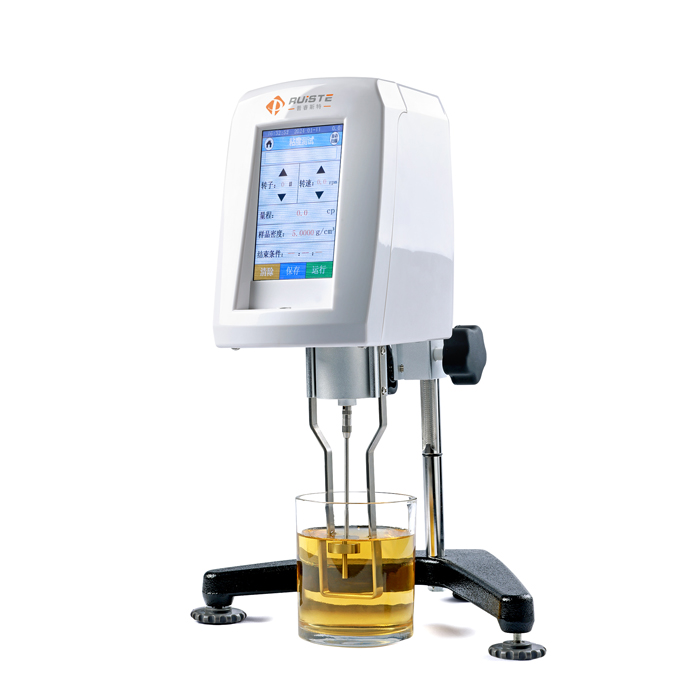
Rotational digital viscometers are the most widely used type in practical applications, with mature working mechanisms and strong adaptability to different viscosity fluids. The overall structure of this equipment consists of a constant-speed drive module, torque sensing module, signal processing unit, and digital display module. During operation, the precision drive system drives the built-in rotor to perform uniform and stable rotational motion at a preset constant speed. The rotor is completely immersed in the fluid sample to be tested, and when rotating at a constant speed, it will be subjected to continuous viscous resistance from the surrounding fluid. The magnitude of this resistance is closely related to the viscosity of the fluid: fluids with greater internal friction produce stronger resistance to the rotating rotor, while fluids with weaker flow resistance generate smaller damping force on the rotor.
To maintain the preset constant rotation speed, the drive system needs to output corresponding torque to offset the viscous resistance of the fluid. The torque sensor installed in the transmission structure can accurately capture the real-time torque change during rotor operation. The detected torque signal is a weak analog physical signal, which cannot be directly recognized and displayed. Therefore, the device transmits the original signal to the internal microcomputer processing unit for amplification, filtering, and analog-to-digital conversion. The system eliminates interference signals generated by mechanical vibration, ambient temperature fluctuation, and minor operational deviation through built-in optimization algorithms, and calculates the exact dynamic viscosity value of the sample based on the pre-calibrated functional relationship between torque, rotation speed, and viscosity.
To adapt to fluid samples with vastly different viscosity ranges, rotational digital viscometers are equipped with multiple rotors of different sizes and structural specifications, as well as adjustable multi-level rotation speeds. Larger rotors or lower rotation speeds are suitable for testing low-viscosity fluids, as they can generate stable and detectable torque signals under weak viscous resistance. Smaller rotors paired with higher rotation speeds are applied to high-viscosity fluids, effectively avoiding excessive resistance that may cause rotor stalling or signal distortion. The matching use of rotors and speeds expands the measurement range of the equipment, ensuring the stability and accuracy of detection data for various fluid samples. In addition, the rotational measurement method can simulate the shear state of fluids in actual industrial production, enabling effective detection of the shear thinning or shear thickening characteristics of non-Newtonian fluids, which provides practical data support for production process parameter adjustment.
Vibrational digital viscometers represent another common technical type, adopting a different signal acquisition mechanism from rotational structures and featuring faster response speed and simpler structural design. Their working principle is based on the mechanical impedance and damping effect of fluids on vibrating components. The core detection part of the equipment is a precision vibrating probe, which is driven by an electronic excitation unit to perform continuous fixed-frequency micro-amplitude vibration. When the probe is immersed in a fluid sample, the viscous force of the fluid will generate a damping effect on the vibration of the probe, consuming the vibration energy and causing changes in vibration amplitude, resonance frequency, and phase difference.
The degree of vibration attenuation is positively correlated with the viscosity of the fluid. Under the same vibration parameters, high-viscosity fluids produce obvious damping effects, leading to significant reduction in vibration amplitude and obvious offset of resonance frequency; low-viscosity fluids have weak damping capacity, so the vibration state of the probe changes slightly. The high-sensitivity sensing module in the device captures real-time changes in vibration parameters, transmits the data to the microcomputer system for analysis and calculation, and converts the vibration damping parameters into standard viscosity values. This type of viscometer has no mechanical rotating friction during operation, with low equipment loss and fast measurement response. It is particularly suitable for real-time online monitoring of fluid viscosity in continuous production processes, such as real-time detection of coating fluid viscosity and beverage raw material consistency in production lines.
Capillary digital viscometers work based on the fluid flow principle in tiny pipelines, combining traditional capillary penetration theory with modern digital sensing technology. According to fluid mechanics principles, when a fluid flows through a uniform capillary tube under stable pressure and temperature conditions, the flow rate and flow time of the fluid are inversely proportional to its viscosity. Fluids with higher viscosity flow slowly in the capillary tube and require longer time to pass through the fixed capillary length, while low-viscosity fluids flow more rapidly. This type of viscometer is equipped with a precision capillary pipeline, a constant-temperature control system, and an optical sensing detection unit.
During measurement, the constant-temperature system maintains the fluid sample and capillary tube at a stable temperature state to eliminate the influence of temperature changes on fluid viscosity. The fluid is guided to flow through the capillary tube at a constant pressure difference, and the optical sensor detects the time required for the fluid to pass through the calibrated effective capillary section. The system calculates the kinematic viscosity of the sample based on the flow time and capillary calibration parameters, and converts it into dynamic viscosity data through internal parameter conversion formulas. Capillary digital viscometers have high measurement accuracy for Newtonian fluids with stable properties, and are widely used in the detection of petroleum products, chemical solvents, and edible oils, where fluid viscosity is relatively uniform and stable.
Temperature is a key external factor affecting viscosity measurement accuracy, and digital viscometers are equipped with intelligent temperature compensation and constant-temperature matching mechanisms to address this issue. The viscosity of most fluids changes significantly with temperature rise or fall: liquid fluids generally show decreased viscosity with increasing temperature, as molecular thermal motion intensifies and intermolecular binding force weakens, reducing internal flow resistance. A built-in high-precision temperature sensor in the real-time monitoring device captures the temperature of the fluid sample during measurement and transmits the temperature data to the processing unit. The system invokes the corresponding temperature correction algorithm according to the fluid type, automatically compensating the viscosity measurement results to eliminate detection errors caused by temperature fluctuation, ensuring that the output data conforms to standard temperature detection specifications.
The overall data processing and output logic of digital viscometers realizes full automation from signal acquisition to result display. After the equipment is started and calibrated, the mechanical or vibration sensing unit completes real-time collection of fluid resistance signals, and the analog signals are converted into digital signals through a high-precision analog-to-digital converter. The microcomputer system filters out abnormal data points generated by accidental interference, performs algorithm calculation and parameter correction based on pre-stored physical models and calibration parameters, and finally outputs stable and accurate viscosity values to the digital display screen. At the same time, most devices support real-time data storage and data transmission, which facilitates subsequent data sorting, comparison, and traceability, meeting the standardized testing requirements of industrial production and laboratory research.
In practical measurement applications, the working stability of digital viscometers also depends on standardized sample detection conditions. The equipment is designed based on the uniform flow state of fluids, so bubbles, impurities, and uneven dispersion in the sample will interfere with the transmission of shear force or vibration damping, resulting in distorted measurement signals. Therefore, the working principle of the device also implies standardized application requirements: the sample needs to be kept uniform and stable, and the detection environment needs to maintain stable humidity and pressure to ensure that the sensing unit can accurately capture the pure viscous resistance signal of the fluid itself, avoiding external factor interference affecting the authenticity of detection data.
Compared with traditional mechanical viscometers that rely on manual reading and mechanical pointer indication, the digital working mode fundamentally reduces human operation errors and improves the repeatability and consistency of measurement results. The integrated microcomputer intelligent processing system can complete complex data calculation and error correction in a short time, realizing rapid and batch detection of samples. Different structural types of digital viscometers complement each other in application scenarios, covering low, medium, and high viscosity fluid detection needs, and can adapt to the detection requirements of Newtonian and non-Newtonian fluids, providing reliable technical support for quality control, formula optimization, and process parameter adjustment in food processing, chemical industry, pharmaceutical manufacturing, new material research, and other fields.
In summary, the working principle of digital viscometers takes fluid viscosity mechanics theory as the core, relies on precision mechanical motion or vibration sensing structure to obtain fluid viscous resistance signals, and realizes quantitative digital detection of fluid viscosity through electronic signal conversion and intelligent algorithm processing. The continuous optimization of its structural design and data processing algorithms enables the equipment to maintain stable detection performance in complex application environments, making it an indispensable precision testing instrument in modern industrial production and scientific research experiments. With the continuous development of intelligent manufacturing and precision testing technology, digital viscometers will further improve their anti-interference ability and detection efficiency, and expand their application scope in more emerging fields of fluid performance testing.
Working Principle of Digital Viscometer
https://www.pruiste.com/digital-viscometer.html
Post Date: May 23, 2026

![Weighing Analytical Balance]()
Weighing Analytical Balance
The weighing analytical balance stands as an indispensable precision measuring instrument widely deployed in laboratory environments, research institutions, and industrial…![Precision Balance Factory]()
Precision Balance Factory
Behind every subtle numerical fluctuation in mass measurement lies the rigorous craftsmanship and profound technological accumulation of precision balance manufacturing. A…![Portable Precision Balance]()
Portable Precision Balance
In modern measurement science, the demand for accurate and convenient mass detection continues to grow across diverse industrial, academic, and daily application scenarios…![Medical Electronic Balance]()
Medical Electronic Balance
In the modern medical industry, precise measurement serves as the fundamental foundation for medical research, clinical diagnosis, pharmaceutical preparation and biologica…![Portable Electronic Balance]()
Portable Electronic Balance
With the continuous advancement of modern measurement technology, weighing instruments have gradually evolved from bulky mechanical structures to compact electronic design…