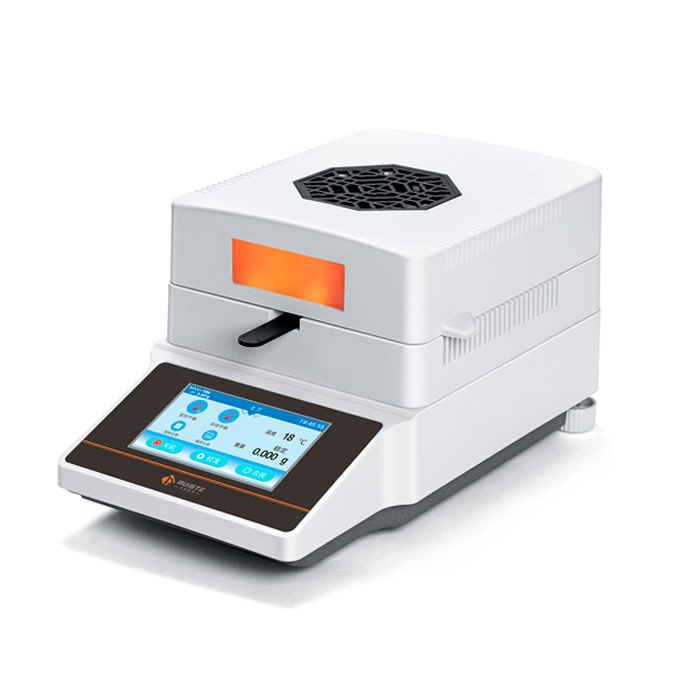
Benchtop Moisture Analyzer
Moisture content stands as one of the most critical physical parameters for a vast range of raw materials, semi-finished products, and finished goods across industrial, agricultural, pharmaceutical, and research fields. Even minor variations in moisture levels can significantly alter material properties, including texture, stability, chemical reactivity, storage durability, and overall performance. For laboratory testing and industrial quality control workflows that require consistent and reliable moisture detection, benchtop moisture analyzers have become essential desktop testing equipment, offering a practical alternative to traditional moisture measurement methods. Unlike time-consuming conventional drying oven techniques that demand hours of waiting and manual data recording, benchtop moisture analyzers integrate precise weighing and uniform heating systems to complete moisture testing within a short timeframe, delivering stable and repeatable test results for daily analytical work.
The core working mechanism of benchtop moisture analyzers relies on the thermogravimetric loss-on-drying principle, a classic and universally recognized testing logic for moisture quantification. This principle operates on a simple physical foundation: the moisture contained in solid or semi-solid samples will completely evaporate under continuous and controlled heating conditions, and the moisture content can be calculated accurately by measuring the weight difference of the sample before and after the drying process. The entire testing process depends on two core functional modules embedded in the equipment: a high-precision weighing unit and a controllable heating unit, supported by an intelligent data processing system that automates data collection, calculation, and result output. Before the start of each test, the weighing unit captures the initial mass of the placed sample with high accuracy, recording the original weight data in real time. Subsequently, the heating unit generates stable and uniform thermal energy to heat the sample, gradually evaporating internal free moisture and partial bound moisture that affects material quality. During the entire drying cycle, the weighing system continuously monitors subtle weight changes of the sample, transmitting real-time weight data to the built-in microprocessor for dynamic analysis. When the sample weight stabilizes and no longer decreases within a set period, the system confirms the completion of drying, automatically calculating the sample’s moisture content, dry substance ratio, and other key data indicators.
The structural design of modern benchtop moisture analyzers focuses on practicality, operational convenience, and testing stability, adapting to daily laboratory and on-site quality control environments. The overall benchtop layout features a compact footprint that saves desktop space, making it suitable for placement in standard laboratory workstations, production line testing areas, and material inspection rooms. The core weighing area is equipped with durable, easy-to-clean sample pans, which are designed to hold granular, powdery, flaky, and paste samples of different textures, meeting the diverse testing needs of various materials. The heating system adopts efficient heating components that can form a uniform temperature field covering the entire sample placement area, avoiding local overheating or uneven heating that may cause incomplete moisture evaporation or sample thermal decomposition. This uniform heating design effectively improves the accuracy of test results and reduces systematic errors in the testing process. The equipment is fitted with a clear display interface that presents real-time data including sample weight, set temperature, real-time temperature, drying duration, and dynamic moisture content changes, allowing operators to observe the entire testing process intuitively. Meanwhile, the built-in microprocessor supports flexible parameter adjustment, enabling users to set targeted heating temperatures, drying durations, and judgment standards for constant weight according to the physical and chemical characteristics of different samples.
Standard operational procedures play a vital role in ensuring the accuracy and reproducibility of test results when using benchtop moisture analyzers. Before initiating testing, equipment preparation is essential to eliminate external interference factors. Operators need to place the analyzer on a horizontal, stable desktop, avoiding placement in areas with direct airflow, strong temperature fluctuations, or direct sunlight, as these environmental factors can affect heating uniformity and weighing precision. The equipment should be preheated for a certain period to stabilize the internal temperature field and weighing system, ensuring the instrument reaches a stable working state. The sample pan needs to be cleaned and dried thoroughly before use to remove residual impurities and moisture from previous tests, then placed in the testing chamber for zero calibration to eliminate the weight influence of the container itself. For sample preparation, representative sampling is key to reliable test data. Samples should be taken from different parts of the bulk material to avoid localized sampling errors, and processed appropriately according to material properties: solid block samples can be crushed into fine particles to increase the contact area with hot air and accelerate moisture evaporation, while viscous paste samples need to be spread evenly on the sample pan to prevent internal moisture from being trapped and unable to evaporate fully. The sample dosage should be controlled within a reasonable range; an excessive sample amount may lead to incomplete internal drying, while an insufficient amount may amplify tiny weighing errors and reduce result stability.
After completing sample placement and parameter setting, the automatic testing process begins without continuous manual supervision. The system first records the initial sample weight, then starts constant-temperature heating, and continuously tracks weight loss data throughout the drying process. In the later stage of drying, the system automatically judges the constant weight state according to preset parameters. Once the weight change per unit time is lower than the set threshold, the system terminates the drying process and locks the final test data. After the test finishes, operators can directly read multiple data indicators, including moisture content percentage and dry weight ratio. It is important to wait for the equipment and sample pan to cool down before removing the sample to avoid scalding and prevent high-temperature residual heat from affecting subsequent tests. Timely cleaning of the testing chamber and sample pans after each use can avoid residual sample accumulation, which may corrode internal components or interfere with the accuracy of subsequent tests.
Benchtop moisture analyzers cover a wide range of application scenarios, penetrating almost all industries that require moisture control for material quality. In the food and beverage industry, moisture content is a core indicator affecting product taste, shelf life, and storage stability. Granular grains, flour, starch, nut products, and snack foods all require precise moisture detection; excessive moisture in grains can easily lead to mildew and deterioration during storage, while inappropriate moisture levels in baked foods will affect their crispness and texture. Dairy products, condiments, and powdered food additives also rely on this equipment for routine moisture testing to maintain consistent product quality in mass production. In the agricultural sector, the analyzer is used for moisture detection of various crop seeds, feed raw materials, and soil samples, providing data support for crop storage, feed formula adjustment, and agricultural planting environment assessment.
In the chemical and new material industries, moisture content directly affects the chemical stability and processing performance of materials. Plastic particles, resin raw materials, coating materials, ink components, and various chemical powders all require strict moisture control. Excess moisture in polymer materials will cause bubbles and cracks during thermal processing, reducing the structural strength and service life of finished products, while unstable moisture in chemical reagents will affect chemical reaction efficiency and product purity. The rapid detection function of benchtop moisture analyzers enables production personnel to adjust raw material formulas and processing parameters in a timely manner, ensuring the stability of industrial production. In the pharmaceutical and cosmetic industries, raw material moisture testing is related to product safety and qualification stability. Traditional Chinese medicine powders, pharmaceutical auxiliary materials, cosmetic powders, and cream substrates all need standardized moisture detection to avoid microbial growth caused by excessive moisture and ensure product compliance with production specifications.
Compared with traditional moisture detection methods, benchtop moisture analyzers exhibit prominent comprehensive advantages in practical application. Traditional blast drying ovens require long drying cycles, often taking several hours to complete a single test, with the entire process requiring manual weighing, recording, and repeated weighing until constant weight, which is time-consuming and labor-intensive, and prone to human operation errors. In contrast, benchtop moisture analyzers shorten the testing cycle significantly, completing the entire drying and testing process in a short time, greatly improving the efficiency of batch sample detection. The highly integrated design of weighing and heating eliminates manual intermediate links, and the intelligent system automatically completes data collection and calculation, reducing human error and improving the consistency of test results. In terms of applicability, the equipment can adapt to samples of multiple textures and states, with adjustable heating temperature ranges and flexible testing modes, which can meet the personalized testing requirements of different materials and avoid the limitation of single testing conditions in traditional methods. In addition, the benchtop design features simple operation and low learning cost, and staff can master basic testing procedures after simple training, making it suitable for both professional laboratory research and daily rapid detection in production workshops.
To maintain long-term stable operation and accurate test performance of benchtop moisture analyzers, standardized daily maintenance and regular performance inspection are indispensable. Daily maintenance mainly focuses on cleaning and environmental management: the testing chamber, heating components, and sample pans should be kept clean and dry at all times, with residual sample debris and stains cleaned up in a timely manner to prevent long-term accumulation from affecting heating efficiency and weighing accuracy. The equipment should be placed in a dry, ventilated, and temperature-stable working environment to avoid humid, dusty, and corrosive gas environments that may damage internal precision components. During use, violent vibration and collision should be avoided to protect the high-precision weighing sensor from structural displacement and performance deviation.
Regular calibration and performance verification are key to ensuring continuous and reliable test data. Operators can conduct daily zero-point calibration before use to eliminate minor weighing deviations caused by environmental changes. Regular professional calibration of weighing accuracy and temperature control accuracy is required to ensure that the weighing unit maintains high precision and the heating unit’s temperature control error is controlled within a reasonable range. When the equipment is not in use for a long time, it should be covered with a dust cover and placed in a dry storage environment, and regular power-on preheating and idle operation should be carried out to maintain the activity of internal electronic components. In case of abnormal data fluctuations or unstable equipment operation during testing, stop using the equipment in a timely manner and check for faults such as residual dirt, parameter setting errors, or component aging, so as to eliminate hidden dangers and ensure the stability of subsequent testing work.
In practical testing work, standardized operation and reasonable parameter setting are crucial to improve test accuracy. Different types of samples have different thermal stability characteristics, so targeted temperature setting is required: heat-sensitive samples such as food powders and biological materials need low-temperature gradual drying to prevent thermal decomposition and volatile component loss caused by high temperature, which may lead to inaccurate moisture data; while inert materials such as mineral powders and plastic particles can adopt relatively high-temperature drying modes to accelerate moisture evaporation and improve testing efficiency. In addition, repeated parallel testing is recommended for key sample tests. Multiple groups of tests for the same sample can verify the reproducibility of results and avoid accidental errors caused by individual sample differences or operational deviations. Recording test parameters, environmental conditions, and test results in detail after each test is conducive to data traceability, subsequent result analysis, and testing process optimization.
With the continuous upgrading of industrial production standards and laboratory testing requirements, the application value of benchtop moisture analyzers is becoming increasingly prominent. It bridges the gap between traditional high-precision but low-efficiency drying methods and rapid but inaccurate portable detection tools, achieving a balanced integration of detection accuracy and work efficiency. In quality control links, it helps enterprises realize real-time monitoring of raw material incoming inspection, production process parameter adjustment, and finished product quality verification, effectively reducing product quality fluctuations caused by moisture abnormalities. In scientific research and experimental scenarios, it provides stable and reliable basic data for material performance research, formula optimization, and process improvement, supporting the standardized development of material research experiments.
Overall, benchtop moisture analyzers, with their mature working principles, stable structural performance, wide application adaptability, and efficient testing capabilities, have become essential basic testing equipment in modern industrial production and scientific research laboratories. Standardized operation, scientific parameter setting, and reasonable daily maintenance can maximize the equipment’s performance, ensure the long-term stability of test results, and provide reliable technical support for material quality control, production process optimization, and scientific research innovation in various industries. As testing technology continues to progress, the functional design of such equipment will be further optimized to adapt to more complex sample testing scenarios and meet the increasingly refined moisture detection needs of various fields.
Benchtop Moisture Analyzer
https://www.pruiste.com/moisture-analyzer.html
Post Date: May 23, 2026
https://www.supplier-manufacturer.com/moisture-analyzer/benchtop-moisture-analyzer.html

![Online Digital Viscometer]()
Online Digital Viscometer
Viscosity stands as one of the most fundamental physical properties of fluid substances, reflecting the internal frictional resistance that occurs when a fluid flows and d…![Digital Viscometer Supplier]()
Digital Viscometer Supplier
Viscosity stands as one of the most fundamental physical properties of fluid materials, reflecting the internal frictional resistance that occurs when a fluid flows or und…![Portable Digital Viscometer]()
Portable Digital Viscometer
Viscosity stands as one of the most fundamental physical properties of fluid substances, reflecting the internal friction and flow resistance that occurs when liquids move…![Food Moisture Analyzer]()
Food Moisture Analyzer
Moisture content stands as one of the most fundamental and influential physical parameters in all types of food materials and finished food products. It exerts a profound …![Chemical Moisture Analyzer]()
Chemical Moisture Analyzer
Moisture content stands as one of the most critical physical and chemical indicators for evaluating the quality, stability, and applicability of various materials across i…