Moisture Analyzer Supplier
Moisture content stands as one of the most critical physical indicators for a wide range of raw materials, semi-finished goods, and finished products across global industrial and research fields. The presence of moisture in materials can alter structural stability, chemical properties, storage performance, and processing characteristics, bringing subtle or profound impacts on product quality and production efficiency. In modern manufacturing, quality control, and scientific research scenarios, accurate and rapid moisture detection has become an indispensable link in standardized production and precise experimental analysis. As core testing instruments for moisture detection, moisture analyzers have gradually become standard equipment in laboratories, production workshops, and research institutions, relying on stable working mechanisms and adaptable functional designs. Understanding the inherent logic, application scenarios, operational norms, and maintenance requirements of moisture analyzers helps industrial users and research practitioners maximize the value of such testing equipment in daily use.
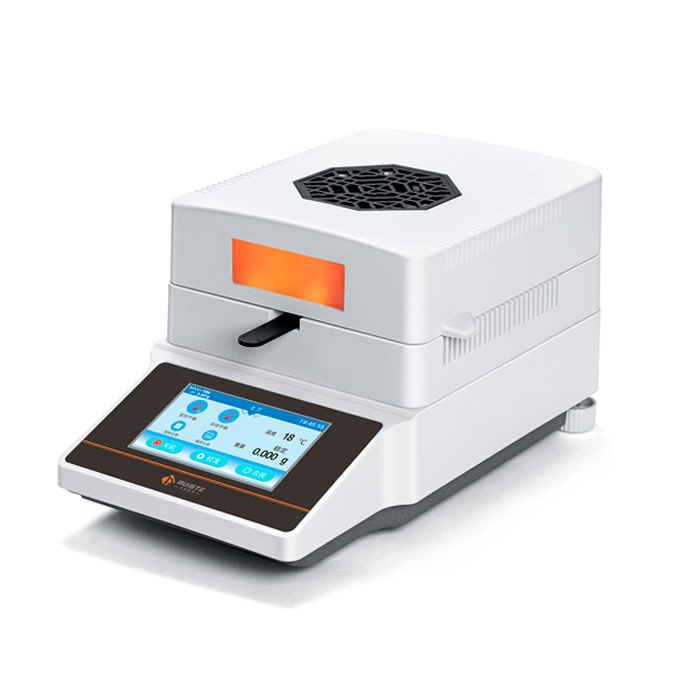
The mainstream working mechanism of modern moisture analyzers is based on thermogravimetric analysis, a mature and reliable testing principle commonly referred to as loss on drying in practical applications. This principle centers on the physical change of moisture evaporation in materials under controlled heating conditions, with moisture content calculated through accurate comparison of sample weight changes before and after drying. The basic operational logic follows a consistent and rigorous process. Before formal testing, a clean and dry sample pan is placed on the precision weighing module of the instrument, and the system automatically calibrates the initial weight data to eliminate the weight interference of the container itself. Users then place an appropriate amount of tested sample into the pan, spreading the sample evenly to ensure uniform heating and complete evaporation of internal moisture, avoiding incomplete drying caused by uneven sample accumulation or excessive thickness.
After completing sample placement, the instrument’s heating system starts to work according to preset temperature and time parameters. Most conventional moisture analyzers adopt efficient heating methods such as halogen heating or infrared heating, which feature uniform heat distribution, fast temperature rise, and stable temperature control performance. These heating modes can quickly form a constant-temperature drying environment inside the testing chamber, effectively evaporating free moisture and partial bound moisture inside the sample without causing thermal decomposition or structural damage to the sample’s effective components. During the entire drying process, the high-precision weighing module inside the instrument continuously monitors and records the sample weight in real time, dynamically tracking the weight loss caused by moisture evaporation. When the sample weight tends to stabilize and no longer changes significantly within a set period, the system judges that the moisture drying process is complete, automatically terminates the heating program, and calculates the moisture content data of the sample based on the recorded initial weight and final stable weight.
Compared with traditional manual moisture detection methods such as oven drying and chemical titration, modern moisture analyzers show obvious advantages in testing efficiency, data stability, and operational convenience. Traditional oven drying usually requires several hours of constant-temperature baking and natural cooling, with manual weighing and calculation throughout the process, which consumes substantial labor and time costs and is easily affected by human operation errors and ambient temperature and humidity changes. Chemical titration methods, while accurate for specific samples, require supporting chemical reagents, professional operation skills, and strict waste treatment procedures, limiting their applicability in rapid batch detection. In contrast, integrated moisture analyzers integrate heating, weighing, data recording, and result calculation into one device, realizing automated and intelligent testing. A single detection cycle can be completed within a short time, greatly improving detection efficiency, and the closed and standardized testing environment effectively reduces external interference, ensuring good repeatability and consistency of detection data in multiple tests.
The versatile performance of moisture analyzers enables their wide application in multiple industrial sectors and research fields, covering daily consumer goods production, industrial raw material processing, biomedical research, agricultural product storage, and new material development. In the food processing industry, moisture content directly affects the taste, texture, storage cycle, and safety of food products. For grain crops such as rice, wheat, and corn, excessive moisture content during storage can easily lead to mold growth, microbial reproduction, and grain deterioration, while insufficient moisture will affect the processing performance of grains in subsequent milling and crushing processes. For processed foods such as baked goods, meat products, dairy products, and condiments, precise moisture control is key to maintaining product flavor stability and extending shelf life. Food production enterprises rely on moisture analyzers to conduct real-time sampling detection of raw materials and finished products, adjusting production parameters and storage conditions according to detection data to maintain stable product quality.
In the pharmaceutical industry, moisture detection is closely related to the stability and efficacy of pharmaceutical products. Both active pharmaceutical ingredients and auxiliary materials have strict moisture control standards. Excess moisture in pharmaceutical raw materials may trigger chemical reactions such as hydrolysis and oxidation, reducing the purity and efficacy of raw materials and even causing invalidation or deterioration. For solid pharmaceutical preparations such as tablets and capsules, inappropriate moisture content will affect the hardness, disintegration speed, and dissolution performance of finished products, further influencing the actual efficacy and safety of drugs. Pharmaceutical laboratories and production workshops use moisture analyzers to conduct comprehensive detection of incoming raw materials, semi-finished products in the production process, and finished products before leaving the factory, providing accurate data support for pharmaceutical quality control and process optimization.
The plastic and chemical industry is another major application scenario for moisture analyzers. Most polymer materials have strong hygroscopicity, easily absorbing moisture from the air during storage and transportation. In the processing of plastic products such as injection molding and extrusion, the moisture remaining in plastic particles will vaporize under high-temperature processing conditions, forming bubbles, cracks, and surface defects inside the products, reducing the mechanical strength, dimensional stability, and appearance quality of finished products. For chemical powders, granular raw materials, and chemical additives, moisture content affects the chemical reaction activity, mixing uniformity, and storage stability of materials. By using moisture analyzers to detect raw material moisture before processing, enterprises can carry out targeted drying treatment on unqualified materials, effectively reducing product defect rates and improving production yield and product consistency.
In agricultural and environmental research fields, moisture analyzers also play an important supporting role. Agricultural research institutions need to detect the moisture content of various crops, seeds, and soil samples to study crop growth rules, seed storage characteristics, and soil water retention performance, providing data basis for agricultural planting optimization, seed preservation, and soil improvement. In environmental monitoring work, the moisture content of sludge, sediment, and solid waste is an important basic indicator for environmental assessment and waste treatment process design. Accurate moisture detection helps researchers judge the physical properties of environmental samples and formulate reasonable environmental treatment and resource utilization plans. In addition, in the fields of textile processing, paper making, building materials, and battery materials, moisture content detection is also a necessary quality control link, and moisture analyzers have become essential testing equipment for related production and research work.
To ensure long-term stable operation and accurate detection results of moisture analyzers, standardized daily operation and regular maintenance are essential. In terms of pre-test preparation, users need to place the instrument on a stable horizontal workbench, avoiding placement in environments with direct sunlight, strong airflow, high temperature, or severe vibration, as external environmental changes may interfere with the instrument’s weighing accuracy and heating stability. Before formal testing, it is necessary to preheat the instrument for an appropriate time to make the internal temperature and weighing system reach a stable working state, eliminating the detection error caused by insufficient instrument preheating. At the same time, the sample pan must be kept clean and dry; residual samples or stains left in previous tests will affect the accuracy of weight measurement and even cause interference to the heating process.
In the sample preparation stage, users need to formulate targeted sample processing schemes according to the physical state and characteristics of different materials. For solid block samples, proper crushing and grinding treatment is required to reduce sample particle size, increase the contact area between the sample and hot air, and ensure thorough moisture evaporation. For viscous and easy-caking samples, uniform spreading is needed to avoid local caking and incomplete internal drying. For volatile samples with special properties, it is necessary to set appropriate heating temperature and testing time parameters to prevent excessive heating from causing loss of effective components and affecting the authenticity of detection results. The selection of sample amount also follows scientific principles; an excessive sample amount will lead to incomplete drying, while a too small sample amount may cause data deviation due to insufficient representativeness of the sample.
During the testing process, users should avoid opening the instrument’s heating chamber at will to prevent the loss of hot air and the interference of external cold air, which will affect the constant-temperature drying effect and extend the testing cycle. After the test is completed, it is necessary to wait for the instrument to cool down naturally before cleaning the sample pan and the internal testing chamber, avoiding high-temperature scalds and preventing residual samples from corroding the internal components of the instrument. In daily maintenance, regular inspection of the weighing system and heating system is required to check whether the weighing sensor is sensitive and whether the heating component works normally. Long-term accumulated dust and residual samples inside the instrument should be cleaned regularly to maintain the internal cleanliness and working stability of the equipment.
Reasonable parameter setting is a key factor to ensure the accuracy of moisture analyzer detection results. Different types of materials have different thermal stability and moisture existing forms, so targeted adjustment of heating temperature, constant-temperature time, and test termination conditions is required. For heat-sensitive materials that are easy to decompose at high temperature, low-temperature gradual drying mode should be adopted to remove surface free moisture and internal bound moisture in stages, avoiding sample decomposition and failure of detection data. For materials with stable thermal properties, appropriate increase of heating temperature can shorten the drying time and improve detection efficiency. With the continuous upgrading of instrument technology, modern moisture analyzers support customized parameter setting and data storage functions, which can store the test parameters and detection data of different materials for a long time, facilitating repeated testing and data comparison analysis for subsequent production and research.
As industrial production continues to develop towards refinement and intelligence, the market demand for moisture detection equipment is also constantly upgrading, driving the continuous technological iteration of moisture analyzers. Traditional moisture detection equipment has single functions and limited parameter adjustment ranges, which can only meet the basic moisture testing needs of conventional materials. Modern new-generation moisture analyzers are optimized in terms of heating efficiency, temperature control accuracy, weighing sensitivity, and data processing capability, realizing more precise temperature control, more stable weighing performance, and more intelligent data analysis functions. At the same time, the equipment structure is more compact and the operation interface is more user-friendly, reducing the difficulty of manual operation and enabling ordinary operators to quickly master the testing process and complete accurate moisture detection.
The stable performance and reliable detection capability of moisture analyzers provide solid technical support for quality control in various industries. In industrial production, standardized moisture detection can help enterprises effectively control product quality fluctuations, reduce defective product output, stabilize production processes, and improve overall production benefits. In scientific research work, accurate moisture data can ensure the authenticity and repeatability of experimental results, providing reliable data support for material performance research, process formula optimization, and new product development. As an important bridge between material physical property detection and industrial standardized production, moisture analyzers have irreplaceable application value in promoting industrial upgrading and scientific research progress.
For industrial equipment purchasers and end users, selecting suitable moisture analysis equipment and establishing standardized use and maintenance systems are crucial to giving full play to the value of the equipment. Different application scenarios have different requirements for instrument detection range, temperature control range, testing efficiency, and functional expansion. Laboratory precision research scenarios need instruments with high weighing accuracy and stable long-term operation performance to meet high-precision experimental testing needs. Industrial batch detection scenarios need equipment with fast testing speed, simple operation, and strong environmental adaptability to adapt to efficient and continuous production testing work. Through matching equipment performance with actual application needs and cooperating with standardized daily operation and regular maintenance, users can maintain the long-term stable working state of moisture analyzers, ensure the accuracy and consistency of detection data, and create continuous value for production optimization and quality improvement.
Moisture Analyzer Supplier
https://www.pruiste.com/moisture-analyzer.html
Post Date: May 23, 2026
https://www.supplier-manufacturer.com/moisture-analyzer/moisture-analyzer-supplier.html

![Custom Precision Balance]()
Custom Precision Balance
Custom precision balance stands as an indispensable measuring instrument in modern industrial production, scientific research, and material analysis sectors, tailored to m…![Precision Balance For Sale]()
Precision Balance For Sale
In modern measurement industries and scientific research fields, precision balances have evolved into essential measuring instruments that support countless professional w…![Types of Precision Balance]()
Types of Precision Balance
Precision balances stand as indispensable measuring instruments in modern quantitative analysis, serving as foundational tools for obtaining reliable mass data across dive…![Electronic Balance Manufacturer]()
Electronic Balance Manufacturer
In the modern industrial and scientific landscape, precise weight measurement serves as an indispensable foundation for countless production, research, and quality control…![Waterproof Electronic Balance]()
Waterproof Electronic Balance
In modern industrial production, laboratory research, food processing and daily commercial measurement scenarios, environmental interference has always been a key factor a…