Hook Test Weight
Hook test weight serves as a foundational component in a wide range of load verification, structural inspection, and mechanical performance testing activities across industrial, manufacturing, laboratory, and construction sectors. Designed specifically for hanging and applying consistent, predefined load forces to various equipment, structural components, and mechanical systems, this type of test weight acts as a reliable reference tool to assess the bearing capacity, structural stability, operational safety, and functional durability of different devices and frameworks that bear tension or pressure loads during regular service. Every operational process that involves lifting, hoisting, suspending, or structural load-bearing support relies on accurate load simulation to confirm whether equipment and structures can work steadily under expected working conditions, and hook test weight provides the most basic and intuitive load simulation medium for such essential testing work. Without standardized and properly applied hook test weight, all load-related detection and verification work would lack credible data support, making it impossible to judge the actual performance and potential hidden risks of tested objects effectively and comprehensively.
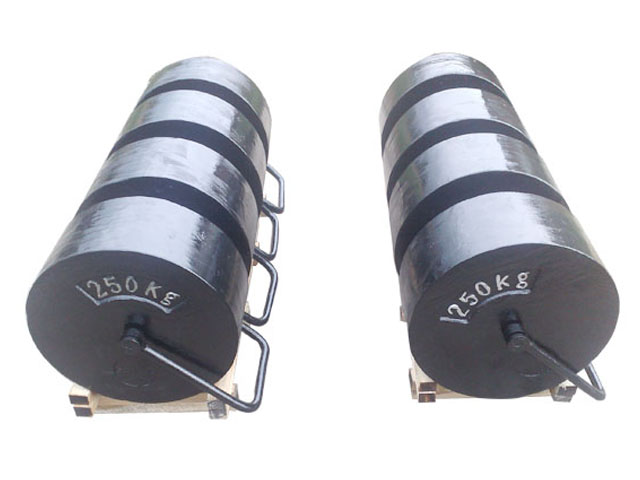
The basic design of hook test weight follows simple and practical structural logic, focusing on meeting the dual core needs of convenient suspension and stable load output. The overall structure generally consists of a solid weight main body and an integrated or assembled hook part, where the hook is carefully crafted to ensure firm connection with various tested hanging points, lifting accessories, and testing equipment connectors, while the weight main body maintains a regular and compact shape to avoid unnecessary shaking, tilting, or load deviation during the entire testing process. The surface of hook test weight is treated with smooth finishing and anti-corrosion processing to adapt to different use environments, including indoor laboratory testing spaces, outdoor construction sites, humid industrial production workshops, and long-term storage conditions. This basic structural and surface treatment design ensures that the test weight will not be affected by external environmental factors such as temperature changes, air humidity, and minor mechanical friction during long-term repeated use, keeping its physical state and load application effect stable and consistent in each test cycle. Even after frequent hanging, dismounting, and moving operations, a well-made hook test weight can maintain its overall structural integrity and basic performance without obvious deformation or functional failure.
Material selection is one of the most critical factors that determine the practical performance and service life of hook test weight, directly affecting the accuracy of load application and the stability of long-term repeated use. Most qualified hook test weight products are made of high-density, uniform texture metal materials with good compression resistance and deformation resistance, which can ensure that the actual load generated by the test weight remains consistent with the preset standard value without subtle changes due to internal material structure loosening or external force extrusion. Materials used for production need to have strong anti-oxidation and anti-rust properties, because many load testing work is carried out in open-air or semi-open working environments, where moisture, dust, and slight chemical corrosion may exist for a long time. If the material lacks anti-corrosion ability, the surface of the test weight will gradually rust and peel off over time, leading to changes in overall mass and uneven stress on the structure, which will further affect the accuracy of each load test result and even cause misjudgment of the performance of tested equipment and structures. In addition, the selected materials need to have good overall density uniformity, avoiding internal hollow areas or uneven density distribution, so that the center of gravity of the hook test weight remains stable during suspension, preventing lateral swing or load offset during the test and ensuring that the load acts vertically and evenly on the tested parts as required by the testing standards.
The application scope of hook test weight covers almost all scenarios that require static load detection and dynamic load simulation verification, involving multiple industry fields closely related to production safety and structural reliability. In the construction industry, hook test weight is commonly used to test the bearing performance of building suspension components, including suspension brackets, ceiling hanging parts, curtain wall connecting pieces, and temporary construction suspension facilities. Before these structural parts are officially put into use in building construction projects, it is necessary to apply continuous and stable load through hook test weight for a certain period of time to observe whether the components have permanent deformation, connection loosening, structural cracking, or displacement exceeding the allowable range. Through such testing work, construction personnel can effectively eliminate potential safety hazards caused by unqualified component quality or unreasonable installation construction, ensuring that all suspension structures in building projects can bear the designed load safely during long-term use and avoid structural accidents caused by insufficient bearing capacity.
In the machinery manufacturing and equipment production industry, hook test weight plays an indispensable role in the factory inspection and regular maintenance testing of lifting and hoisting equipment. Various small and medium-sized lifting tools, electric hoists, manual cranks, and supporting lifting connection accessories need to undergo strict load simulation tests before leaving the factory. By hanging different specifications of hook test weight step by step, testers can detect whether the lifting equipment can run smoothly under rated load conditions, whether the braking system can respond effectively and lock stably, whether the transmission parts have abnormal friction or stuck phenomena, and whether the connecting structures of each part are firm and reliable. For equipment that has been put into long-term production and use, regular testing with hook test weight can help maintenance personnel timely discover fatigue damage, part aging, and connection loosening problems that are not easy to detect in daily use, so as to carry out targeted maintenance and replacement work in advance, prevent equipment failure during production and operation, and maintain the continuity and stability of industrial production work.
Laboratory scientific research and teaching experimental work also rely heavily on hook test weight to carry out mechanical principle verification and material performance research. In physics mechanics experiments and material mechanics research projects, researchers and teaching staff need to apply accurate and controllable tension and pressure loads to experimental samples such as metal materials, plastic parts, and composite materials. Hook test weight can provide stable and standard load force under static conditions, helping experimenters observe the deformation law, stress distribution characteristics, and fatigue resistance of different materials under different load levels. Through repeated experiments with hook test weight, relevant mechanical data can be accumulated, providing reliable basic data support for material improvement research, mechanical structure optimization design, and professional teaching demonstration. The good stability and easy operation of hook test weight make it a common and basic experimental tool in various scientific research and teaching laboratories, helping researchers and students intuitively understand the basic laws of mechanical load bearing and material stress changes.
The standardized operation of hook test weight in the testing process is the key to ensuring accurate test results and personal and equipment safety. Before each formal test, testers need to carefully check the overall state of the hook test weight, including whether the hook part has cracks, deformation, or wear and tear, whether the weight main body has obvious damage, corrosion shedding, or structural distortion, and whether the connecting part between the hook and the weight main body is firm and without loosening. Any small damage or abnormal state of the test weight may lead to load deviation during the test, and in serious cases, it may cause the test weight to fall off during the load-bearing process, causing safety risks to on-site personnel and testing equipment. After the inspection of the test weight itself is completed, it is also necessary to check the tested hanging point and connecting parts to confirm that the connection position is firm, the stress direction is vertical and reasonable, and there is no obstacle interference or uneven stress distribution, so as to ensure that the load applied by the hook test weight can completely act on the tested object according to the test requirements.
During the formal load testing process, the placement and hanging of hook test weight need to be carried out slowly and steadily, avoiding rapid hoisting, sudden release, and violent collision operations. Rapid operation will generate instantaneous impact load, which is different from the static load required by the test standard, resulting in inaccurate test data and failure to reflect the actual bearing performance of the tested object under normal working conditions. In the process of load maintenance, testers need to observe the state of the tested object and the hook test weight in real time, record the deformation changes and structural state of the tested object within the specified load-bearing time, and make detailed and accurate test records. After the test is completed, the hook test weight should be unloaded slowly in the reverse order, and it is not allowed to unload quickly or knock the test weight at will. After all testing work is finished, the test weight should be cleaned of surface dust and stains in time, and placed in a dry and flat storage area to avoid long-term stacking, extrusion, and exposure to humid and corrosive environments, so as to maintain the good performance of the test weight for a long time.
Daily maintenance and regular inspection management of hook test weight are essential to extend its service life and maintain the stability of test accuracy. Even hook test weight with good production quality will gradually experience minor wear and aging after long-term repeated use and environmental impact, so it is necessary to formulate a reasonable daily maintenance system. In daily management, the surface of the test weight should be kept clean and dry regularly, anti-rust protection treatment should be carried out for the metal surface according to the use frequency and environmental conditions, and the hook connection part should be regularly checked for wear and deformation. For hook test weight that has been used for a long time or frequently, regular professional calibration and performance inspection should be arranged to confirm that the actual load value of the test weight is consistent with the standard value, and there is no mass deviation or structural performance change. Once the test weight is found to have serious deformation, obvious corrosion, loose connection, or excessive mass deviation during the inspection, it should be stopped immediately and replaced or repaired in a timely manner, and it is strictly prohibited to use unqualified test weight for load testing work to avoid inaccurate test results and potential safety hazards.
In the whole field of load testing and structural performance verification, hook test weight may seem simple in structure and basic in function, but it undertakes the important basic work of data reference and safety verification that cannot be replaced by other testing tools. All industrial production, construction engineering, scientific research and teaching work related to load-bearing safety need to rely on the stable performance and accurate load application of hook test weight to complete performance detection and risk assessment. With the continuous development of various industries and the continuous improvement of safety production and structural use standards, the requirements for the accuracy, stability and durability of hook test weight are also constantly improving. Paying attention to the reasonable selection, standardized use, scientific maintenance and regular inspection of hook test weight is not only an important part of ensuring the accuracy of load testing work, but also a key link to maintain production safety, structural use reliability and experimental research authenticity. Every practitioner engaged in testing, production, construction and scientific research should fully understand the important value of hook test weight, strictly abide by relevant operation and maintenance specifications, and give full play to the basic role of hook test weight in various load testing work, so as to lay a solid foundation for the safe and stable operation of various projects and equipment.
Hook Test Weight
https://www.veidtweighing.com/test-weight.html
Post Date: May 4, 2026
https://www.supplier-manufacturer.com/test-weight/hook-test-weight.html

![Laboratory Weight Set]()
Laboratory Weight Set
In every laboratory environment dedicated to scientific research, experimental analysis, quality inspection, and academic teaching, consistent and dependable mass measurem…![500g Stainless Steel Weight]()
500g Stainless Steel Weight
A 500g stainless steel weight stands as one of the most fundamental and widely utilized weighing auxiliary tools across countless professional sectors, daily operational s…![Stainless Steel Cylindrical Calibration Weight All Sizes]()
Stainless Steel Cylindrical Calibration Weight All Sizes
Stainless steel cylindrical calibration weights serve as fundamental metrological tools across laboratory research, industrial production, commercial measurement, and qual…![M1 Class Stainless Steel Weight]()
M1 Class Stainless Steel Weight
In the intricate and interconnected world of modern measurement and industrial operation, maintaining consistent and dependable weighing results stands as a foundational r…![Polished Stainless Steel Precision Weighing Weight]()
Polished Stainless Steel Precision Weighing Weight
Polished stainless steel precision weighing weights stand as essential foundational tools in the field of metrology, serving a core role in calibrating weighing equipment,…