Moisture Analytical Balance
Moisture content stands as one of the most fundamental physical attributes for countless raw materials, semi-finished goods, and finished products across diverse industrial and scientific sectors. The subtle variation in moisture proportion can noticeably affect material stability, physical texture, chemical reactivity, and storage durability, which makes accurate moisture detection an indispensable part of laboratory analysis and industrial quality control. A moisture analytical balance serves as a specialized analytical instrument designed to quantify moisture percentages in various samples through standardized physical or chemical detection approaches. Differing from conventional weighing balances that merely record static sample mass, this integrated device combines high-precision weighing modules with controllable heating or reaction systems, enabling continuous monitoring of mass changes during moisture elimination and delivering reliable moisture data for qualitative and quantitative analysis. Its widespread utilization covers food processing, chemical production, pharmaceutical research, agricultural inspection, and new material development, offering consistent technical support for raw material screening, production parameter adjustment, and finished product qualification verification.
The operational logic of a moisture analytical balance mainly derives from two mature detection principles, with the loss-on-drying method being the most commonly adopted mechanism for routine testing. This principle relies on the physical separation of moisture from sample components through controlled thermal treatment. Under a stable heating environment, free moisture contained in solid or viscous samples gradually evaporates, and the internal high-sensitivity weighing sensor records real-time mass fluctuations of the sample throughout the heating process. When the sample mass maintains a steady state without further reduction, it indicates the complete evaporation of free moisture. The system then calculates the moisture proportion by comparing the initial sample mass with the constant dry mass. Another mainstream detection principle is the chemical reaction-based method, which depends on the quantitative chemical reaction between moisture and specific reagents. Within a closed reaction chamber, trace moisture in liquid or low-moisture solid samples reacts with matched chemical reagents, and the instrument quantifies moisture content by measuring the consumption of reactive substances or electrical parameter changes generated during the reaction. These two distinct detection mechanisms cater to different sample characteristics, allowing the moisture analytical balance to adapt to diverse testing scenarios ranging from high-moisture organic samples to trace-moisture inorganic chemical materials.
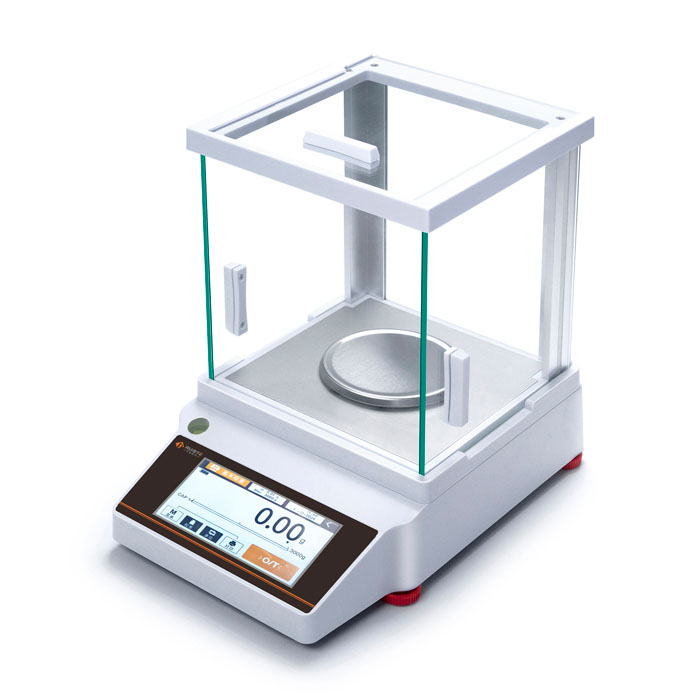
A standard moisture analytical balance consists of multiple interconnected functional modules that jointly ensure testing stability and data accuracy. The high-precision weighing unit acts as the core component, equipped with a sensitive sensing structure capable of capturing tiny mass variations. This unit maintains stable detection performance under subtle temperature fluctuations and minor external vibration interference, laying a solid foundation for credible moisture calculation. The heating module, a key auxiliary component for the loss-on-drying method, adopts uniform heat emission structures to form a balanced temperature field inside the heating chamber. The adjustable temperature setting function allows operators to set appropriate heating temperatures according to sample thermal tolerance, effectively avoiding sample decomposition, oxidation, or internal structural damage caused by excessive heating. Sealed reaction chambers are configured for chemical reaction-based detection models, isolating internal reaction environments from external air to prevent interference from ambient moisture and gas impurities. Additionally, the instrument integrates an intelligent control panel, a data display interface, and a data transmission port. The control panel enables manual parameter configuration including heating duration, constant temperature value, and testing termination conditions; the display interface intuitively presents real-time sample mass, elapsed testing time, and dynamic moisture proportion; the transmission port supports data export to external storage devices or computer terminals for subsequent data sorting, archiving, and comparative analysis.
Standardized operational procedures are essential to reduce human-induced detection errors and ensure repeatable testing results when using a moisture analytical balance. Before initiating each test, operators need to place the instrument on a horizontal vibration-isolation platform, keeping the surrounding environment dry and ventilated to avoid direct sunlight and corrosive gas exposure. Preheating treatment is necessary to stabilize the internal temperature and sensor sensitivity, eliminating residual interference from previous testing cycles. The sample preparation process requires strict compliance with uniform sampling standards: solid samples need crushing and grinding to form fine particles with consistent particle size, while viscous samples require even stirring to ensure component homogeneity. Such pretreatment measures enable uniform heat penetration or reagent contact during detection, improving the comprehensiveness of moisture separation and reaction. An appropriate sample weight should be selected based on sample density and moisture range; excessive sample stacking may lead to incomplete internal moisture evaporation, while an overly small sample volume can amplify accidental detection errors. After placing the sample in a clean inert container and positioning it steadily on the weighing platform, operators close the protective cover to isolate the internal testing space and set customized testing parameters. Once the test starts, the system automatically records data without manual intervention, and the testing process can be observed in real time through the display interface. When the system judges that the sample mass reaches a constant state, it automatically terminates the test and generates final moisture data.
Moisture analytical balances exhibit extensive application value in multiple industries due to their flexible detection modes and stable performance. In the food industry, these instruments detect moisture in grain crops, flour products, dried fruits, meat products, and condiments. Reasonable moisture control inhibits microbial reproduction, extending food shelf life while maintaining optimal taste and texture. For agricultural production, they test moisture in seeds, forage, and soil samples, providing data support for seed storage condition adjustment and farmland irrigation planning. In the chemical industry, the instrument detects moisture in organic solvents, chemical powders, and polymer raw materials. Trace moisture in chemical reagents often affects reaction efficiency and product purity, so precise detection helps stabilize industrial production processes. The pharmaceutical sector utilizes moisture analytical balances to inspect medicinal raw materials, intermediate products, and finished tablets. Excessive moisture may trigger drug deterioration and reduce medicinal efficacy, making regular moisture monitoring a key link in pharmaceutical quality management. Moreover, in material research laboratories, researchers apply the instrument to analyze moisture changes in new composite materials, ceramic raw materials, and battery materials, exploring the correlation between moisture content and material physical and chemical properties to optimize material formulation and production processes.
To maintain long-term stable performance and extend the service life of a moisture analytical balance, daily maintenance and standardized storage management are indispensable. Regular surface cleaning should be conducted after each use, with dry soft cloths used to wipe dust and residual sample contaminants from the weighing platform, heating chamber, and shell. Corrosive cleaning agents are strictly prohibited to prevent erosion of internal precision components and surface protective layers. The heating module requires periodic inspection of heat emission components to check for uneven heating or aging attenuation, ensuring consistent temperature control accuracy during repeated use. For instruments adopting chemical reaction detection structures, the reaction chamber and electrode components need regular cleaning and replacement of consumable reagents to avoid residual reaction products affecting subsequent detection results. The instrument should be stored in a dry constant-temperature environment when not in use, avoiding long-term exposure to humid air that may cause sensor dampness and circuit aging. External vibration and strong electromagnetic interference should also be kept away to prevent permanent damage to high-precision sensing structures. In addition, regular calibration is required at fixed intervals to revise weighing deviation and temperature control errors, ensuring that detection data remains within a reasonable error range for a long time.
Despite mature structural design and stable detection performance, moisture analytical balances still have inherent limitations that require rational attention during practical application. Physical drying detection is not suitable for heat-sensitive samples that are prone to decomposition or oxidation under high-temperature conditions, as high heating temperature may damage sample structures and generate volatile substances other than moisture, leading to biased detection data. Chemical reaction detection methods are restricted by reagent compatibility, making them inapplicable for samples that can undergo side reactions with testing reagents. Meanwhile, ambient environmental factors including ambient temperature, air humidity, and atmospheric pressure can exert subtle impacts on detection precision. Excessively high external air humidity may cause moisture adhesion on low-temperature sample surfaces, while drastic temperature fluctuations can affect sensor sensitivity. In addition, manual operation errors such as inconsistent sample particle size, uneven sample spreading, and inaccurate parameter setting will also reduce result repeatability. Therefore, operators need to select appropriate detection modes based on sample characteristics, strictly abide by operating specifications, and set blank control groups for comparative testing to eliminate external interference and improve result authenticity.
With the continuous advancement of laboratory intelligence and industrial automation technology, moisture analytical balances are evolving toward integrated design, intelligent control, and diversified compatibility. Modern optimized models adopt compact integrated structures to reduce space occupation while optimizing internal airflow and heat conduction paths, further improving heating uniformity and moisture separation efficiency. Intelligent algorithm systems can automatically identify sample drying endpoints, adjust heating rates dynamically according to real-time mass change curves, and reduce unnecessary energy consumption. The expansion of data interaction functions enables seamless connection with intelligent laboratory management systems, realizing one-click data recording, sorting, and cloud storage to meet standardized data management requirements of scientific research institutions and large-scale enterprises. In terms of application adaptation, upgraded instruments are equipped with detachable sample containers and replaceable reaction modules, which can meet the detection demands of solid, liquid, and colloidal samples without complex structural modification. These technological improvements continuously enhance the practicability and universality of moisture analytical balances, enabling them to adapt to increasingly complex detection scenarios in modern industrial production and scientific research.
In summary, moisture analytical balances act as vital analytical and testing instruments in modern industrial production and scientific research systems. Through simple and efficient physical drying or precise chemical reaction mechanisms, they achieve quantitative detection of moisture content in diverse samples. Their simple operational logic, stable detection performance, and wide application coverage make them indispensable equipment in quality control laboratories, research institutions, and production workshops. Standardized operation procedures and daily maintenance measures effectively maintain instrument stability, while continuous technological optimization keeps improving detection efficiency and data accuracy. In future industrial upgrading and material research development, moisture analytical balances will continue to play an irreplaceable role, providing accurate and reliable moisture data for raw material screening, production process optimization, product quality improvement, and scientific experimental research, and laying a solid technical foundation for the standardized and refined development of various industries.
Moisture Analytical Balance
https://www.pruiste.com/analytical-balance.html
Post Date: May 19, 2026
https://www.supplier-manufacturer.com/analytical-balance/moisture-analytical-balance.html

![Digital Viscometer NDJ SERIES]()
Digital Viscometer NDJ SERIES
NDJ series viscometer has 2 optional keys and touch screen. The whole series balance adopts high precision sensor, microcomputer control and one key fast measurement. The …![Electronic Balance JA SERIES]()
Electronic Balance JA SERIES
The JA series uses high-definition buttons, and the entire series of balances uses Nuosheng sensors and brand sensors to ensure high accuracy and stability of weighing res…![Online Digital Viscometer]()
Online Digital Viscometer
Viscosity stands as one of the most fundamental physical properties of fluid substances, reflecting the internal frictional resistance that occurs when a fluid flows and d…![Digital Viscometer Supplier]()
Digital Viscometer Supplier
Viscosity stands as one of the most fundamental physical properties of fluid materials, reflecting the internal frictional resistance that occurs when a fluid flows or und…![Portable Digital Viscometer]()
Portable Digital Viscometer
Viscosity stands as one of the most fundamental physical properties of fluid substances, reflecting the internal friction and flow resistance that occurs when liquids move…