Painted Cast Iron Weight
Painted cast iron weight stands as a fundamental and reliable physical object deeply integrated into industrial production, daily operational debugging, mechanical balancing, and conventional weighing verification work, carrying the basic function of maintaining mass stability and realizing force balance in various practical scenarios. For decades, this kind of weight has maintained a steady presence in different working environments, not relying on fancy design or complex auxiliary structures, but relying on the inherent physical properties of cast iron materials and the protective and decorative effects of professional painted surfaces to form a practical and durable product form that adapts to diverse use needs. Unlike lightweight metal counterweights that are prone to deformation and plastic weights that lack long-term stability, painted cast iron weights strike a proper balance between structural solidity, mass uniformity, and environmental adaptability, making them a common and essential auxiliary tool in many production, processing, and measurement links around daily industrial and civilian operations.
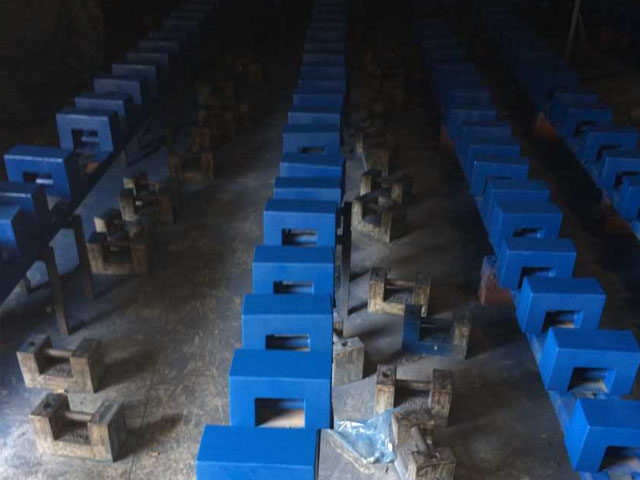
The core foundation of every painted cast iron weight lies in the inherent characteristics of cast iron as the base material, a material with a long application history in engineering and manufacturing fields that has been continuously optimized and inherited in the production of standard weights. Cast iron features a relatively low melting point and excellent fluidity during the casting process, which allows the molten raw material to fully fill every corner of the prefabricated mold, forming weight blanks with uniform internal structure and consistent external contours without obvious internal gaps or hollow areas that affect mass accuracy. The chemical composition of conventional cast iron used for weight production contains a reasonable proportion of carbon and silicon elements, which endows the material with good machinability and strong resistance to deformation and wear in subsequent processing and long-term use. This material will not produce obvious mass deviation due to slight external extrusion or conventional friction during daily handling and placement, and its internal molecular structure remains stable under normal temperature and conventional humidity conditions, ensuring that the basic mass of the weight can stay consistent for a long time after production and processing are completed. Such stable material performance lays a solid prerequisite for painted cast iron weights to perform weighing calibration, mechanical counterbalancing, and other core functions steadily over years of repeated use.
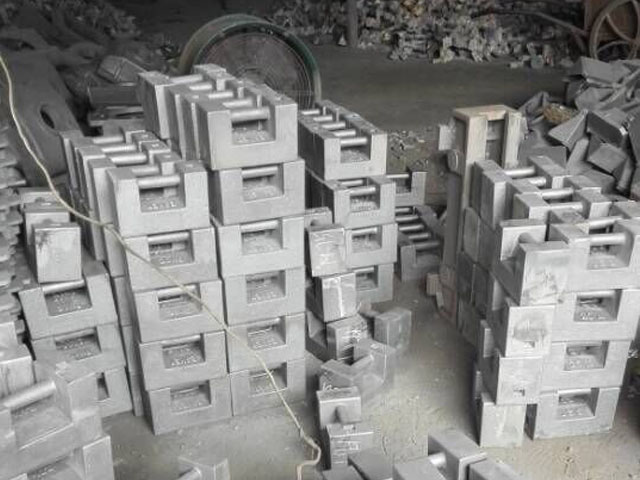
The production process of painted cast iron weights follows rigorous and standardized casting and processing steps, starting with the preparation of professional sand molds tailored to different shape and volume requirements. Sand casting technology, which has been widely used in the production of such weights, can create weight blanks of various conventional shapes, including block, cylindrical, and styles with integrated handles for easy manual carrying and moving. After the molten cast iron is poured into the mold and fully cooled and solidified, the preliminary weight blank is formed, and then follow-up finishing processes are carried out one by one. Workers remove excess burrs and uneven edges on the surface of the blank through polishing and grinding work, making the overall outline of the weight smooth and neat, avoiding sharp corners that may cause scratches during handling, and also creating a flat and smooth base surface for the subsequent painting process. After surface finishing, each weight undergoes fine mass adjustment, with workers carefully trimming the local part of the blank to make the actual mass of each finished piece match the preset nominal mass standard. This fine adjustment work is meticulous and requires careful repeated detection and slight modification to ensure that every painted cast iron weight can meet the basic mass consistency required for subsequent use, whether it is used for simple daily weighing detection or regular calibration of industrial weighing equipment.
The painting process is a key subsequent processing link that distinguishes painted cast iron weights from ordinary bare cast iron weights, and it undertakes dual core tasks of surface protection and visual identification. Before formal painting, the surface of the cast iron weight blank will go through thorough dust removal, oil removal, and rust prevention pretreatment, ensuring that the cast iron surface is clean and dry without any impurities that may affect paint adhesion. Only after the surface pretreatment meets the basic requirements can the professional protective paint be evenly sprayed on the surface of the weight multiple times. The paint selected for this kind of weight is specially adapted to the characteristics of cast iron materials and daily use environments, with good adhesion, chip resistance, and anti-corrosion performance. After the paint is sprayed and naturally air-dried or properly cured, a uniform and compact protective film is formed on the entire surface of the weight, completely isolating the cast iron base material from the external air, moisture, and various corrosive substances that may exist in the working environment. In many industrial workshops, outdoor operation sites, and storage environments with relatively high humidity, bare cast iron products are prone to oxidation and rust over time, which not only changes the surface state of the weight but also may cause slight changes in mass due to rust accumulation and material corrosion, affecting the accuracy of use. The painted layer effectively avoids such problems, slowing down the aging and corrosion speed of the cast iron base material and greatly extending the overall service life of the weight.
In addition to the core protective function, the painted surface of cast iron weights also plays a practical role in visual classification and convenient management. Different paint colors can be used to distinguish weights of different nominal mass specifications or different use purposes, making it easier for operators to quickly identify and select the required weights in the working process without spending extra time on repeated mass confirmation. In large industrial production workshops, laboratory measurement rooms, and warehousing and logistics weighing stations, multiple types of cast iron weights with different specifications are often used and stored in a centralized manner. The painted colors with obvious distinguishing effects can help staff complete sorting, placement, and use work efficiently, reducing the probability of mixing different weights and avoiding operational errors caused by misselection. At the same time, the smooth and uniform painted surface also makes the daily cleaning and maintenance of the weight more convenient; dust, stains, and sundries attached to the surface can be wiped off simply and quickly, and the surface state of the weight can be kept neat for a long time, which is not only conducive to maintaining the overall appearance but also ensures that the surface will not be affected by dirt accumulation to cause local corrosion or mass change.
The application scenarios of painted cast iron weights cover a wide range of fields, spanning industrial production, commercial weighing, laboratory testing, mechanical equipment debugging, and many other links, showing strong practical versatility. In industrial manufacturing plants, these weights are often used for mechanical counterbalancing work, providing stable gravity support for large mechanical equipment, production processing devices, and transmission components to maintain the stable operation of the equipment and avoid mechanical vibration or operational deviation caused by unbalanced mass distribution. Many mechanical devices need to rely on fixed counterweights to maintain structural balance during operation, and painted cast iron weights are favored for their solid structure and stable mass, becoming a conventional matching part for mechanical debugging and equipment commissioning. In various commercial weighing occasions, such as market weighing stations, logistics cargo weighing areas, and commodity distribution and measurement links, painted cast iron weights are used for regular detection and debugging of various weighing tools, ensuring that the weighing data of scales and other equipment is accurate and reliable, and maintaining the fairness and standardization of commercial measurement work.
In laboratory environments and quality inspection departments, painted cast iron weights undertake the important work of daily calibration of weighing instruments and experimental mass comparison testing. Many experimental projects and quality detection work require accurate weighing data as the basis, and regular calibration of weighing equipment with stable and consistent standard weights is an essential step to ensure the accuracy of experimental results and detection data. The stable material properties and reliable painted protection of painted cast iron weights enable them to maintain stable performance in laboratory environments with constant temperature and conventional humidity, and they can be used for long-term repeated calibration work without frequent replacement due to performance attenuation. In addition, in daily life and small-scale production and processing scenarios, such as small processing workshops, farm product weighing and statistics, and household simple mechanical debugging, painted cast iron weights also play a practical role, meeting the basic mass weighing and counterbalancing needs of different groups of people with their simple structure and easy operation.
The handling and storage design of painted cast iron weights fully considers the actual needs of daily use and long-term storage, and most finished products are designed with integrated grip handles or convenient stress parts for carrying. This structural design allows operators to move, place, and stack the weights safely and laboriously, avoiding safety risks such as hand slipping and collision damage that may occur during handling. During daily use, as long as simple standardized operation is followed, such as avoiding violent throwing and severe impact, the structural integrity and painted surface state of the weight can be well maintained. For long-term storage, it is only necessary to place the painted cast iron weights in a dry, ventilated, and flat storage area, avoiding long-term stacking in damp, corrosive, or high-temperature environments. Simple daily maintenance work can keep the performance of the weights stable for a long time, without complex maintenance procedures or high maintenance costs, which is also an important reason why painted cast iron weights have always maintained high cost performance and strong practicability in various fields.
Over the long period of practical application, painted cast iron weights have been continuously optimized in production technology, surface painting technology, and structural design according to the actual feedback of different use scenarios, always adapting to the changing market demand and use environment. With the continuous development of industrial production and measurement technology, the requirements for the stability and durability of basic weighing and counterbalancing auxiliary tools are constantly improving, and painted cast iron weights have been continuously improved in material ratio, casting precision, and paint quality, always maintaining stable and reliable use performance. Although various new material counterweight products have appeared on the market in recent years, painted cast iron weights still occupy an irreplaceable position in many conventional and professional scenarios by virtue of their mature production technology, stable material performance, good environmental adaptability, and simple maintenance characteristics.
From the most basic material casting and fine processing to the key surface painting protection and later convenient use and maintenance, every link of painted cast iron weights is closely around the core demand of maintaining stable mass and durable use. It is not a complicated high-tech product, but it is an indispensable basic auxiliary tool in modern production, measurement, and mechanical operation links. Its value lies in long-term stable performance, reliable environmental adaptability, and convenient and efficient use experience. Whether in large-scale industrial production lines, professional laboratory detection rooms, or daily commercial and civilian use scenarios, painted cast iron weights always maintain a down-to-earth and practical product attribute, steadily providing basic mass guarantee and balance support for all kinds of work, and silently supporting the smooth progress of various production and measurement work behind the scenes.
Painted Cast Iron Weight
https://www.veidtweighing.com/cast-iron-weights.html
Post Date: May 4, 2026
https://www.supplier-manufacturer.com/cast-iron-weight/painted-cast-iron-weight.html

![Commercial Scales]()
Commercial Scales
Commercial scale represents the critical transition from experimental, small-batch, or prototype-based production to systematic, market-oriented operation that meets stead…![Working Principle of Cast Iron Weight]()
Working Principle of Cast Iron Weight
Cast iron weights stand as fundamental functional components widely applied in industrial measurement, mechanical calibration, weighing equipment debugging, and physical f…![Pocket Scales]()
Pocket Scales
In an era where portability and precision have become essential elements of modern life, compact weighing devices have emerged as practical tools that bridge the gap betwe…![Painted Cast Iron Weight]()
Painted Cast Iron Weight
Painted cast iron weight stands as a fundamental and reliable physical object deeply integrated into industrial production, daily operational debugging, mechanical balanci…![Textile Balances]()
Textile Balances
Textile balance stands as one of the most fundamental and profound concepts within the entire textile industry, weaving through every stage of fiber processing, fabric for…