Working Principle of Cast Iron Weight
Cast iron weights stand as fundamental functional components widely applied in industrial measurement, mechanical calibration, weighing equipment debugging, and physical force testing scenarios, serving as reliable mediums for mass comparison and force transmission in various precision and conventional measurement environments. The core working logic of these cast iron-based counterweights is rooted in basic physical laws related to mass stability, gravitational force action, and mechanical force balance, supplemented by the unique physical and chemical properties of cast iron materials and standardized casting forming processes, which together ensure that each cast iron weight can maintain stable mass output and consistent force conduction for a long time in different application environments. Unlike temporary weighted objects made of ordinary materials, cast iron weights are not simple solid metal blocks; their design, production, and actual application all follow a complete set of inherent scientific principles, covering material density matching, internal structural stability, external force balance adaptation, and environmental interference resistance, all of which jointly support their basic functions of mass reference and mechanical counterweight in daily industrial and measurement work. To fully understand the working principle of cast iron weights, it is necessary to start from the basic physical relationship between mass and gravity, then extend to the material characteristics of cast iron that determine weight stability, the structural design logic formed by casting processing, the force transmission mechanism in actual use, and the adaptive adjustment principle under different external environmental conditions, so as to clarify why cast iron has become a preferred material for manufacturing standard weights and how these weights maintain accurate and reliable working effects in long-term repeated use.
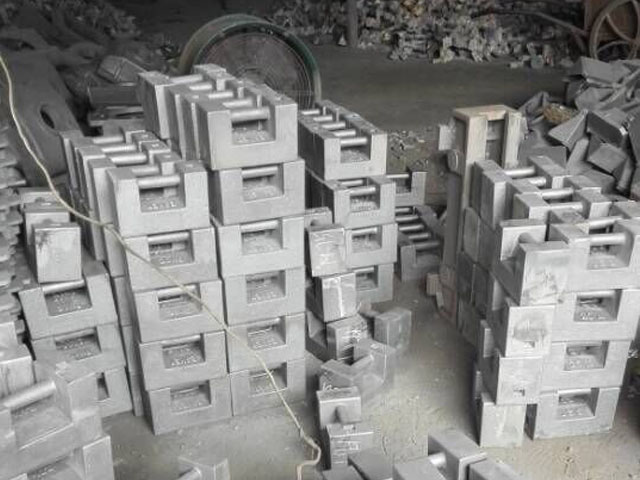
At the most basic physical level, the working foundation of every cast iron weight relies on the universal gravitational effect and the inherent invariance of material mass under conventional stable environmental conditions. In the same fixed geographical area, the gravitational acceleration remains relatively constant, so the gravitational force generated by any object is directly proportional to its own mass, and this stable proportional relationship constitutes the core premise for cast iron weights to realize weighing calibration and counterweight balancing. The essential role of a cast iron weight is to provide a fixed and known mass reference value. When applied to weighing equipment calibration, mechanical load testing, or balance adjustment of various mechanical devices, the gravitational force generated by this fixed mass acts on the stress-bearing surface of the corresponding equipment or structure, forming a stable downward acting force. This acting force interacts with the elastic support force, lever transmission force, or sensor induction force inside the equipment, and finally reaches a mechanical balance state, completing the measurement comparison or load adjustment work. The mass of the cast iron weight itself is determined by the product of the material density and the solid volume formed after casting and finishing processing. Cast iron materials used for weight production have stable and uniform internal density distribution after smelting and casting, with no obvious internal gaps or heterogeneous material mixing, which ensures that the actual mass of the finished weight is highly consistent with the theoretical calculated mass, avoiding mass deviation caused by uneven material density that would affect the normal working effect of the weight.
The material characteristics of cast iron are key prerequisites for supporting the long-term stable operation of cast iron weights and are an important part of their overall working principle. Cast iron is an iron-based alloy mainly composed of iron, carbon, and silicon elements, with a reasonable proportion of other trace elements added during the smelting process. This material formula gives cast iron excellent comprehensive physical properties suitable for weight manufacturing, including high bulk density, good structural compactness, strong compressive resistance, and stable chemical inertness. High density allows cast iron to form a standard mass requirement with a relatively small solid volume, making the overall structure of the weight compact and easy to carry, place, and stack in actual use, while avoiding excessive volume and space occupation caused by low density of other materials. Good structural compactness means that there are almost no penetrating pores or loose structures inside the cast iron after casting and cooling molding. A dense internal structure can effectively prevent external moisture, dust, and corrosive gases from penetrating into the interior of the weight, avoiding internal material corrosion, volume expansion, or local mass loss caused by environmental erosion, which would lead to changes in the overall mass of the weight and weaken its working accuracy. Strong compressive resistance enables cast iron weights to withstand repeated stacking, placing, and slight external impact during long-term use without permanent deformation or structural damage. Once the weight is deformed, its overall volume and stress-bearing area will change, directly affecting the stability of mass output and force transmission, and damaging the balance effect in measurement and counterweight work. In addition, cast iron has relatively stable chemical properties, and it does not easily undergo intense chemical reactions with conventional air, humidity, and common industrial contact media. The slow surface oxidation reaction that occurs in the natural environment only forms a thin protective oxide layer on the surface, which will not cause obvious changes in the overall mass and internal structure of the weight, ensuring that the weight can maintain stable working performance for many years.
The casting forming and subsequent finishing processing principles further optimize the working performance of cast iron weights and lay a structural foundation for their accurate and stable operation. The casting process of cast iron weights follows the basic law of metal liquid cooling and solidification. The molten cast iron liquid smelted according to the fixed material ratio is poured into a prefabricated standard mold, and after natural cooling and gradual solidification, it forms a preliminary weight blank with a fixed shape and basic volume. The mold design strictly follows the standard volume and structural size requirements, ensuring that each batch of weight blanks has consistent external dimensions and internal solid structure, avoiding individual structural differences leading to inconsistent mass benchmarks. During the cooling and solidification process of cast iron liquid, the internal shrinkage rate is accurately controlled by adjusting the cooling speed and ambient temperature, reducing internal shrinkage cavities and microscopic gaps as much as possible, and further improving the compactness of the weight structure. After the preliminary casting blank is formed, subsequent finishing and fine-tuning processes are carried out. The main purpose of this link is to slightly remove redundant materials on the surface of the weight, accurately adjust the overall mass to reach the required standard reference value, and at the same time smooth the surface and edges of the weight to ensure that the weight has a flat and stable stress-bearing contact surface when placed for use. A flat contact surface can make the cast iron weight evenly bear force and transmit force vertically downward when acting on weighing equipment or mechanical structures, avoiding force deviation caused by uneven contact surface, tilting placement, or local stress concentration, which would lead to inaccurate balance results and affect the normal working effect of the weight. The structural design of integrated casting and integral molding also ensures that the cast iron weight has overall structural integrity, no loose assembly parts, no relative displacement between internal components during force transmission, and the force generated by mass gravity can be transmitted stably and uniformly to the stressed equipment or structure in a concentrated manner.
The core mechanical operation principle of cast iron weights is reflected in the force balance and force transmission process in actual application scenarios, which is the direct embodiment of their working function. In most common weighing calibration scenarios, cast iron weights are placed on the weighing platform of mechanical balances, electronic weighing instruments, or large-scale industrial weighing equipment. At this time, the gravitational force generated by the mass of the weight acts vertically downward on the weighing platform, and the weighing equipment generates an upward elastic support force or sensor induction feedback force on the weight. When the downward gravitational force and the upward support force reach a mutual balance, the weighing equipment can form a stable numerical feedback and complete the calibration of the equipment’s measurement accuracy. In mechanical equipment counterweight and balance adjustment work, cast iron weights are installed on the designated counterweight parts of mechanical facilities. The downward gravity generated by the weights offsets the unbalanced force generated by the eccentric structure or load deviation of the mechanical equipment itself, adjusting the mechanical operation structure to a horizontal and balanced running state, reducing mechanical vibration and operating deviation caused by unbalanced force, and ensuring the stable and normal operation of the mechanical equipment. In physical load testing and pressure resistance testing work, cast iron weights are used as graded load applying objects. By increasing or reducing the number and specification of placed weights, stable and graded fixed load pressure is applied to the tested product or structure, and the bearing capacity and structural stability of the tested object are detected through the stable force output of the weights. In all these application processes, the working principle of cast iron weights remains consistent, that is, relying on their own stable mass to generate fixed gravitational force, and using the interaction and balance between this gravitational force and other mechanical forces to complete measurement calibration, counterweight adjustment, and load testing work.
The environmental adaptation and anti-interference working principle is an important supplementary part to ensure that cast iron weights maintain stable working effects in complex and changeable use environments. In actual industrial production and measurement work, cast iron weights often need to be used in different temperature, humidity, and atmospheric environment conditions, and small changes in external environmental factors may have a certain impact on the mass and volume of metal materials. The structural and material characteristics of cast iron determine that it has good environmental adaptability. Under normal temperature changes within the conventional range, the thermal expansion and contraction coefficient of cast iron is small, and the volume change caused by temperature fluctuation is extremely slight, which will not cause obvious changes in the overall mass and gravity of the weight, so it will not affect the accuracy of measurement and counterweight work. In high-humidity or slightly corrosive working environments, the dense structure and stable chemical properties of cast iron can effectively resist moisture erosion and slight corrosion, avoiding mass loss or structural damage caused by material deterioration. Even if a small amount of moisture adheres to the surface of the weight in a humid environment, the surface treatment of the cast iron weight makes the moisture not easy to penetrate and adhere for a long time, and the surface moisture will not cause obvious changes in the overall mass of the weight after natural volatilization. In addition, cast iron weights have strong anti-aging ability, and their material properties and structural state will not change significantly with the extension of service time. After long-term use, they can still maintain stable mass and force transmission effects, avoiding frequent replacement and repeated calibration caused by performance attenuation, and ensuring the continuity and stability of long-term measurement and counterweight work.
It is also essential to understand the working principle of cast iron weights by distinguishing the essential difference between mass and weight in physical concepts and their practical application correlation. In professional measurement work, the core reference standard of cast iron weights is their own inherent mass, which will not change with the change of use location and environmental conditions, while the gravity generated by mass will have slight differences due to different gravitational acceleration in different regions. However, in actual industrial and conventional measurement scenarios, most work is carried out in a fixed geographical area, and the gravitational acceleration value is fixed and unchanged. Therefore, the fixed mass of the cast iron weight can be converted into a stable gravitational force acting effect, meeting the daily use needs of calibration and counterweight. For high-precision measurement work, fine calibration can be carried out according to the local gravitational environment, and the cast iron weight itself still maintains a stable mass benchmark, which will not be affected by external gravitational conditions. This working mode of taking mass as the fixed core and gravity as the external acting force enables cast iron weights to adapt to different precision measurement needs, ranging from conventional industrial rough weighing to fine equipment calibration, and can exert stable and reliable working effects.
In summary, the working principle of cast iron weights is a comprehensive system formed by the combination of basic physical gravitation laws, excellent cast iron material properties, scientific casting and finishing processes, stable mechanical force transmission and balance mechanism, and good environmental anti-interference adaptation performance. Every structural design and material selection of cast iron weights revolves around the core goal of maintaining long-term stable mass and accurate force output. From the internal material density and structural compactness to the external flat contact surface and overall structural integrity, from the basic gravitational force generation to the force balance interaction in actual use, all links are closely connected and mutually supportive. Cast iron weights do not rely on complex mechanical transmission structures or electronic induction components to work, but rely on the most stable physical and material inherent characteristics to realize simple, efficient, and durable mass reference and mechanical counterweight functions. This simple and reliable working mechanism makes cast iron weights occupy an irreplaceable position in industrial measurement and mechanical balance work, and can maintain stable and efficient working performance in various conventional and complex working environments, providing a solid basic guarantee for the accurate development of various industrial production and measurement and testing work.
Working Principle of Cast Iron Weight
https://www.veidtweighing.com/cast-iron-weights.html
Post Date: May 4, 2026
https://www.supplier-manufacturer.com/cast-iron-weight/working-principle-of-cast-iron-weight.html

![Small Gram Size Laboratory Standard Test Weight]()
Small Gram Size Laboratory Standard Test Weight
Small gram size laboratory standard test weights are essential precision tools designed to deliver accurate mass reference values for microscopic and fine-scale weighing o…![Laboratory Traceable Calibration Weight For Analytical Lab]()
Laboratory Traceable Calibration Weight For Analytical Lab
In modern analytical laboratories, the accuracy and reliability of quantitative experimental data serve as the fundamental foundation for all scientific research, material…![Standard Weight For Precision Scales]()
Standard Weight For Precision Scales
In the realm of precision measurement, standard weights stand as the foundational benchmark that upholds the accuracy, reliability, and traceability of all precision scale…![Precision Calibration Weight For Weighing Scale]()
Precision Calibration Weight For Weighing Scale
In every industry and laboratory setting that relies on accurate mass measurement, precision calibration weights serve as foundational tools to sustain the functional reli…![Calibration Weight For Electric Forklift Weighing Calibration Use]()
Calibration Weight For Electric Forklift Weighing Calibration Use
In modern industrial material handling scenarios, electric forklifts have become indispensable equipment for warehouse storage, cargo handling, and logistics distribution …