Structure of Cast Iron Weight
The structure of cast iron weight forms the fundamental foundation that determines its overall performance in industrial balancing, load stabilization, counterforce provision, and static pressure maintenance across diverse operational scenarios. Unlike ordinary cast iron components designed for mechanical movement or structural bearing, cast iron weight is engineered with a targeted structural system that prioritizes high density uniformity, dimensional stability, long-term structural integrity, and consistent mass distribution, all of which are closely tied to its metallurgical composition, internal microscopic configuration, integral solid geometric structure, surface protective formation, and auxiliary functional structural details. Every part of its structural design and formation process is optimized to meet the core demand of maintaining stable weight output and reliable structural durability under long-term static placement, frequent handling, and complex environmental exposure, making the internal and external structural layout of cast iron weight a professional and systematic engineering design rather than a simple cast iron forming process. The overall structural characteristics of cast iron weight can be comprehensively analyzed from the inherent metallurgical material structure at the microscopic level, the internal solid organizational structure inside the casting body, the external geometric physical structure that defines its shape and placement stability, the surface anti-corrosion and wear-resistant protective structure, and the transitional connection structure between different functional parts, with each structural layer influencing and cooperating with one another to ensure the cast iron weight can maintain stable physical properties and structural stability throughout its entire service cycle.
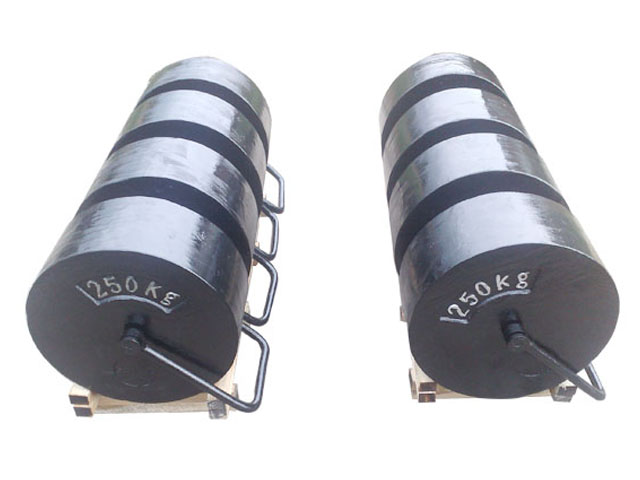
At the most fundamental microscopic level, the structural essence of cast iron weight lies in the specific metallurgical microstructure of the cast iron material selected for production, which directly determines the density consistency, internal compactness, and basic mechanical properties of the weight body. Cast iron used for weight production is primarily an iron-carbon-silicon ternary alloy, with carbon content controlled within a reasonable range between 2.1 percent and 4.5 percent and silicon content maintained from 1 percent to 3 percent, while appropriate amounts of manganese and trace elements of phosphorus and sulfur are incorporated to adjust the solidification state and internal structural compactness during the casting process. During the molten iron smelting and pouring solidification stage, the cooling rate and alloy element ratio jointly determine the distribution form of carbon in the cast iron matrix, which further shapes the core microscopic structural morphology of the weight. Most cast iron weights adopt gray cast iron as the base material, whose microscopic structure is composed of pearlite and ferrite matrix embedded with uniformly distributed graphite flakes. These graphite flakes are stably dispersed in the metal matrix instead of forming concentrated agglomerations or large structural voids, a key microscopic structural feature that endows the cast iron weight with stable overall density and good internal pressure resistance. Different from white cast iron that contains a large amount of cementite and shows high brittleness, the microscopic structure of cast iron weight avoids excessive hard and brittle cementite precipitation, preventing internal structural cracking or local fragmentation during handling and long-term static compression. Ductile cast iron is occasionally used for cast iron weights that need slight impact resistance, whose microscopic structure replaces flake graphite with spherical graphite particles evenly distributed in the ferrite and pearlite mixed matrix, enhancing the internal structural toughness while maintaining high density without changing the basic weight stability. The internal microscopic structure of qualified cast iron weight has no obvious microscopic pores, shrinkage cavities, or structural segregation, and the metal matrix and graphite phases are arranged in a balanced and uniform state, ensuring that every local position of the weight body has consistent density, avoiding mass deviation caused by uneven microscopic structure distribution, and laying a solid material structural foundation for the basic weight function of the cast iron weight.
On the basis of stable microscopic metallurgical structure, the internal solid entity structure of cast iron weight serves as the main body structure that bears mass accumulation and internal stress balance, and this internal structure is designed according to the core requirement of high compactness and low internal defect rate. The internal entity structure of cast iron weight is a continuous and integrated solid cast iron body formed by one-time pouring and solidification without any internal assembly gaps, splicing interfaces, or hollow structures in conventional standard specifications. The overall internal structure presents a dense solid state from the core center to the outer edge of the weight body, with no artificial hollow cavities or internal partition structures, ensuring that the effective volume of the cast iron body is fully converted into stable mass. During the casting solidification process, the internal structural shrinkage of the cast iron weight is precisely controlled by adjusting pouring temperature, mold cooling speed, and riser setting position, effectively avoiding the formation of concentrated shrinkage cavities, dispersed porosity, and internal cracks inside the weight body. The core area of the internal structure has the slowest cooling speed during solidification, forming the most compact metal organizational structure with uniform density distribution, while the transition area from the core to the outer layer maintains a gradual and stable structural change without abrupt differences in organizational compactness. For cast iron weights with large individual specifications, the internal solid structure adopts a balanced wall thickness design to prevent excessive local wall thickness from causing excessive solidification shrinkage and internal structural looseness, and also avoids too thin local structure leading to insufficient overall structural strength. The internal stress distribution of the solid entity structure is uniform and balanced after natural aging treatment, eliminating casting internal stress generated during rapid solidification, preventing long-term natural deformation or internal structural cracking of the weight body in subsequent use. This integrated and compact internal solid structure not only ensures that the cast iron weight has accurate and stable basic mass but also enables it to withstand long-term static load pressure and external slight vibration without internal structural damage, maintaining the long-term stability of weight performance.
The external geometric structure of cast iron weight is the intuitive structural part that determines its placement stability, stacking convenience, and handling adaptability, and all geometric structural designs are matched with the internal solid structure to achieve coordination between external shape and internal mass distribution. The overall external geometric structure of most conventional cast iron weights adopts a regular symmetrical design, commonly including cylindrical, square block, rectangular block, and disc shapes, and the symmetrical structural layout ensures that the center of gravity of the weight body coincides with its geometric center, avoiding tilting, rolling, or unstable placement caused by eccentric center of gravity. The bottom structure of the cast iron weight is designed with a flat and smooth contact surface, and the flat bottom structure increases the contact area between the weight and the placed foundation, effectively dispersing the downward pressure of the weight body, preventing sliding or tilting during static placement, and improving the overall placement safety and stability. The top structure of the cast iron weight is usually designed with a matching suspended structure or a stacked positioning structure according to actual use needs; the suspended structure is mostly a reserved integrated lifting hole or a cast lifting lug structure, which is integrally cast with the weight body without subsequent welding or assembly, ensuring the connection strength between the lifting part and the main weight body structure and avoiding structural fracture at the connection position during lifting and handling. The stacked positioning structure adopts a concave-convex matching design on the top and bottom of the weight body, so that multiple cast iron weights can be stably stacked up and down, the upper and lower structures are clamped and positioned with each other, no sliding or dislocation occurs during stacking, and the overall stacked structure remains stable. The side external structure of the cast iron weight is designed with smooth transition arcs or straight flat surfaces, avoiding sharp corners and sharp edges, which not only prevents edge chipping and local structural damage during handling and collision but also facilitates daily transportation and storage management. The dimensional proportion of the external geometric structure is scientifically matched according to the density characteristics of cast iron material, ensuring that the weight meets the standard mass requirements under reasonable volume specifications, and the overall structural shape is simple and practical, suitable for various industrial use environments and placement conditions.
The surface protective structure of cast iron weight is an important peripheral auxiliary structure attached to the outer layer of the main cast iron body, which protects the internal main structure from external environmental erosion and mechanical wear and prolongs the overall service life of the weight. The surface protective structure is divided into two parts: the base surface treatment structure and the outer coating protective structure. The base surface treatment structure is formed by post-casting finishing treatment of the outer surface of the cast iron weight, including surface polishing, burr removal, and surface pore filling treatment, which smoothes the rough casting surface, eliminates surface micro-pores and tiny cracks generated during casting, and forms a dense and flat base transition layer on the surface of the weight body. This base treatment structure can effectively prevent moisture, dust, and corrosive substances in the external environment from penetrating into the internal cast iron structure through surface pores, avoiding internal material corrosion and structural loosening caused by long-term environmental erosion. On the basis of the base treatment structure, the outer coating protective structure is uniformly covered on the entire outer surface of the weight body, forming a continuous and complete protective isolation layer. The coating structure has appropriate thickness and good adhesion, closely combined with the cast iron base surface without peeling, falling off, or local cracking, and can resist daily friction wear, atmospheric corrosion, and slight outdoor weathering erosion. The surface protective structure does not change the original geometric size and basic mass of the cast iron weight, and the coating thickness is controlled uniformly and reasonably to avoid affecting the mass accuracy and structural symmetry of the weight body. For cast iron weights used in humid or corrosive working environments, the surface protective structure adopts enhanced treatment methods to improve anti-corrosion and anti-rust performance, ensuring that the external surface structure remains intact and the internal main structure is not damaged even after long-term use in harsh environments.
The transitional connecting structure between different functional parts of cast iron weight plays a vital role in maintaining the overall structural integrity and stress transmission balance, and this part of the structure is often easily overlooked but directly affects the structural durability of the weight in long-term use. The transitional connecting structure mainly includes the connection transition part between the lifting structure and the main weight body, the transition connection between the bottom supporting surface and the side outer wall, and the structural transition between the stacked positioning part and the main body. All transitional connecting structures adopt smooth arc transition design instead of right-angle sudden change structure, which can effectively disperse local stress concentration generated during lifting, stacking, and bearing, avoid structural fatigue and local cracking at the stress concentration position after long-term repeated force application. The connection between the lifting lug or lifting hole and the main weight body adopts an integrated casting thickened transition structure, appropriately increasing the structural thickness of the connection part, enhancing the structural connection strength, ensuring that the stress generated during lifting can be evenly transmitted to the entire main weight body through the transitional structure, and preventing local structural fracture at the connection position. The transition part between the bottom supporting surface and the side outer wall adopts a rounded corner smoothing structure, reducing the impact damage caused by accidental collision during handling, and avoiding edge corner breakage affecting the placement stability and structural integrity of the weight. The transitional connecting structure between the stacked positioning part and the main body maintains consistent structural compactness with the internal solid structure of the weight body, no loose structural defects occur at the transition position, ensuring that the overall structure of the cast iron weight is integrated and unified, and all parts coordinate with each other to bear force and maintain stability.
The structural design of cast iron weight also takes into account the adaptive structural adjustment according to different application scenarios, making the overall structure highly compatible with actual industrial use requirements while maintaining basic structural stability. For cast iron weights used for mechanical equipment vibration reduction and balance stabilization, the internal solid structure maintains high density uniformity, the external geometric structure adopts a low-center-of-gravity flat design, and the surface protective structure is optimized for wear resistance to adapt to long-term vibration working conditions; for cast iron weights used for building foundation load stabilization and pressure bearing, the internal structure enhances overall compactness and pressure resistance, the bottom supporting structure is widened and thickened to improve bearing capacity, and the surface anti-corrosion structure is strengthened to adapt to outdoor construction environmental conditions; for small-specification cast iron weights used for laboratory calibration and small equipment debugging, the internal and external structures pursue high dimensional accuracy and mass consistency, the microscopic metallurgical structure is more uniform, and the external geometric structure is more precise to meet the requirements of fine weight matching. No matter how the adaptive structure is adjusted according to different scenarios, the core structural characteristics of integrated solid main body, symmetrical geometric layout, uniform microscopic organization, and complete surface protection of cast iron weight will not be changed, always taking structural stability and weight accuracy as the core design orientation.
In summary, the structure of cast iron weight is a complete and systematic structural system composed of microscopic metallurgical material structure, internal solid entity structure, external geometric placement structure, surface anti-corrosion protective structure, and transitional connecting functional structure. Each structural layer has independent functional characteristics and interacts and cooperates with each other to jointly support the core use performance of cast iron weight. The excellent structural design enables cast iron weight to maintain accurate mass output, stable placement state, good structural durability, and strong environmental adaptability in various industrial and civilian application scenarios. The continuous optimization of structural design and structural manufacturing process further improves the overall structural performance of cast iron weight, ensuring that it can always maintain reliable working effects in long-term static use, frequent handling and transportation, and complex and changeable external environments, and become a basic industrial component with stable structure and reliable performance.
Structure of Cast Iron Weight
https://www.veidtweighing.com/cast-iron-weights.html
Post Date: May 4, 2026
https://www.supplier-manufacturer.com/cast-iron-weight/structure-of-cast-iron-weight.html

![2kg Standard Weight]()
2kg Standard Weight
In the intricate and interconnected world of modern measurement science and industrial production, the consistency and reliability of every numerical data point form the i…![Precision Balance Test Weight]()
Precision Balance Test Weight
Precision balance test weights serve as fundamental reference tools in the field of mass measurement, forming the cornerstone of accurate and consistent weighing operation…![500g Standard Weight]()
500g Standard Weight
In every corner of human daily life and professional production, the concept of weight measurement exists as an invisible and fundamental foundation, shaping the way peopl…![Wheelchair Scales]()
Wheelchair Scales
Weight measurement serves as one of the most fundamental and routine health assessment methods in daily care and clinical medical work, offering intuitive data support for…![1kg Standard Weight]()
1kg Standard Weight
In the intricate and interconnected world of modern measurement science, industrial production, daily commercial transactions, and scientific research exploration, the con…