Analytical Balance FA Series
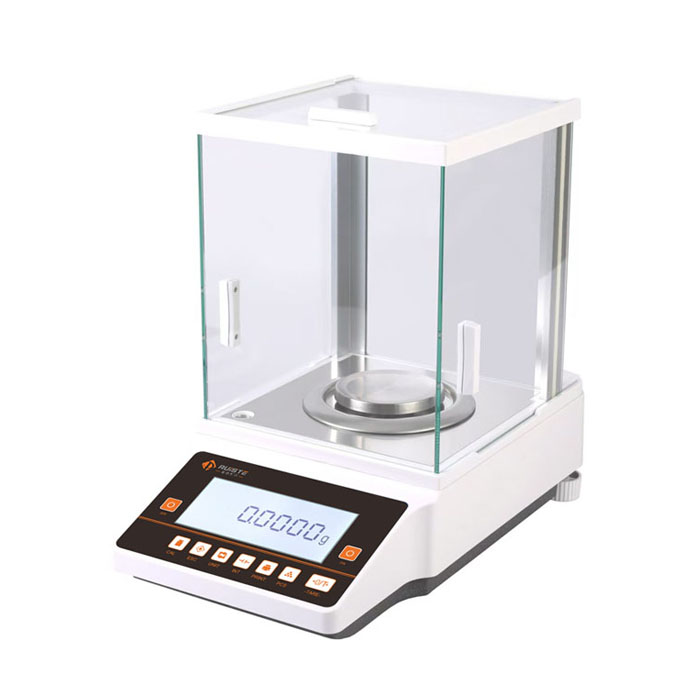
FA series electromagnetic force balance adopts key structure. The whole series balance adopts high-performance single-chip microprocessor to control high-speed CPU and special ASIC chip. The electromagnetic force Reed high-precision sensor can ensure high accuracy and stability of weighing results. This series has a one-key switching mode in Chinese and English interface, adopts a high-efficiency die-cast aluminum alloy base, the bearing base is stable and solid, and the sample of a fully transparent glass windproof cover is clearly visible. The whole machine is made of stainless steel table panels and stainless steel scales, and is made of precision cast ABS Environmental protection materials. It has weighing, counting, percentage, unit conversion time setting, and density weighing modes.
Within the controlled environments of modern laboratories, precise mass measurement stands as one of the most fundamental and essential operations across scientific research, industrial testing, and academic experimentation. Serving as a core instrument for high-precision mass detection, the analytical balance has become an irreplaceable tool for scenarios that demand rigorous data accuracy and stable measurement repeatability. Unlike ordinary weighing devices designed for rough mass estimation, this instrument is engineered to capture extremely subtle variations in sample mass, enabling researchers and technicians to obtain reliable numerical data for microscale samples that cannot be effectively measured by conventional equipment. Its unique structural design and advanced working mechanism allow it to eliminate most external interference factors, laying a solid foundation for the authenticity and credibility of experimental and testing results in numerous professional fields.
The operational logic of contemporary analytical balances relies on the mature electromagnetic force restoration principle, a technological mechanism that abandons the traditional mechanical beam balancing mode of early weighing tools. In the working state, when a sample is placed on the weighing pan, the gravity generated by the sample mass produces a downward mechanical force that triggers tiny displacement of the internal sensing component. The high-sensitivity optical and inductive sensors built into the instrument can instantly capture this minimal displacement signal and transmit it to the internal control circuit system. The circuit then automatically adjusts the current flowing through the built-in electromagnetic coil, generating a reverse electromagnetic force that counteracts the downward gravity of the sample. Once the two forces reach a state of dynamic equilibrium and the sensing component returns to its original stable position, the system converts the real-time current value, which is positively correlated with the sample mass, into intuitive digital mass data and displays it on the output screen. This non-mechanical balancing structure effectively reduces mechanical friction and wear during operation, ensuring long-term stable measurement performance and
The overall structural design of the analytical balance is fully optimized for precision and anti-interference performance, with every component tailored to adapt to high-precision weighing requirements. The core weighing unit is installed inside a fully enclosed protective cavity, surrounded by transparent movable baffles that form a complete isolation space. This enclosed structure serves multiple critical protective functions: it effectively blocks the interference of indoor air convection and tiny air currents, which are the primary causes of unstable floating data during micro-weighing; it prevents floating dust and fine particulate matter in the air from falling onto the weighing pan or internal sensing components, avoiding cumulative errors caused by dust accumulation; it also buffers the impact of subtle indoor temperature and humidity fluctuations on the internal precision components, maintaining a stable working environment for the core sensing system. The weighing pan itself is made of high-stability metal materials with smooth and flat surfaces, uniform stress-bearing performance, and strong corrosion resistance, which can adapt to the weighing needs of various chemical, biological, and industrial samples while ensuring uniform force bearing during measurement.
Auxiliary functional structures further improve the practicability and standardization of analytical balance operation. Most mainstream configurations are equipped with a zero-tare function, which allows users to reset the instrument’s display value to zero after placing containers such as weighing papers, weighing boats, or test tubes on the weighing pan. This function eliminates the mass interference of auxiliary tools, enabling direct and accurate measurement of the net mass of target samples and simplifying the experimental operation process. The instrument is also fitted with high-precision level adjustment feet and a built-in level indicator. Since horizontal deviation of the equipment will directly affect the force balance of the internal sensing system and lead to systematic errors, operators need to adjust the supporting feet before use to ensure the instrument is in a horizontal state, which is a key prerequisite for guaranteeing measurement accuracy. In addition, modern analytical balances are equipped with standardized data transmission interfaces, which can realize real-time transmission, storage, and sorting of weighing data with external terminal equipment, facilitating data archiving, subsequent analysis, and experimental result traceability in standardized laboratory workflows.
Standardized operation specifications are crucial to maintaining the measurement accuracy and service life of analytical balances, and every step of the operation process needs to follow rigorous laboratory norms. Before starting the measurement work, the instrument should be placed on a stable and shock-proof experimental platform to avoid vibration interference from surrounding equipment or human activities. After confirming the horizontal state of the equipment, the instrument is powered on and preheated for a certain period, allowing the internal circuit and sensing system to reach a stable working state and avoid data drift caused by insufficient component temperature stability. During the sample weighing process, the protective baffle of the closed cavity should be opened gently, the sample should be placed in the center of the weighing pan to prevent eccentric force from causing measurement deviation, and the baffle should be closed completely before reading data to isolate external environmental interference.
It is necessary to select appropriate weighing auxiliary tools according to the properties of different samples. For powdered, granular, or trace liquid samples, inert weighing paper or special weighing boats are required to avoid direct contact between samples and the weighing pan, preventing chemical corrosion, sample residue, or cross-contamination between different samples. For volatile, hygroscopic, or easily oxidized samples, the weighing operation needs to be completed quickly in a closed cavity to reduce mass changes caused by sample volatilization, moisture absorption, or oxidation reaction with air. After each weighing is completed, the weighing pan and the internal closed cavity should be cleaned in a timely manner to remove residual sample debris and dust, keeping the internal environment clean and tidy to prevent long-term residue from affecting the sensitivity of precision components.
Routine maintenance and scientific daily management are essential to sustain the stable performance of analytical balances for a long time. The instrument should be placed in a dry, clean, and well-ventilated laboratory space, avoiding long-term exposure to direct sunlight, high temperature, high humidity, and corrosive gas environments, as these adverse conditions will accelerate the aging of internal circuits and precision mechanical components and reduce measurement sensitivity. Regular manual cleaning of the weighing cavity and weighing pan is required, using soft, dust-free tools to wipe the surface gently, avoiding the use of corrosive cleaning solutions that may damage the surface structure and internal components. In daily use, violent collision, extrusion, and sudden heavy load impact on the weighing pan are prohibited, as excessive instantaneous force will cause irreversible damage to the high-precision sensing unit and affect the long-term measurement stability of the equipment.
Regular calibration is a core link in maintaining the accuracy of analytical balances. Affected by long-term use, subtle changes in ambient temperature and humidity, and minor mechanical stress, the instrument’s measurement benchmark may produce tiny deviations over time. Timely calibration can correct these systematic deviations, restore the instrument’s accurate measurement performance, and ensure the consistency and reliability of experimental data. Calibration operations follow standardized process requirements, with professional calibration procedures to adjust the internal benchmark parameters, ensuring that the instrument’s measurement error is always controlled within a reasonable range suitable for high-precision experimental scenarios.
The application scope of analytical balances covers almost all professional fields that require high-precision mass measurement, showing extremely high practical value and industry adaptability. In chemical laboratory research, it is widely used for the precise weighing of trace reagents, standard substances, and experimental samples, providing accurate mass data for solution preparation, chemical reaction ratio calculation, and substance purity analysis. Accurate reagent dosage is the basis for reproducing chemical experiments and obtaining reliable reaction results, and the high sensitivity of analytical balances fully meets the stringent dosage requirements of microscale and semimicroscale chemical experiments.
In pharmaceutical research and drug testing fields, analytical balances undertake the measurement work of raw material ingredients, drug standard samples, and trace impurity detection samples. The formulation of drug formulas and the detection of drug component content rely on precise mass data, which directly affect the stability of drug quality and the accuracy of safety detection results. In food testing and agricultural research, the instrument is used for the weighing of food additive samples, pesticide residue detection samples, and crop component analysis samples, providing data support for food safety screening and agricultural product quality evaluation.
In materials science research, analytical balances are used to measure the mass changes of new material samples before and after experiments, including weight loss rate tests of material corrosion, thermal weight loss analysis, and component ratio detection of composite materials. The subtle mass changes of materials in various experimental environments can be accurately captured by the instrument, providing key data for analyzing material performance changes and structural characteristics. In environmental monitoring experiments, it is applied to the weighing of atmospheric dust samples, water body sediment samples, and soil trace component samples, supporting quantitative analysis of environmental pollutants and ecological environment quality assessment.
In academic teaching and basic scientific research, analytical balances are important teaching and experimental equipment for cultivating students’ standardized experimental operation habits and rigorous scientific thinking. Through hands-on operation of high-precision weighing equipment, students can master the operation norms of precision instruments, understand the impact of environmental factors and operation details on experimental data, and establish a correct cognition of experimental data accuracy and error analysis. At the same time, it provides basic technical support for various innovative experimental projects and basic research work in colleges and research institutions.
Compared with traditional mechanical weighing equipment and ordinary electronic scales, the comprehensive advantages of analytical balances in precision, stability, and anti-interference performance are extremely prominent. Its electromagnetic force balancing mechanism avoids the mechanical error and wear aging problems of traditional beam balance weights and lever structures, achieving more sensitive and stable micro-mass measurement. The fully enclosed anti-interference structure makes its measurement results less affected by external environmental changes, with better data repeatability and stability in long-term continuous use. The intelligent data processing and transmission function also adapts to the development trend of modern laboratory informatization and standardized management, improving the overall efficiency and standardization level of experimental work.
In the continuous development of modern laboratory technology, the performance optimization of analytical balances is also advancing with the times. The continuous upgrading of sensing technology and circuit control systems further improves the instrument’s sensitivity and response speed, enabling it to capture more subtle mass changes and complete stable reading in a shorter time. The optimization of structural materials enhances the equipment’s environmental adaptability and corrosion resistance, allowing it to maintain stable working performance in more complex experimental environments. The improvement of intelligent functions simplifies the operation process, reduces human operation errors, and makes high-precision weighing work more efficient and convenient.
As a key basic precision instrument in laboratory systems, the analytical balance plays an irreplaceable foundational role in scientific research, industrial testing, quality inspection, and teaching practice. All high-precision experimental data and quantitative analysis results involving mass measurement are inseparable from the accurate support provided by analytical balances. Standardized operation, scientific maintenance, and regular calibration can maximize the performance advantages of the instrument, ensure the authenticity, accuracy, and repeatability of measurement data, and provide reliable technical guarantees for the progress of various scientific research experiments and testing work. With the continuous improvement of laboratory precision requirements and the continuous innovation of testing technology, analytical balances will continue to iterate and upgrade in performance and functions, adapting to more diverse and rigorous high-precision measurement scenarios, and continuously empowering the development of modern scientific research and industrial detection fields.
ANALYTICAL BALANCE FA SERIES
https://www.pruiste.com/ajxl/fxtpfa
Post Date: Jun 7, 2026
https://www.supplier-manufacturer.com/counting-weighing-balance/analytical-balance-fa-series.html

![Automatic Moisture Analyzer]()
Automatic Moisture Analyzer
Moisture content stands as one of the most critical physical indicators that determine the quality, stability and practical performance of various raw materials and finish…![Benchtop Moisture Analyzer]()
Benchtop Moisture Analyzer
Moisture content stands as one of the most critical physical parameters for a vast range of raw materials, semi-finished products, and finished goods across industrial, ag…![Compact Laboratory Balance]()
Compact Laboratory Balance
Compact laboratory balances serve as essential precision measuring instruments in modern scientific research, educational experimentation, industrial sample processing, an…![Explosion-proof Laboratory Balance]()
Explosion-proof Laboratory Balance
Laboratory environments that handle flammable liquids, volatile chemical vapors, combustible dust particles, and reactive gaseous mixtures demand specialized measuring equ…![Industrial Laboratory Balance]()
Industrial Laboratory Balance
Industrial laboratory balances serve as foundational precision measuring instruments in modern industrial production, scientific research, and quality inspection workflows…