Food Moisture Analyzer
Moisture content stands as one of the most fundamental and influential physical parameters in all types of food materials and finished food products. It exerts a profound impact on food texture, taste, nutritional stability, storage durability, and processing adaptability, running through every link from raw material procurement, intermediate processing to finished product delivery in the food industry. Tiny fluctuations in moisture levels can trigger noticeable changes in food quality, such as altered crispness of baked goods, softened texture of dried ingredients, accelerated microbial growth in preserved foods, and degraded fluidity of powdered food materials. In modern food manufacturing and quality management systems, stable and precise moisture detection has become an essential technical means to standardize production processes and maintain consistent product quality. The food moisture analyzer, as a professional testing device tailored for food moisture detection, has gradually replaced traditional manual detection methods and become a mainstream testing tool in food factories, research laboratories, and quality inspection institutions due to its stable operation, convenient use, and reliable detection data.
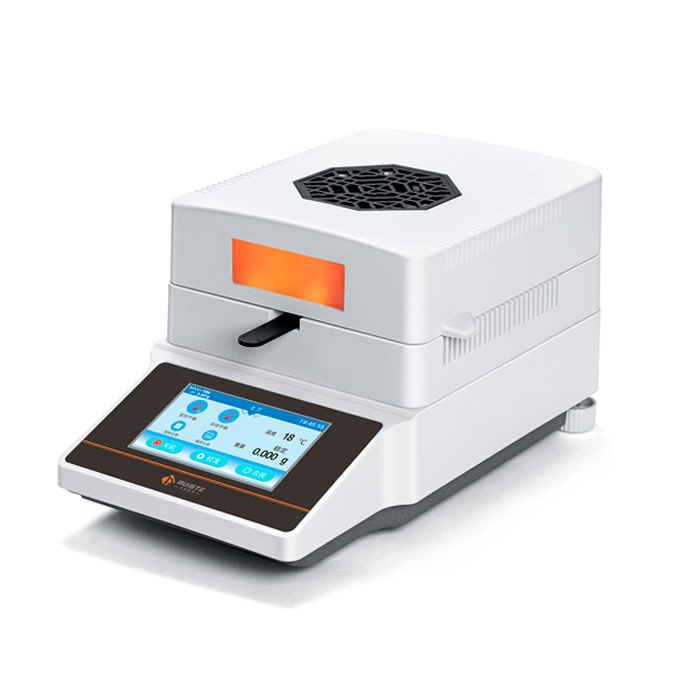
The working mechanism of food moisture analyzers is primarily based on the thermo-gravimetric loss-on-drying principle, a scientific detection logic that conforms to the basic physical properties of water. The entire detection process relies on two core functional modules: a high-precision weighing unit and a controllable heating unit, which cooperate synchronously to complete automatic moisture measurement. Before detection begins, a representative food sample is taken and placed on a dedicated weighing pan inside the instrument, and the initial weight of the sample is accurately recorded by the built-in weighing system. Subsequently, the heating unit releases stable and uniform thermal energy to heat the sample, prompting the free water and partial bound water inside the food sample to evaporate continuously. During the whole heating and drying process, the weighing unit keeps real-time monitoring of the sample weight changes, automatically recording weight data at set intervals. When the sample weight no longer decreases within a certain period, it indicates that the moisture in the sample has been fully evaporated, the drying process ends automatically, and the instrument calculates the moisture content of the sample based on the total weight loss before and after drying, presenting intuitive and readable data results.
Different from traditional oven drying methods that require long-time heating, manual weighing and complex data calculation, modern food moisture analyzers optimize the heating structure and temperature control logic, effectively shortening the detection cycle. Traditional drying detection often requires several hours of constant-temperature baking and repeated weighing and recording, which is low in efficiency and vulnerable to human operation errors. In contrast, the heating components of food moisture analyzers can form a uniform heating environment, enabling the sample to be heated evenly in all directions and avoiding incomplete drying or local overheating caused by uneven temperature. The intelligent temperature control system can adjust the heating power in real time according to sample characteristics and set parameters, maintaining a stable drying temperature and preventing the decomposition of food organic components caused by excessive high temperature, which may interfere with detection accuracy. This optimized design not only improves detection efficiency but also enhances the stability and repeatability of test data, making the detection results more consistent with actual food moisture conditions.
The application scenarios of food moisture analyzers cover almost all subdivided fields of the food industry, with targeted detection value for different types of food raw materials and finished products. In grain and staple food processing, moisture detection of rice, wheat, corn, flour, starch and other raw materials is crucial for raw material storage and subsequent processing. Excess moisture in grains will accelerate the reproduction of mold and harmful microorganisms during storage, leading to mildew, deterioration and agglomeration, while low moisture will affect the processing performance of grains, resulting in poor taste of finished products. By using moisture analyzers to detect grain moisture in batches, production enterprises can classify raw materials scientifically, formulate targeted storage and processing plans, and reduce raw material waste and quality risks caused by unqualified moisture content.
In the field of baked and puffed food processing, moisture content directly determines the core sensory quality of products. Biscuits, pastries, bread, puffed snacks and other products have strict moisture control ranges. Appropriate moisture content can maintain the crispness of puffed foods and the softness of pastries, while excessive moisture will make products damp and soft, losing their unique taste, and too low moisture will lead to dry and hard texture, affecting consumer experience. Food production enterprises will conduct real-time moisture monitoring on semi-finished products in the production process and finished products after processing through moisture analyzers, adjust baking time, temperature and feeding parameters according to detection data, so as to keep the product moisture within a reasonable range and ensure the consistency of product taste and texture in different production batches.
Meat, dairy and aquatic product processing industries also rely heavily on moisture detection technology. Fresh meat products, cured meat products and frozen meat products have different moisture control standards. Stable moisture content can maintain the tenderness and juiciness of meat products, avoid excessive water loss leading to dry meat quality, and also reduce the growth of bacteria caused by excessive residual moisture during refrigeration and storage. For dairy products such as milk powder, yogurt powder and condensed milk powder, moisture content is closely related to product solubility and shelf stability. Excess moisture in powdered dairy products will cause agglomeration and affect dissolution effect, and also easily induce lipid oxidation and microbial breeding, shortening the product shelf life. Aquatic products such as dried fish, shrimp and seaweed products also need strict moisture control to prevent mildew and deterioration during long-term storage, and moisture analyzers can provide accurate data support for the quality control of these products.
In addition, leisure foods, condiments, honey, dried fruits and other characteristic food categories also require regular moisture detection. Dried fruits and preserved fruits with unqualified moisture content are prone to sugar precipitation and mildew, while condiments such as sauces, vinegar and soy sauce will have unstable flavor and shortened storage period due to abnormal moisture content. Honey products with excessive moisture are easy to ferment and deteriorate, resulting in sour taste and reduced nutritional value. Through the rapid detection function of food moisture analyzers, production personnel can quickly screen unqualified products in the production line, realize online process adjustment, and avoid large-scale quality problems of products.
In addition to product quality control, food moisture analyzers also play an important role in production process optimization and cost control. In food processing, many technological parameters are closely linked to material moisture. By monitoring the moisture changes of raw materials and semi-finished products in real time, enterprises can accurately adjust processing parameters such as drying time, heating temperature and material feeding amount, avoid energy waste caused by excessive drying, and reduce production cost consumption. At the same time, stable moisture detection data can help enterprises form standardized production parameter databases, summarize optimal production processes for different products, realize standardized and refined production management, and improve the overall production level of enterprises.
The operation design of modern food moisture analyzers fully considers the actual use needs of industrial production and laboratory testing, with high usability and safety. The equipment is equipped with intuitive human-computer interaction interfaces, allowing operators to set detection temperature, drying time and termination conditions according to the characteristics of different food samples. For heat-sensitive food samples such as dairy products and fruit and vegetable powders, low-temperature gradual drying modes can be adopted to prevent sample thermal decomposition and ensure detection accuracy. For high-moisture samples such as fresh fruits and meat, high-efficiency rapid drying modes can be used to shorten detection time and improve detection efficiency. The built-in data storage function of the instrument can record historical detection data for a long time, which is convenient for production personnel to trace product quality, analyze production process changes, and provide effective data support for product quality improvement and process optimization.
In terms of equipment performance and durability, food moisture analyzers adopt stable structural design and high-quality core components, which can adapt to long-term continuous operation in production workshops and laboratory environments. The precision weighing sensor can resist slight external interference, ensuring the accuracy of weighing data in the detection process. The sealed heating structure can reduce heat loss, improve heating efficiency, and avoid the impact of external dust and air flow on the drying process. The simple and detachable sample weighing structure is convenient for daily cleaning and maintenance, preventing sample residue from affecting subsequent detection results, and ensuring the long-term stable operation of the equipment.
In the field of food quality inspection and scientific research, food moisture analyzers are also indispensable testing equipment. Food safety supervision and inspection work requires accurate detection of food moisture indicators to judge whether products meet production specifications and quality standards. Food research institutions need to analyze the moisture change rules of different food materials under different processing and storage conditions, explore the correlation between moisture content and food quality and shelf life, so as to develop new processing technologies and fresh-keeping technologies. The efficient and accurate detection capability of food moisture analyzers provides reliable experimental data for food scientific research, promotes the continuous innovation and upgrading of food processing and fresh-keeping technologies, and helps the food industry develop in a more standardized and high-quality direction.
It is worth noting that although food moisture analyzers have excellent detection performance, the accuracy of detection results is also affected by standardized operation and sample processing. In the detection process, operators need to ensure that the samples are representative, conduct uniform sampling according to standard specifications, and avoid local sample concentration or uneven particle size leading to incomplete drying. At the same time, the instrument needs to be placed in a flat, dry and stable detection environment to avoid the interference of temperature, humidity and air flow in the external environment on the detection process. Regular cleaning and maintenance of the equipment can maintain stable detection performance, ensure the consistency and accuracy of long-term detection data, and give full play to the application value of the equipment in food quality control.
With the continuous development of the food industry towards refinement, standardization and intelligence, the importance of moisture detection in food production and quality management is becoming increasingly prominent. As a professional and efficient detection tool, food moisture analyzers are breaking the limitations of traditional detection methods, improving the efficiency and precision of food moisture detection, and providing solid technical support for ensuring food quality safety, stabilizing product sensory experience, optimizing production processes and reducing production costs. In the future, with the continuous upgrading of detection technology, food moisture analyzers will develop towards more intelligent operation, wider sample adaptability and more diversified data management functions, and will be more widely applied in all links of the food industry, helping the entire industry continuously improve the level of quality control and production standardization.
Food Moisture Analyzer
https://www.pruiste.com/moisture-analyzer.html
Post Date: May 23, 2026
https://www.supplier-manufacturer.com/moisture-analyzer/food-moisture-analyzer.html

![Bench Top Electronic Balance]()
Bench Top Electronic Balance
In modern laboratory testing, industrial production quality control, pharmaceutical research, food ingredient preparation and daily scientific research experimentation, th…![What is Precision Balance]()
What is Precision Balance
In the field of quality measurement and precision detection, precision balances are indispensable basic measuring instruments. Different from ordinary weighing equipment, …![Explosion-proof Balance EX Series]()
Explosion-proof Balance EX Series
EX explosion-proof balance whole is 304 stainless steel, rust and corrosion resistance. The whole series of balance adopts intrinsically safe explosion-proof battery. Expl…![Types of Digital Viscometer]()
Types of Digital Viscometer
Viscosity serves as a fundamental physical property that reflects a fluid’s internal resistance to flow and shear deformation, playing a vital role in quality control, pr…![Digital Viscometer Wholesale]()
Digital Viscometer Wholesale
Viscosity measurement stands as a fundamental part of industrial quality control, material research, and production process optimization across diverse global sectors. As …