Laboratory Precision Balance
In every modern scientific laboratory that focuses on experimental research, material analysis, and sample component testing, the laboratory precision balance stands as an indispensable fundamental measuring device, undertaking the critical task of capturing micro and trace mass data that determine the authenticity and credibility of all subsequent experimental results. Unlike ordinary weighing tools used for rough mass estimation in daily life or simple industrial preliminary sorting, this type of precision weighing instrument is designed and manufactured to meet the rigorous measurement requirements of scientific research scenarios, where even tiny deviations in mass reading can lead to obvious changes in experimental reaction trends, inaccurate component ratio calculations, and even the complete failure of long-cycle research projects. The essence of laboratory scientific research lies in the repeatability and verifiability of experimental data, and stable and reliable micro mass measurement supported by precision balances is the primary prerequisite for realizing these two core scientific research attributes. Whether in chemical reagent proportioning for basic chemistry experiments, trace sample detection in biomedical research, material component testing in new material development, or quality consistency verification in environmental monitoring sample analysis, the laboratory precision balance always serves as the starting point of all quantitative experimental work, silently providing accurate and stable mass data support for every link from experimental preparation to result summary and data analysis.
The internal working mechanism of laboratory precision balance has undergone continuous technological iteration from traditional mechanical lever structure to modern electromagnetic force compensation structure, and the mainstream equipment used in current laboratory daily work mostly adopts mature and stable electromagnetic force balance sensing technology, which abandons the cumbersome weight adding and subtracting operation and manual reading mode of traditional mechanical balances, and realizes automatic induction, rapid balancing and digital real-time display of mass measurement. The core operating logic of this working principle follows the basic physical law of force balance interaction. When a sample to be tested is stably placed on the weighing pan of the balance, the gravity generated by the sample mass will cause the rigidly connected load-bearing structure and internal sensing coil to produce extremely subtle downward displacement, a displacement change that is almost imperceptible to the human eye but can be accurately and sensitively captured by the high-precision displacement sensing component built into the equipment. After the displacement sensor captures the tiny position change, it will immediately convert the mechanical displacement signal into a continuous electrical signal and transmit it to the built-in closed-loop control circuit and microprocessor system of the balance. The intelligent control system will quickly adjust the current intensity flowing through the internal electromagnetic coil according to the real-time electrical signal data, so that the coil generates an electromagnetic force opposite to the direction of the sample gravity and equal in magnitude, effectively offsetting the pressure brought by the sample mass and pushing the load-bearing structure back to the initial horizontal balance position set by the system.
In this complete dynamic balance adjustment process, the current intensity required for the electromagnetic force to completely counteract the sample gravity maintains a strict linear proportional relationship with the actual mass of the measured sample. The internal microprocessor of the balance will convert the collected stable current data into intuitive mass numerical information through precise digital-to-analog conversion and built-in algorithm calculation, and finally present it on the high-definition digital display screen in real time for laboratory researchers to record and use. The whole measurement process is completed in a very short time, and the intelligent adjustment system can continuously fine-tune the current state in real time to resist slight external interference, ensuring that the final displayed mass data maintains long-term stability and does not fluctuate randomly with minor environmental changes. Compared with the traditional mechanical balance that relies on manual comparison of standard weights and visual reading of scale values, the modern precision balance with electromagnetic force balance structure effectively reduces human operation errors and visual reading deviations, greatly improving the consistency and stability of each weighing operation, and making the measurement process more efficient and convenient while maintaining high measurement accuracy.
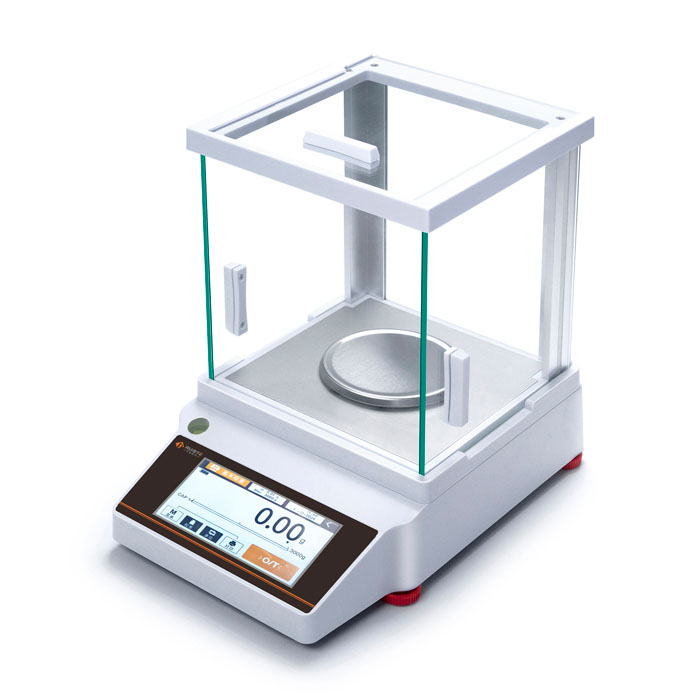
The overall structural design of the laboratory precision balance is fully centered on the core goal of maintaining high measurement stability and reducing external interference, and each component is carefully configured and scientifically arranged to create a stable internal measurement environment for micro mass detection. The external part of the balance is equipped with a closed protective wind shield made of transparent and corrosion-resistant materials, which is one of the most essential basic structures for ensuring precise weighing. In the laboratory environment, natural air convection, personnel walking airflow, and slight ventilation system wind power will produce tiny air flow impacts on the weighing pan and samples. For conventional weighing equipment, these subtle air flows will not have an obvious impact on measurement results, but for precision balances that need to measure trace mass changes, even weak air flow disturbance will cause continuous shaking of the weighing pan, resulting in unstable jumping of displayed data and inability to obtain accurate and repeatable measurement values. The closed wind shield can completely isolate the internal weighing space from the external air flow environment, keep the air inside the shield static and stable, and eliminate the measurement interference caused by air flow to the greatest extent.
The weighing pan in direct contact with the sample is made of high-strength, corrosion-resistant and deformation-resistant special materials, with a smooth and flat surface and stable structural stress performance, which can avoid mass measurement errors caused by surface corrosion, structural deformation or sample residue adhesion during long-term use. The bottom of the main body of the balance is equipped with adjustable horizontal supporting feet and a built-in horizontal bubble induction device, which is used to ensure that the balance is always kept in a horizontal working state during placement and use. The horizontal state is the basic spatial guarantee for the force balance operation of the precision balance. Once the balance is tilted slightly, the gravity of the sample will produce lateral component force, which cannot be completely offset by the vertical electromagnetic force generated by the coil, resulting in systematic deviation of all measured data and affecting the accuracy of experimental research. In addition, the internal core sensing and circuit parts of the balance are wrapped and protected by shock-absorbing and anti-interference structural components, which can buffer the slight vibration generated by laboratory equipment operation and personnel activities, and avoid the impact of vibration on the internal sensing accuracy and structural stability, further consolidating the reliability of long-term weighing work.
The environmental conditions of the laboratory where the precision balance is placed have a decisive impact on the performance of measurement work and the service life of the equipment, and high-precision weighing work cannot be separated from a stable and suitable external working environment. Temperature change is one of the most critical environmental factors affecting the weighing effect. Too high or too low ambient temperature, and frequent and drastic temperature fluctuations will cause thermal expansion and contraction of the internal metal structure, sensing coil and circuit components of the balance, changing the stress state and sensing sensitivity of the core components, leading to gradual drift of zero point and deviation of measurement data. It is necessary to place the balance in an indoor space with constant temperature conditions as much as possible, avoiding direct sunlight exposure and cold wind blowing from air conditioning or ventilation equipment, so as to keep the ambient temperature within a gentle and stable fluctuation range and ensure that the internal components of the balance work under constant temperature conditions.
Ambient humidity also needs to be kept within a reasonable and stable range. Excessively humid air will cause moisture to accumulate inside the balance, which may lead to damp aging of internal circuit components and slight corrosion of metal structural parts, affecting the normal operation of the sensing system and circuit control system; while excessively dry air is easy to generate static electricity, and static adsorption will affect the placement stability of light samples and the accuracy of mass measurement, especially for tiny particle samples and thin film samples, the interference of static electricity on weighing results is particularly obvious. At the same time, the placement position of the balance should be far away from experimental areas with volatile corrosive gases, dust and splashing chemical reagents. Long-term erosion of corrosive gases and dust accumulation will damage the internal precision structure and surface protective layer of the balance, reduce the measurement performance of the equipment, and shorten the normal service cycle. Keeping the placement platform stable, the surrounding environment clean and the temperature and humidity balanced is the basic daily environmental management work to maintain the good working state of the precision balance.
Standardized operating procedures are the key to giving full play to the measurement performance of the laboratory precision balance and obtaining accurate and effective experimental data. Before each formal weighing experiment, researchers need to complete a series of pre-operation preparation work to ensure that the balance is in the best working state. First of all, it is necessary to check the horizontal state of the balance in advance, adjust the supporting feet according to the position of the horizontal bubble to make the equipment reach a complete horizontal level, and check whether the weighing pan and the internal wind shield are clean and free of sample residue, dust and sundries. If there is residual dirt left by previous experiments, it needs to be gently wiped with a soft professional cleaning tool to avoid the interference of residual sundries on the basic zero point and sample weighing quality. After completing the cleaning and horizontal adjustment, the balance needs to be preheated for a certain period of time according to the operating requirements. Long-term shutdown or power-off state will make the internal circuit and sensing system of the balance in an unstable working state, and sufficient preheating can make the electronic components and sensing structure reach a stable working temperature, eliminate the data deviation caused by the cold start of the equipment, and ensure the stability of subsequent weighing.
After the preheating work is completed, the zero setting operation must be carried out first to calibrate the initial state of the balance, so that the display data is kept at zero when there is no sample load, eliminating the zero drift generated by the equipment after placement adjustment and long-term standby. For experimental scenarios that need to use weighing containers such as weighing bottles and beakers to hold samples, it is necessary to place the empty container on the weighing pan first and perform peeling and zero setting processing, so as to automatically deduct the mass of the container itself, and the subsequent measured data can directly present the net mass of the experimental sample, simplifying the data calculation process and reducing the calculation error caused by manual subtraction. When placing the sample, researchers need to handle it gently and place it in the center of the weighing pan as much as possible. Placing the sample on the edge of the weighing pan will cause uneven stress on the load-bearing structure, resulting in deviation of force transmission and affecting the accuracy of measurement results. During the weighing process, the wind shield door should be kept closed to avoid air flow interference caused by opening the door for a long time, and personnel should avoid touching the balance main body and weighing pan at will to prevent human body temperature transfer and slight vibration from affecting data stability.
After the weighing data is stabilized and recorded completely, the subsequent finishing work cannot be ignored. It is necessary to take out the sample and the weighing container in time, clean up the residual sample debris and dust inside the wind shield and on the weighing pan, keep the internal and external environment of the balance clean and tidy for the next use, and then turn off the equipment power according to the standard operation and do a good job in daily placement protection. In the whole operation process, it is necessary to avoid overloading the balance with excessive mass samples. Each precision balance has a reasonable weighing load range, and long-term overload use will cause irreversible deformation and damage to the internal sensing structure and load-bearing components, permanently reducing the measurement accuracy and service life of the equipment. Abnormal operations such as knocking and shaking the balance are also prohibited, so as to protect the internal precision mechanical and electronic structures from damage and maintain the long-term stable working performance of the equipment.
Laboratory precision balances have extremely wide application coverage in various scientific research and experimental fields, and almost all experimental work involving quantitative analysis and precise proportioning of materials cannot do without the support of its accurate weighing data. In chemical laboratory research, precision balances are used for accurate weighing of various chemical raw materials, standard reagents and experimental samples. The accurate proportioning of reactant mass is directly related to the progress degree and reaction yield of chemical synthesis experiments, as well as the accuracy of solution concentration preparation and titration analysis experiments. Trace chemical analysis and impurity content detection in chemical experiments require extremely high precision of sample mass data, and only the stable measurement performance of precision balances can meet the experimental requirements and ensure the repeatability and accuracy of chemical experimental results.
In the field of biomedical and pharmaceutical research, precision balances are used for weighing biological samples, experimental drugs, culture medium raw materials and trace reagents. The research and development of new drugs, the preparation of biological reagents and the testing of biological sample components all need to rely on accurate micro mass measurement to ensure the scientific rationality of experimental formula ratio and the accuracy of biological activity detection data. Slight mass errors in drug proportioning and biological sample preparation may affect the experimental activity of biological samples and the pharmacological effect test results of drugs, thus affecting the progress of biomedical research and drug research and development work.
In the research and development and performance testing of new materials, precision balances are used for weighing new material raw materials, testing the mass change of materials before and after performance experiments, and analyzing the component proportion of composite materials. The lightweight design and performance optimization of new materials require accurate mass data support, and the mass change detection of materials under different experimental conditions is an important basis for judging the structural stability and performance changes of materials. In environmental monitoring and food safety testing laboratories, precision balances are responsible for weighing environmental sediment samples, food detection samples and trace detection reagents, providing accurate basic data for environmental pollution degree assessment and food safety component testing, and providing reliable data support for environmental governance and food safety supervision work.
Daily maintenance and long-term maintenance work is an important part of maintaining the lasting measurement accuracy and extending the service life of laboratory precision balances, and scientific and standardized maintenance can effectively reduce equipment failure rates and avoid unnecessary measurement errors caused by equipment aging and damage. The most basic daily maintenance work is regular cleaning and dust removal. After each use and at the end of each experimental day, the weighing pan, wind shield inner wall and the surface of the balance main body should be carefully cleaned to remove residual sample dust, reagent splashes and accumulated dirt. Cleaning tools need to use soft and clean special wiping materials to avoid scratching the smooth surface of the weighing pan and damaging the internal protective structure of the balance. It is necessary to avoid using corrosive cleaning liquids to prevent chemical corrosion and damage to the balance surface and internal components.
Regular calibration and performance inspection are also essential maintenance links. With the increase of equipment use time and the change of laboratory environment, the zero point and measurement sensitivity of precision balances will produce slight natural drift. Regular professional calibration can correct the data drift in time, restore the original measurement accuracy of the equipment, and ensure that the weighing data of each experiment is always within the accurate and reliable range. In daily placement and use, the balance should be protected from long-term exposure to high temperature, high humidity and corrosive gas environment, and long-term idle equipment should be regularly powered on and preheated for inspection to avoid circuit damp and component aging caused by long-term shutdown. Once abnormal data fluctuation, unbalanced zero point and other abnormal conditions are found in the use process, the equipment should be stopped in time for inspection and adjustment, and blind use with faults is prohibited to prevent continuous generation of wrong experimental data and affect the progress of scientific research experiments.
Throughout the entire process from basic structural design, working principle operation, standardized use and management to daily maintenance and maintenance, the laboratory precision balance always embodies the rigorous requirements of scientific research work for accurate data and stable performance. It is not only a simple experimental measuring instrument, but also an important guarantee for the authenticity and scientificity of modern laboratory experimental research work. Every detail in operation, environment and maintenance is closely related to the accuracy of weighing results, and every standardized operation and careful maintenance is to maintain the stable working state of the precision balance. In the continuous development and innovation of scientific research undertakings, as the most basic and core precision measuring equipment in the laboratory, the precision balance will always maintain its important basic position, continuously provide accurate and reliable micro mass measurement support for various professional experimental research, and lay a solid and solid data foundation for the continuous progress and innovative breakthroughs in various scientific research fields.
Laboratory Precision Balance
https://www.pruiste.com/precision-balance.html
Post Date: May 5, 2026
https://www.supplier-manufacturer.com/precision-balance/laboratory-precision-balance.html

![Digital Viscometer NDJ SERIES]()
Digital Viscometer NDJ SERIES
NDJ series viscometer has 2 optional keys and touch screen. The whole series balance adopts high precision sensor, microcomputer control and one key fast measurement. The …![Electronic Balance JA SERIES]()
Electronic Balance JA SERIES
The JA series uses high-definition buttons, and the entire series of balances uses Nuosheng sensors and brand sensors to ensure high accuracy and stability of weighing res…![Online Digital Viscometer]()
Online Digital Viscometer
Viscosity stands as one of the most fundamental physical properties of fluid substances, reflecting the internal frictional resistance that occurs when a fluid flows and d…![Digital Viscometer Supplier]()
Digital Viscometer Supplier
Viscosity stands as one of the most fundamental physical properties of fluid materials, reflecting the internal frictional resistance that occurs when a fluid flows or und…![Portable Digital Viscometer]()
Portable Digital Viscometer
Viscosity stands as one of the most fundamental physical properties of fluid substances, reflecting the internal friction and flow resistance that occurs when liquids move…