Specifications of Moisture Analyzer
A moisture analyzer is a fundamental analytical device designed to quantify the moisture content present in solid, powdered, granular, and viscous materials across diverse industrial and research environments. Rooted in thermogravimetric measurement principles, the device delivers consistent and repeatable moisture detection by tracking weight variations of test samples during controlled thermal drying processes. Unlike traditional manual drying methods that rely on external ovens and manual weighing operations, modern moisture analyzers integrate heating modules, precision weighing systems, and intelligent control units into a compact integrated structure, streamlining the entire moisture testing workflow and reducing human-induced operational errors. The core specifications of such devices define their operational boundaries, detection accuracy, applicable sample types, and overall operational stability, serving as the key reference for equipment selection, experimental standardization, and industrial quality control implementation.
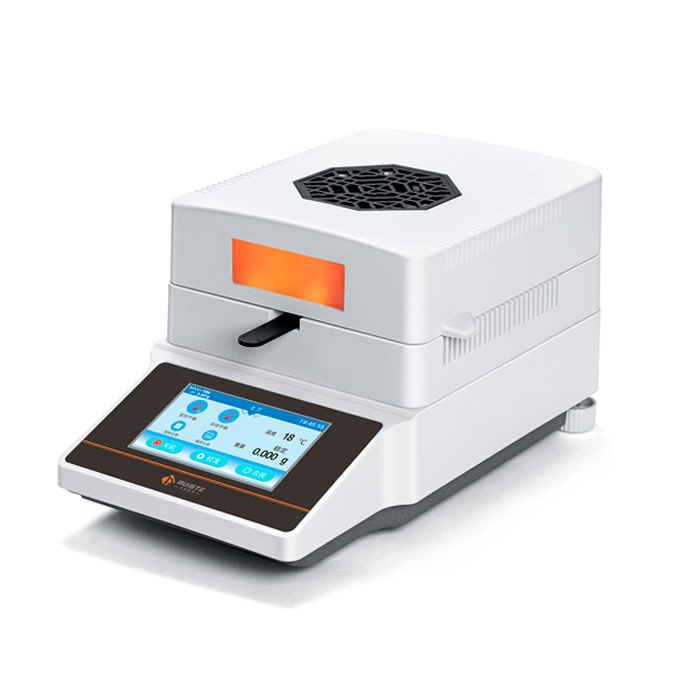
The core working principle that underpins all standard moisture analyzer operations is the loss-on-drying methodology, which operates on a simple physical logic: moisture contained in material samples vaporizes under continuous and uniform thermal exposure, and the weight loss recorded throughout the drying process corresponds directly to the total moisture content of the sample. Before the initiation of each test cycle, the built-in precision weighing unit conducts an accurate measurement of the initial sample weight and stores the baseline data in the internal control system. Subsequently, the heating module raises the ambient temperature of the sample chamber to a preset target value, maintaining a stable thermal environment to facilitate the gradual evaporation of free and loosely bound moisture within the sample. Throughout the entire drying duration, the weighing unit continuously captures real-time weight data of the sample, transmitting dynamic weight change information to the microprocessor for real-time calculation and data updating. The testing process concludes when the sample weight fluctuates within a predefined minor range for a sustained period, indicating the completion of effective moisture evaporation. The system then computes the moisture content ratio based on the difference between initial and final stable sample weights, generating intuitive numerical results for subsequent data recording and analysis.
Heating system specifications constitute one of the most critical functional parameters of a moisture analyzer, directly influencing drying efficiency, temperature uniformity, and the authenticity of detection results. Most conventional moisture analyzers adopt radiant heating structures, which deliver even thermal coverage across the sample placement area to avoid localized overheating or incomplete drying. The adjustable temperature range of mainstream devices covers low-temperature drying intervals suitable for heat-sensitive materials and high-temperature intervals for materials with stable thermal properties, accommodating the testing requirements of most common industrial and laboratory samples. Temperature control resolution determines the fine-tuning capability of the heating system, enabling precise adjustment of thermal output to match the moisture release characteristics of different materials. Uniform heat distribution across the sample tray prevents inconsistent drying status among different parts of a single sample, which could otherwise lead to biased weight change data and inaccurate moisture content calculations. Additionally, the heating system features rapid temperature response, shortening the preheating preparation period and improving overall testing efficiency without compromising the stability of constant-temperature operation during formal detection.
Weighing system specifications are pivotal to the detection precision of moisture analyzers, as subtle weight changes during sample drying require high-sensitivity measurement components. The internal electronic balance is engineered with high resolution to capture minor weight reductions caused by gradual moisture evaporation, ensuring that even small amounts of residual moisture can be effectively identified. The weighing range is reasonably configured to adapt to different sample dosage requirements, supporting both small-quantity precise testing for high-value fine materials and conventional dosage testing for bulk industrial materials. To adapt to long-term continuous operation, the weighing unit is equipped with anti-interference structures that reduce the impact of external environmental factors such as minor air flow and subtle temperature fluctuations inside the instrument chamber. Real-time data sampling frequency of the weighing system ensures continuous tracking of sample weight changes, avoiding data omission during rapid moisture evaporation stages and ensuring the integrity and continuity of the entire testing data set.
Control and data processing specifications define the operational intelligence and data credibility of modern moisture analyzers. Equipped with a dedicated microprocessor control system, the device supports flexible setting of multiple operational parameters, including target drying temperature, constant-temperature maintenance duration, and testing termination criteria. Users can customize testing programs according to the physical properties and moisture characteristics of different samples, forming targeted detection schemes for various materials. The system features stable data operation logic, which automatically eliminates abnormal data fluctuations caused by transient environmental interference and retains valid weight change data throughout the drying process. After test completion, the system automatically calculates core indicators including moisture content ratio, solid content ratio, and real-time weight change rate, and supports real-time display of dynamic testing curves to visualize the entire moisture evaporation process. Built-in data storage functionality allows the device to retain a certain number of historical test records, facilitating subsequent data review, experimental comparison, and quality trend analysis in production and research scenarios.
Structural and environmental adaptation specifications ensure the stable and safe operation of moisture analyzers in diverse usage scenarios. The overall structural design adopts a sealed and heat-insulated layout for the heating chamber, which reduces internal heat loss, maintains stable internal temperature, and prevents external air convection from interfering with internal drying conditions. The sample tray is made of high-temperature-resistant, corrosion-resistant, and thermally conductive materials, ensuring uniform heat absorption and transfer while avoiding chemical reactions with test samples that could affect detection accuracy. The instrument is equipped with standardized heat dissipation structures to discharge excess heat generated during high-temperature operation, preventing internal component overheating and extending the service life of core functional parts. In terms of environmental adaptability, the device can operate stably in conventional laboratory and production workshop environments with moderate temperature and humidity ranges, resisting minor environmental parameter fluctuations to ensure consistent testing performance. The compact overall structure saves placement space, while the modular component layout facilitates daily inspection and routine maintenance of internal parts.
Operational stability and repeatability specifications are key indicators for evaluating the comprehensive performance of moisture analyzers. During repeated testing of the same batch of homogeneous samples, the device can produce highly consistent detection results, with minor data deviations that meet conventional analytical testing standards. This stable repeatability stems from the coordinated operation of the precision weighing system, stable heating control module, and standardized data processing algorithm, effectively reducing systematic errors in the testing process. The instrument maintains stable long-term operation without frequent parameter drift, and key functional components retain consistent performance after prolonged continuous use. For samples with different moisture content levels, the device can accurately distinguish subtle differences in moisture proportion, maintaining stable detection sensitivity across low, medium, and high moisture concentration ranges. Such stable operational performance ensures that the device can meet the continuous testing demands of industrial production quality control and long-term experimental research projects.
Applicable sample range specifications clarify the application boundaries of moisture analyzers, guiding users to conduct standardized sample testing. The device is compatible with solid materials in various forms, including powdered chemical raw materials, granular food ingredients, flaky plastic particles, and fibrous agricultural products, as well as low-viscosity colloidal samples that can be evenly spread on sample trays. It adapts to samples with different moisture existing states, including free moisture attached to the material surface and shallow bound moisture inside material structures, completing effective separation and detection of moisture through programmed temperature control. Nevertheless, the device is not suitable for samples that undergo thermal decomposition, oxidation, or volatile substance evaporation at conventional drying temperatures, as such material changes will cause additional weight loss and interfere with the accuracy of moisture data. Reasonable matching between sample characteristics and instrument application specifications is a prerequisite for obtaining valid and reliable test results.
Standardized operation specifications are closely linked to the functional specifications of moisture analyzers, and standardized operational procedures can fully release the instrument’s detection performance. Before testing, users need to place the instrument on a horizontal stable platform to avoid tilting-induced weighing errors, and complete preheating and zero calibration of the weighing system to eliminate baseline deviations. During sample preparation, samples should be evenly spread on the tray with appropriate thickness and dosage to ensure full contact with thermal radiation and uniform moisture evaporation; excessive sample stacking will lead to internal moisture evaporation obstruction, while insufficient sample volume may amplify data random errors. In the testing process, the instrument chamber should remain closed to maintain a stable internal thermal environment, and external environmental interference such as strong air flow and violent temperature changes should be avoided. After test completion, users need to cool the instrument chamber, clean residual sample impurities, and record test data to ensure the normal operation of subsequent test cycles.
Daily maintenance and calibration specifications are essential to maintain the long-term performance stability of moisture analyzers. Regular cleaning of the heating chamber, sample tray, and weighing sensor area prevents residual sample accumulation from affecting heat conduction and weighing accuracy. The heating module requires periodic operational inspection to check for uniform heating status and stable temperature output, ensuring the heating function meets standard testing requirements. The weighing system needs regular calibration with standard weights to correct minor parameter drift caused by long-term use and external environmental changes, maintaining high-precision weighing performance. The internal control system requires regular data sorting and program inspection to ensure stable operation of data processing and parameter setting functions. Good maintenance habits can effectively reduce equipment failure rates, extend the service cycle of core components, and ensure that the instrument’s various functional specifications remain within the standard range for a long time.
In practical application scenarios, the comprehensive specifications of moisture analyzers support efficient and accurate moisture detection in multiple industries. In food processing, the device detects moisture content of raw grains, flour products, snack ingredients, and preserved foods, helping enterprises control product taste, storage stability, and production consistency. In chemical and new material industries, it conducts moisture testing of powder raw materials, resin particles, and inorganic chemical products, avoiding excessive moisture affecting material chemical properties and product quality. In agricultural detection, it analyzes moisture content of grains, seeds, and forage, providing data support for agricultural product storage, transportation, and quality grading. In laboratory scientific research, it provides accurate and repeatable moisture data for material component analysis, experimental formula optimization, and product performance research, supporting the standardization and refinement of scientific research experiments.
In summary, the complete specifications of a moisture analyzer cover heating performance, weighing precision, control logic, structural adaptability, operational stability, and application scope, forming a systematic performance evaluation system for the device. Each specification parameter coordinates and restricts with others, jointly determining the instrument’s testing accuracy, operational efficiency, and scenario adaptability. Understanding and abiding by the core specifications of moisture analyzers, cooperating with standardized operation and scientific maintenance, can maximize the equipment’s functional value, provide reliable moisture data support for industrial production quality control, academic research experiments, and material performance analysis, and lay a solid foundation for standardized and refined material detection work in various fields.
Specifications of Moisture Analyzer
https://www.pruiste.com/moisture-analyzer.html
Post Date: May 23, 2026
https://www.supplier-manufacturer.com/moisture-analyzer/specifications-of-moisture-analyzer.html

![Weighing Scale Vender In China]()
Weighing Scale Vender In China
China has established a solid and influential position in the global weighing scale manufacturing sector, with numerous dedicated vendors covering diverse production scale…![Weighing Scale Manufacturer]()
Weighing Scale Manufacturer
The weighing scale manufacturing sector stands as an indispensable segment within the global industrial and consumer manufacturing landscape, quietly supporting the operat…![Moisture Analyzer DHS Series]()
Moisture Analyzer DHS Series
DHS series adopts the Internet of Things 5 inch color TFT control system integrated touch HD screen, and the whole series moisture meter adopts German HBM sensor and brand…![Counting Scale Manufacturer]()
Counting Scale Manufacturer
Counting scales have become indispensable measuring equipment in modern industrial production, commercial circulation, and material management, serving as a reliable tool …![Dual-range Counting Scale]()
Dual-range Counting Scale
In modern industrial production, inventory management, and material sorting processes, the demand for accurate and efficient quantitative measurement continues to grow ste…