Industrial Moisture Analyzer
Moisture content stands as one of the most critical physical indicators that determine the quality, stability, and processing performance of industrial materials across diverse manufacturing and production sectors. Even minor fluctuations in moisture levels can alter the structural properties of raw materials, disrupt standardized production workflows, reduce the consistency of finished goods, and lead to unnecessary material waste or operational risks in long-term industrial operation. In response to the demand for stable, real-time, and reliable moisture detection in modern industrial production, industrial moisture analyzers have become essential testing and process control equipment, widely deployed in offline laboratory testing and online continuous production monitoring. These professional analytical devices are designed to quantify the moisture proportion in solid, powder, granular, and even liquid industrial materials through standardized physical detection methods, providing reliable data support for production parameter adjustment, quality consistency control, and production efficiency optimization.
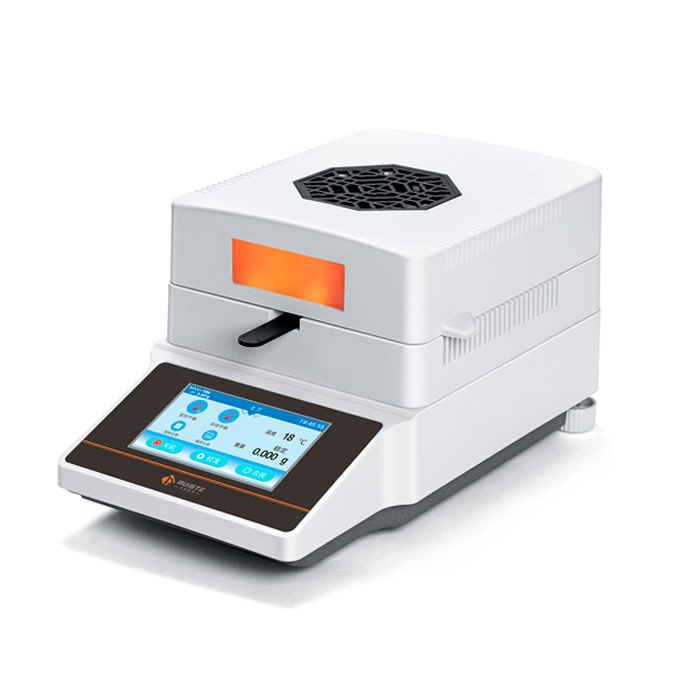
The core operational logic of industrial moisture analyzers is rooted in mature physical detection principles, with thermogravimetric analysis serving as the most widely adopted foundational technology in industrial scenarios. This principle relies on the inherent physical property that free and bound moisture in materials can be completely evaporated under controlled heating conditions, while the effective components of the tested materials remain stable without thermal decomposition or quality loss within a set temperature range. During detection, the device first records the precise initial weight of the sampled material, then applies uniform and controllable heat to the sample to accelerate moisture volatilization. A high-precision weighing module continuously monitors the weight changes of the sample throughout the heating and drying process, and the system calculates the moisture content ratio based on the total weight loss after the sample weight reaches a stable state with no further reduction. This detection logic fits the basic testing needs of most conventional industrial materials, featuring intuitive data calculation logic and stable detection repeatability, which lays a solid foundation for large-scale industrial application.
To adapt to the diversified detection demands of complex industrial production scenarios, modern industrial moisture analyzers have expanded multiple technical detection modes on the basis of traditional thermogravimetric technology, forming a multi-dimensional detection system covering contact and non-contact, offline and online monitoring. Microwave and radio frequency detection technologies are typical non-contact detection methods widely used in continuous production lines. These technologies take advantage of the significant difference in dielectric properties between water and other industrial materials. When microwave or radio frequency signals penetrate the flowing or static materials on the production line, the moisture contained in the materials will cause regular attenuation and phase shift of electromagnetic signals. The built-in data processing module of the analyzer converts the collected signal change data into accurate moisture content values through fixed algorithm models. This detection method requires no sampling and no damage to materials, and can realize real-time dynamic monitoring of materials in continuous production such as grain processing, plastic granulation, and building material production, effectively solving the problem of delayed data feedback caused by traditional offline sampling testing.
Infrared and halogen heating technologies are optimized upgrades of traditional thermogravimetric detection, focusing on improving heating uniformity and detection efficiency. Different from traditional resistance heating, infrared and halogen heating elements can form uniform thermal radiation coverage on the sample surface, realizing rapid and consistent heating of materials. This heating mode avoids local overheating of the sample, prevents thermal decomposition of heat-sensitive materials that may affect detection accuracy, and shortens the drying and detection cycle on the premise of ensuring complete moisture evaporation. Such optimized thermogravimetric analyzers are mostly used in laboratory offline sampling detection scenarios, suitable for precise sampling inspection of raw materials, semi-finished products and finished products in food processing, pharmaceutical manufacturing, fine chemical and other industries, and can meet the strict precision requirements of product quality inspection links.
The functional design of modern industrial moisture analyzers fully conforms to the standardized and automated development trend of industrial production, with core performance advantages reflected in detection stability, operational convenience and data traceability. In terms of detection performance, the equipment is equipped with high-precision weighing sensors and temperature control modules, which can maintain stable detection accuracy in different ambient temperature and humidity environments, effectively reducing detection errors caused by environmental fluctuations and manual operation differences. The temperature control system supports multi-stage temperature regulation and constant-temperature drying, which can set targeted heating parameters according to the thermal stability characteristics of different materials, ensuring that only moisture is removed during the drying process while the material matrix remains intact, thus guaranteeing the authenticity and effectiveness of detection data.
In terms of operational design, most industrial moisture analyzers adopt modular and automated operation logic, simplifying complex detection steps into standardized processes. Operators only need to complete sample laying and parameter presetting, and the equipment can automatically finish heating, weighing, data calculation and result display. Some advanced models are equipped with data storage and output functions, which can record detection time, sample information, temperature parameters and moisture test results in real time, facilitating subsequent production data sorting, quality tracking and production process optimization. The simplified operation mode reduces the threshold for personnel operation, avoids detection errors caused by unstandardized manual operation, and improves the overall efficiency of industrial moisture detection work.
Industrial moisture analyzers have extremely high application penetration in multiple industrial sectors, and their detection results directly affect the core quality and production benefits of each industry. In the food and agricultural product processing industry, moisture content is a key indicator affecting product shelf life, taste and storage stability. Excess moisture in grain, flour, feed and baked food will easily lead to microbial growth, mildew and deterioration during storage and transportation, while excessively low moisture will affect the taste and structural stability of products. By using moisture analyzers to strictly control the moisture range of raw materials and finished products, enterprises can effectively extend product storage cycles, maintain stable product quality, and reduce product loss caused by unqualified moisture content.
In the chemical and new material industry, moisture control is closely related to the chemical stability and processing performance of materials. For powder chemical raw materials, plastic particles, coating additives and resin materials, excessive moisture will cause agglomeration of powder materials, reduce the uniformity of material mixing, and affect the molding effect and structural strength of finished products. In the production process of fine chemicals, unqualified moisture content may also trigger subtle chemical reactions inside the materials, leading to changes in material purity and performance attenuation. Industrial moisture analyzers can conduct regular sampling detection and real-time online monitoring of chemical materials, help enterprises lock in the optimal moisture range suitable for production processing, and ensure the consistency of material batch performance.
The pharmaceutical industry puts forward more stringent requirements on moisture detection due to the particularity of product attributes. The moisture content of pharmaceutical raw materials, tablet preparations, capsule contents and auxiliary materials directly affects the efficacy stability and storage safety of drugs. Too high moisture content will accelerate the degradation of active pharmaceutical ingredients and increase the risk of drug deterioration, while unreasonable moisture proportion will also affect the forming efficiency of pharmaceutical preparations and the accuracy of ingredient ratio. Professional industrial moisture analyzers can meet the high-precision detection needs of pharmaceutical production, provide accurate data support for pharmaceutical quality control, and help production enterprises maintain standardized production levels.
In the building materials and mining industry, moisture detection is an important link to ensure production efficiency and product qualification rate. Raw materials such as cement raw meal, mineral powder, sand and gravel will affect the mixing ratio and molding quality of building materials due to excessive moisture, and will also increase the energy consumption of drying and processing in the production process. Real-time moisture monitoring of building materials raw materials through industrial analyzers can help enterprises adjust the feeding ratio and drying process parameters in a timely manner, reduce energy waste in the production process, and improve the compactness and structural stability of finished building materials. In addition, in the processing of metal powder and mineral materials, moisture detection can also avoid processing failures and equipment wear caused by material agglomeration, ensuring the smooth progress of continuous production.
In the actual industrial application process, the standardized use and daily maintenance of moisture analyzers are crucial to maintaining long-term stable detection performance. Before daily detection, it is necessary to check the horizontal state of the equipment, the cleanliness of the weighing pan and the normal operation of the heating module to avoid detection errors caused by equipment deviation or residual impurities. For different types of materials, targeted detection parameters need to be set according to material characteristics. Heat-sensitive materials need low-temperature gradual heating parameters to prevent thermal decomposition, while high-stability industrial raw materials can adopt conventional heating procedures to balance detection accuracy and efficiency. At the end of each detection, the equipment should be cleaned and maintained in time to keep the detection cavity and weighing components clean and dry, which can effectively extend the service life of the equipment and maintain the stability of detection data for a long time.
With the continuous upgrading of modern industrial intelligent production systems, industrial moisture analyzers are also evolving towards intelligence, integration and high efficiency. Traditional single-function detection equipment is gradually upgraded to integrated equipment that can realize real-time monitoring, data automatic analysis and production linkage control. The combination of moisture detection data and production control systems can realize automatic adjustment of production parameters based on moisture changes of materials, forming a closed-loop control from detection to parameter optimization, which further improves the intelligent level of industrial production. At the same time, the continuous optimization of non-contact detection technology makes the equipment more adaptable to high-speed continuous production lines, meeting the moisture monitoring needs of large-scale and high-efficiency industrial production.
In the entire industrial production system, the value of industrial moisture analyzers is not limited to simple moisture data detection. More importantly, they provide basic data support for production standardization, quality stabilization and cost optimization. Accurate moisture detection can help enterprises reduce unqualified products caused by unstable material moisture, lower raw material waste and product loss rates, and optimize energy consumption in the material drying and processing links. In the long-term production operation, standardized moisture management relying on professional analytical equipment can effectively improve the overall production quality level of enterprises, enhance the stability of batch product performance, and create stable economic benefits for industrial production while meeting industry production specifications.
As all industrial sectors continue to improve their requirements for production refinement and quality standardization, the importance of moisture control in the production process will continue to rise. Industrial moisture analyzers, as key equipment for material moisture monitoring, will keep pace with the development of industrial technology, continuously optimize detection accuracy, operational efficiency and scenario adaptability, and provide more reliable and intelligent technical support for the high-quality development of various industrial production fields. Whether in offline laboratory precision testing or online real-time monitoring of production lines, such analytical equipment will remain an indispensable part of modern industrial quality control systems, supporting the sustainable and standardized operation of industrial production.
Industrial Moisture Analyzer
https://www.pruiste.com/moisture-analyzer.html
Post Date: May 23, 2026
https://www.supplier-manufacturer.com/moisture-analyzer/industrial-moisture-analyzer.html

![Explosion-proof Balance EX Series]()
Explosion-proof Balance EX Series
EX explosion-proof balance whole is 304 stainless steel, rust and corrosion resistance. The whole series of balance adopts intrinsically safe explosion-proof battery. Expl…![Types of Digital Viscometer]()
Types of Digital Viscometer
Viscosity serves as a fundamental physical property that reflects a fluid’s internal resistance to flow and shear deformation, playing a vital role in quality control, pr…![Digital Viscometer Wholesale]()
Digital Viscometer Wholesale
Viscosity measurement stands as a fundamental part of industrial quality control, material research, and production process optimization across diverse global sectors. As …![Precision Digital Viscometer]()
Precision Digital Viscometer
Viscosity stands as one of the most fundamental physical properties of fluid substances, reflecting the internal friction and flow resistance generated during the movement…![Purposes of Moisture Analyzer]()
Purposes of Moisture Analyzer
Moisture content stands as one of the most fundamental and influential physical properties of nearly all raw materials, semi-finished goods, and finished products across i…