2000kg Test Weight
In the complex and interconnected ecosystem of modern industrial production, logistics transportation, engineering construction, and mechanical equipment operation, the stability and accuracy of load bearing detection and weighing measurement work serve as the fundamental cornerstone for maintaining orderly production links, ensuring operational safety, and unifying measurement standards across all scenarios. Among the various essential physical reference tools supporting such critical work, the 2000kg test weight stands out as a vital medium that bridges theoretical load parameter settings and actual on-site working condition verification. Unlike small-sized test weights that are suitable for laboratory fine calibration and low-load daily inspection, this heavy-duty test mass is specially designed and crafted to adapt to medium and large-scale load testing scenarios, covering the calibration of industrial weighing equipment, load bearing performance detection of lifting machinery, structural stress testing of engineering facilities, and routine safety inspection of large-scale handling equipment. Its existence enables every link involving weight measurement and load bearing assessment in industrial and engineering fields to obtain intuitive, reliable, and repeatable physical reference data, effectively avoiding potential operational risks and measurement deviations caused by inaccurate equipment operation, structural fatigue, or long-term service wear of mechanical components. The application of 2000kg test weight runs through the entire life cycle of industrial equipment from factory commissioning, daily operational use, regular performance inspection to later maintenance and renovation, becoming an indispensable basic guarantee for standardized and safe production in various industries.
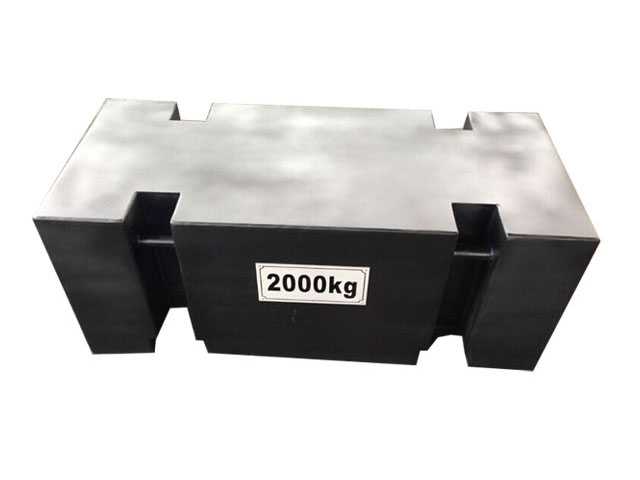
The manufacturing and structural design of the 2000kg test weight focus on practicality, durability, and stable mass retention, with every production link and structural detail formulated around the core demand of maintaining long-term mass stability and adapting to complex on-site use environments. The main raw material selected for production is high-quality cast iron with lamellar graphite structure, a material that possesses excellent overall density uniformity, strong compression resistance, and good anti-deformation performance under long-term static and slight dynamic load conditions. Compared with other common metal materials used for making test masses, this cast iron material will not produce obvious structural deformation or mass change under conventional industrial environmental conditions, and has natural resistance to daily wear, surface oxidation, and slight external impact damage that are inevitable in on-site handling and use processes. In the casting process, strict smelting and pouring processes are adopted to ensure the internal structure of the entire test weight is dense and uniform, without internal pores, sand holes, or structural cracks that may affect mass accuracy and overall structural stability. After the initial casting forming, the test weight will go through multiple stages of natural aging and mechanical stress relief treatment, which can effectively eliminate internal stress generated during the casting process and prevent slow structural deformation or local mass loss caused by stress release during long-term subsequent use. The overall external structure of the 2000kg test weight adopts a regular block design with reasonable length, width and height proportions, which not only ensures the stability of placement during static load testing and weighing calibration, preventing tilting or sliding during use, but also facilitates stacking placement in temporary storage and layered loading in multi-load combined testing work. A reserved adjustment area is specially designed inside the test weight structure, which can be filled with auxiliary filling materials for fine mass trimming in the later stage according to actual use requirements, ensuring that the overall mass of the test weight remains within the required reasonable range for long-term use and compensating for tiny mass changes caused by long-term environmental erosion or surface wear.
The surface treatment process of the 2000kg test weight is another key link to extend its service life and maintain stable surface condition in complex working environments. After finishing mechanical polishing and deburring of the cast body, the surface is treated with professional anti-rust and anti-corrosion coating treatment. The coating material has strong adhesion and weather resistance, which can effectively isolate the contact between the internal metal material and external air, moisture, dust, and chemical trace substances existing in industrial production environments. This surface treatment can avoid surface rust, corrosion, and peeling damage that may occur when the test weight is used for a long time in outdoor construction sites, factory production workshops, humid storage warehouses, and other harsh environments. For areas that are frequently contacted and rubbed during handling and use, the surface coating is thickened and reinforced appropriately to reduce surface wear caused by frequent hoisting, stacking, and moving operations. The overall surface of the processed test weight is smooth and flat without sharp edges and protruding corners, which not only avoids accidental scratch damage to operators and handling equipment during use and transportation, but also prevents local stress concentration caused by uneven surface structure during load bearing placement, ensuring that the pressure generated by the test weight acts evenly on the contact surface during all testing and calibration processes. In terms of handling structure design, the 2000kg test weight is equipped with reserved stress-bearing parts suitable for mechanical hoisting and forklift handling on both sides and the bottom. This structural design fully considers the actual on-site operation needs, realizing convenient access and stable stress bearing for various conventional handling equipment, completely eliminating the need for manual handling that is impossible for heavy loads, and greatly improving the convenience and safety of transportation, placement, and transfer work before and after each test operation.
The core functional application of the 2000kg test weight is first concentrated in the calibration and accuracy verification of various industrial weighing equipment, which is the most basic and widely used usage scenario of this heavy-duty test mass. In modern industrial production, logistics warehousing, port transportation, and commodity circulation links, various large and medium-sized weighing devices undertake the important task of weight data statistics, raw material proportioning calculation, finished product weight inspection, and cargo settlement measurement. The accuracy of these weighing devices directly affects the production proportioning accuracy of manufacturing enterprises, the statistical authenticity of logistics cargo volume, and the fairness of commodity transaction settlement. Due to long-term continuous use, frequent load bearing impact, environmental temperature and humidity changes, and mechanical vibration interference in the working environment, the internal sensing components and mechanical bearing structures of weighing equipment are prone to slight performance drift and parameter deviation over time. If not calibrated and verified regularly, the weighing data displayed by the equipment will gradually deviate from the actual weight value, leading to a series of problems such as unqualified product production proportioning, inaccurate cargo quantity statistics, and inconsistent transaction measurement data. The 2000kg test weight provides a stable and fixed standard mass reference for solving such problems. When carrying out weighing equipment calibration work, operators only need to steadily place the test weight on the weighing platform of the equipment to be detected according to standardized operation steps, record the weighing data displayed by the equipment in real time, and compare it with the standard mass parameter of the test weight itself. Through simple data comparison and analysis, the deviation range of the weighing equipment can be accurately judged, and targeted parameter adjustment and performance correction can be carried out according to the deviation situation to ensure that the weighing equipment can restore accurate and stable measurement performance.
The types of weighing equipment suitable for calibration and verification with the 2000kg test weight cover almost all medium and large-scale weighing devices commonly used in industrial and logistics fields, including floor scales used in factory workshops for finished product and raw material weighing, truck scales used in ports, freight yards and logistics parks for whole vehicle cargo weighing, forklift scales installed on handling vehicles for real-time cargo weighing during transportation, and various special supporting weighing instruments used in chemical production, building materials processing, grain storage and other industries. In the daily management and maintenance work of enterprises, regular calibration with the 2000kg test weight has become a necessary part of measurement management. Many production and logistics enterprises arrange special measurement management personnel to conduct weighing equipment verification and calibration work on a monthly or quarterly basis, and the 2000kg test weight, as a fixed standard reference tool, can adapt to frequent repeated use without obvious mass attenuation or performance change, maintaining consistent calibration effect for a long time. In addition to regular daily calibration, this test weight is also required for initial commissioning and debugging of new weighing equipment before formal put into use. After the installation and assembly of new weighing equipment is completed, it is necessary to use standard test weights of different specifications for multi-range load testing to check whether the equipment has stable data display under different load conditions and whether the structural bearing performance meets the use requirements. The 2000kg test weight, as a medium-load standard test mass, plays an important connecting role in the multi-range calibration process, covering the core load range that is most frequently used in actual operation of most industrial weighing equipment, ensuring that the equipment can maintain accurate measurement status in the main working load interval.
Another key application field of the 2000kg test weight is the load bearing performance test and safety performance inspection of various lifting and handling machinery and equipment. Lifting machinery such as cranes, hoists, electric winches, and large forklifts are widely used in construction engineering, factory production workshops, mine operation sites, and logistics cargo handling links. These mechanical equipment bear heavy load lifting and handling tasks every day, and their structural bearing capacity, lifting system stability, and braking system reliability are directly related to on-site construction safety and operator personal safety. After long-term use, the metal structure of lifting equipment will have fatigue wear, the lifting steel rope will have aging attenuation, and the braking system will have performance degradation. These potential hidden dangers cannot be directly observed through daily visual inspection, and must be detected and verified through professional load testing work. The 2000kg test weight provides a safe and controllable standard load for the load testing of lifting equipment. During the test, the test weight is steadily lifted and lowered by the lifting equipment according to the test operation specifications, and the operating state of the equipment under standard load is observed and recorded in detail, including whether the lifting operation is stable without jitter and abnormal noise, whether the braking system can quickly and accurately stop the load at a fixed position, whether the structural components of the equipment have obvious deformation or abnormal vibration, and whether the safety protection devices can operate normally in place.
Through the load test with the 2000kg test weight, equipment management and safety inspection personnel can accurately judge the actual bearing performance and operational safety status of lifting machinery, timely discover potential structural faults and performance degradation problems that cannot be found in daily inspection, and arrange targeted maintenance, component replacement or equipment maintenance work in advance. For newly installed or renovated lifting equipment, it is necessary to carry out strict load acceptance test before formal put into use to verify whether the equipment meets the design load standards and safe operation requirements. The 2000kg test weight can be used alone for single-load testing, and can also be used in combination with multiple test weights of the same specification to form different total load values, meeting the load test requirements of lifting equipment with different load levels. The overall stable structure and uniform mass distribution of the test weight ensure that no unbalanced load or sudden load impact will be generated during the lifting test process, making the test process safe and controllable, and the test data true and reliable. This kind of load testing work with standard test weights effectively avoids safety accidents such as equipment collapse, load falling and mechanical failure caused by overloaded operation or performance degradation of lifting equipment in actual work, and provides a solid safety guarantee for the stable operation of lifting handling links in various industries.
In the field of engineering construction and structural engineering research, the 2000kg test weight also undertakes the important work of structural load bearing testing and mechanical performance detection of building components and engineering facilities. In the process of building construction, bridge engineering construction, tunnel supporting structure construction and new building material performance research, it is necessary to carry out static load pressure test and structural stress deformation detection on building beams, plates, supporting columns, bridge decks, temporary supporting structures and new building materials to verify whether their bearing capacity, structural stability and deformation resistance meet engineering design standards and construction safety requirements. The structural safety of engineering facilities is related to the service life of the project and the safety of subsequent use personnel, so the load testing work in the construction stage and regular safety inspection during the service period is extremely rigorous and important. The 2000kg test weight, as a stable and controllable static load applying tool, can apply uniform and continuous fixed load to the tested structural parts, and cooperate with professional detection instruments to record the deformation degree, stress change and structural displacement data of the structure under fixed load for a long time.
In the construction of temporary construction supporting structures on construction sites, such as temporary support frames for high-rise building construction and temporary bearing platforms for bridge construction, regular static load testing is required during the construction process to ensure that the temporary structures can bear the construction load without structural collapse or excessive deformation. The 2000kg test weight is stacked and placed on the surface of the temporary structure according to the test plan to form a stable test load, and the structural changes are observed continuously for a long time to judge the structural safety. In the performance research and development test of new building materials, many new wall materials, prefabricated building components and thermal insulation and load-bearing integrated materials need to undergo load-bearing performance testing before market promotion and engineering application. The 2000kg test weight provides a standard load source for material performance testing, helping scientific research and testing personnel accurately obtain the load-bearing limit and deformation performance parameters of new materials, providing reliable data support for material improvement research and engineering application demonstration. Different from the instantaneous impact load generated by professional impact testing equipment, the static load formed by the 2000kg test weight can simulate the long-term static pressure state borne by engineering structures and building materials in actual use, making the test results more in line with actual working conditions and ensuring that the structural design and material application of engineering projects are more scientific and reasonable.
Daily storage, handling and maintenance management are crucial to maintaining the long-term mass stability and service life of the 2000kg test weight. Although the test weight is made of high-strength cast iron material with good durability and anti-damage performance, long-term improper storage, rough handling and lack of regular maintenance will still lead to surface coating damage, local structural wear, surface rust and even tiny mass changes, affecting the accuracy and stability of subsequent testing and calibration work. In terms of storage management, the 2000kg test weight should be stored in a dry, ventilated and flat special storage area, avoiding long-term placement in outdoor open-air environments exposed to wind, sun and rain, and also avoiding storage in humid workshops, chemical corrosion environments and dusty harsh spaces. The storage ground needs to be flat and solid concrete ground to ensure that the test weight is placed stably without tilting, and prevent the bottom of the test weight from being deformed or worn due to uneven ground stress. When multiple test weights are stored in stacks, the number of stacking layers should be reasonably controlled according to the structural bearing capacity, avoiding excessive stacking leading to excessive pressure on the bottom test weight and structural deformation caused by long-term compression.
In terms of handling management, all transfer and moving work of the 2000kg test weight must be completed by professional handling equipment such as forklifts and cranes, and standardized hoisting and handling operation procedures must be strictly followed. It is forbidden to throw, drop or drag the test weight on the ground during handling, so as to prevent structural deformation caused by strong impact and surface coating damage and local wear caused by friction and collision. The stress-bearing parts specially designed on the test weight must be used for hoisting and handling, and random binding and hoisting of non-stress-bearing parts are prohibited to avoid structural stress concentration and local damage of the test weight during hoisting. In terms of daily maintenance, special management personnel should be arranged to regularly inspect and maintain the 2000kg test weight on a regular basis. The surface condition of the test weight should be checked regularly every month, including whether the surface anti-corrosion coating is intact, whether there is rust, crack and wear on the surface and bottom, and whether the reserved handling stress-bearing parts are deformed or damaged. If local coating peeling and slight rust are found, timely derusting and supplementary coating treatment should be carried out to prevent the rust from further expanding and affecting the internal metal structure. For the tiny mass changes caused by long-term use, regular mass detection and fine adjustment should be carried out according to the frequency of use, and the filling materials in the internal adjustment area should be appropriately supplemented or reduced to ensure that the mass of the test weight is always kept within the standard range required for use.
The reasonable selection and standardized use of the 2000kg test weight also need to be matched with actual working condition requirements and operation specifications to ensure that each test and calibration work achieves ideal results and avoids operational errors and test deviations. In the actual selection of test work, operators need to reasonably determine whether to use a single 2000kg test weight or multiple combined test weights according to the rated load range of the tested equipment and the test objectives. For medium-load conventional calibration and routine safety inspection, a single test weight can meet the use needs; for high-load equipment acceptance testing and extreme structural stress testing, multiple test weights can be combined to form a larger standard load to meet different test requirements. Before each test operation, it is necessary to check whether the placement surface of the tested equipment and the placement position of the test weight are flat and clean, remove sundries, dust and oil stains on the contact surface, so as to prevent the test weight from placing unstable and the test data from being affected by foreign matters. During the test process, the test weight must be placed slowly and steadily, avoiding sudden impact and rapid placement, so as to prevent instantaneous impact load from causing temporary structural deformation of the tested equipment and resulting in inaccurate test results.
After the completion of each test and calibration work, the test weight should be lifted and moved away slowly according to the operation specifications, and placed back to the fixed storage position in time for subsequent cleaning and maintenance work. The test operation records should be filled in in detail, including the use time, test equipment name, test purpose, test data and the status of the test weight before and after use, so as to form a complete use management file, facilitate subsequent equipment management and data traceability, and also provide reference for the regular maintenance and performance detection of the test weight itself. In addition, operators who operate the 2000kg test weight for handling and testing must receive professional pre-job training, master correct handling methods, test operation steps and safety protection precautions, understand the structural characteristics and use taboos of the test weight, and avoid unstandardized operation leading to test weight damage, test data deviation and on-site safety accidents. Standardized operation and standardized management not only ensure the working effect of the test weight in various application scenarios, but also effectively extend its service life, reduce the frequency of replacement and maintenance costs, and create more stable basic conditions for industrial production and engineering safety work.
With the continuous development and upgrading of modern industrial production technology, engineering construction standards and safety management systems, the importance of unified measurement standards and standardized load testing work in various industries is becoming increasingly prominent. All links from industrial product production, cargo logistics circulation to engineering infrastructure construction and mechanical equipment operation are inseparable from accurate weight measurement and reliable load bearing safety detection. As a basic and important standard test tool, the 2000kg test weight undertakes the important task of maintaining measurement accuracy and ensuring operational safety in these links. Its stable structural performance, durable use characteristics and flexible and diverse application scenarios make it play an irreplaceable role in industrial production, engineering construction, logistics transportation and many other fields. Whether it is daily regular calibration of weighing equipment, regular safety load testing of lifting machinery, or structural performance detection of engineering facilities and research and development testing of new building materials, the 2000kg test weight can provide stable, reliable and repeatable standard load reference support.
In the long-term industrial production and engineering operation process, attaching importance to the standardized use and scientific maintenance of the 2000kg test weight, establishing a sound use and management system, and carrying out regular inspection and maintenance work can not only ensure the accuracy of each calibration and test work, but also effectively reduce potential safety hazards in production and operation links, avoid production losses and safety accidents caused by measurement deviation and equipment performance failure. The simple and practical structural design, reliable material performance and wide application scope make the 2000kg test weight always maintain strong practicability and applicability in the constantly developing industrial era. It is not only a simple load-bearing test tool, but also an important basic guarantee for the standardized development of industrial measurement work and the safe and stable operation of engineering and mechanical equipment. In the future, with the continuous improvement of industrial safety production requirements and measurement standard management systems, the application value and management importance of the 2000kg test weight in various industries will be further highlighted, continuously providing solid and reliable basic support for the high-quality development of modern industrial and engineering construction undertakings.
2000kg Test Weight
https://www.veidtweighing.com/test-weight.html
Post Date: Apr 29, 2026
https://www.supplier-manufacturer.com/test-weight/2000kg-test-weight.html

![100g Calibration Weight For Pocket Scale Calibration]()
100g Calibration Weight For Pocket Scale Calibration
Pocket scales have become indispensable tools in countless daily and professional scenarios, favored for their compact size, portability, and ability to deliver fine weigh…![High Precision Laboratory Weight Set]()
High Precision Laboratory Weight Set
In every modern laboratory environment where quantitative measurement serves as the fundamental foundation for all experimental research, data recording, and material form…![Cylindrical Standard Weight]()
Cylindrical Standard Weight
Cylindrical standard weights are fundamental mass measurement tools widely adopted in metrology laboratories, industrial production lines, quality inspection procedures, a…![Laboratory Standard Weight]()
Laboratory Standard Weight
In every scientific laboratory that engages in experimental research, material analysis, chemical formulation, physical property testing, and industrial precision testing,…![Specifications of Standard Weight]()
Specifications of Standard Weight
Standard weight serves as a fundamental reference tool in the field of metrology, laying a solid foundation for accurate weight measurement and consistent data comparison …