Counting Scales
In modern industrial production, warehouse management, commercial retail, and laboratory operations, the accurate counting of small and uniform items has always been a core link that affects operational efficiency and management quality. Traditional manual counting methods rely on human vision and hands-on sorting, which are prone to inherent problems such as human error, low speed, and high labor consumption. Long-term repetitive counting work can also cause visual fatigue and operational burnout among staff, further increasing the probability of counting discrepancies. To solve these practical pain points, counting scales have become a widely adopted auxiliary device in various industries, realizing fast and precise quantity statistics through the combination of weight measurement and intelligent data calculation, and bringing standardized and efficient solutions for batch item counting work.
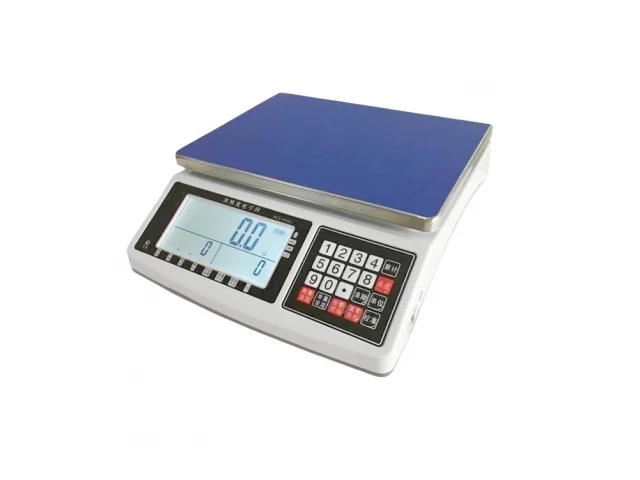
Different from ordinary weighing devices that only provide total weight data, counting scales are designed with independent data calculation logic centered on unit weight conversion. The core working logic of the equipment follows a simple and reliable physical conversion principle: all identical or highly uniform individual items have relatively stable single-piece weight parameters, and the total quantity of a batch of items can be deduced by calculating the ratio of the total batch weight to the average single-piece weight. This working mode completely subverts the limitations of manual counting, turning tedious one-by-one sorting work into automated data calculation, and greatly optimizing the overall process of batch quantity inspection and inventory counting.
The complete operation process of a counting scale is divided into two core stages: sample calibration and batch counting. Before formal counting work, users need to complete sample sampling to establish an accurate single-piece weight reference standard. In actual operation, staff will select a certain number of intact and representative individual items as test samples and place them stably on the weighing platform of the equipment. The equipment will accurately measure the total weight of the sampled items through high-sensitivity sensing components, and automatically calculate the average weight of a single item by dividing the total sample weight by the known sample quantity. To ensure the stability and authenticity of the reference data, it is usually recommended to select a moderate number of samples for calibration. A reasonable sample quantity can effectively avoid data deviation caused by individual subtle weight differences of items and lay a solid foundation for subsequent high-precision counting.
After the average unit weight data is generated and stored in the equipment’s internal system, the device enters the formal batch counting state. Users can place large batches of target items on the weighing platform continuously or in batches. The real-time weighing system of the counting scale will continuously collect total weight data, and automatically divide the real-time total weight by the pre-calibrated average single-piece weight to obtain the real-time quantity of items. The whole calculation process is completed instantly by the internal program, and the quantity data will be presented on the display screen in real time. When items are added or removed from the platform, the data will update synchronously, allowing operators to grasp the batch quantity changes at any time. For long-term repeated counting of the same items, the equipment can retain the stored unit weight data, eliminating the need for repeated sampling and calibration and further improving daily operation efficiency.
Counting scales have extremely high practical value in industrial production scenarios, especially in the processing and manufacturing industry involving small precision parts. In mechanical processing, electronic manufacturing, and hardware production links, a large number of small parts such as screws, nuts, gaskets, bearings, and miniature electronic components need to be counted, packaged, and inspected in batches. These items are small in size, large in single-batch quantity, and highly uniform in specification, which perfectly matches the application characteristics of counting scales. In the production and packaging link, workers can use the equipment to quickly complete quantitative packaging of parts, ensuring that the number of parts in each packaging unit meets the production and delivery standards. In the production inspection link, the equipment can be used to spot-check the quantity of finished and semi-finished products to avoid quantity shortages in assembled parts and ensure the smooth progress of subsequent assembly work.
Warehouse and logistics management is another key application scenario for counting scales. For manufacturing enterprises and distribution enterprises, regular inventory counting of spare parts, accessories, and bulk small commodities is a daily essential work. Traditional manual inventory consumes a lot of human resources and time, and counting errors often lead to inconsistent account and actual inventory, affecting procurement plans and production arrangements. The application of counting scales simplifies the inventory process greatly. Warehouse staff can complete the quantity statistics of bulk goods in a short time through weight conversion counting, realizing fast inventory sorting and stock data verification. In the goods receiving and delivery link of warehousing, the equipment can also be used to check the quantity of incoming and outgoing goods, effectively avoiding quantity discrepancies in the process of goods handover and reducing operational risks caused by counting errors.
The pharmaceutical and food industries also put forward high requirements for precise counting, and counting scales play an important role in standardized production in these fields. In pharmaceutical production, tablets, capsules, and granular medicinal materials need to be counted quantitatively in packaging and quality inspection. These medicinal products have strict specification standards with uniform single-piece weight, and counting scales can meet the high-precision counting requirements of pharmaceutical production, ensuring that the quantity of each finished pharmaceutical product meets the industry specifications and market sales standards. In the food industry, the equipment is suitable for counting and packaging bulk snacks, candy, grain particles, and standardized small packaged food, realizing unified quantitative production of food products and maintaining the consistency of product specifications.
In commercial retail and daily service scenarios, counting scales also bring convenient operational support. Many retail stores engaged in hardware accessories, small daily necessities, and bulk bulk goods sales need to carry out temporary quantitative sales and inventory sorting. The flexible operation mode of counting scales can adapt to small-batch and multi-frequency counting work, helping retail staff quickly complete customer demand matching and commodity quantity statistics. In addition, in financial service scenarios such as supermarket cash rooms and bank outlets, the equipment can assist in counting standardized coin batches, improving the efficiency of cash sorting and finishing, and realizing standardized management of cash inventory.
Laboratory scientific research and precision material management scenarios also rely on the accurate performance of counting scales. In chemical experiments, material science research, and biological research, many granular and block experimental materials need to be counted in precise quantities to ensure the accuracy of experimental ratio configuration and repeated experimental results. The high-sensitivity sensing and accurate data conversion capabilities of counting scales can meet the fine counting requirements of small-batch precision experimental materials, providing reliable data support for scientific research experiments and avoiding experimental errors caused by inaccurate material quantities.
Compared with manual counting and other traditional counting methods, counting scales show obvious comprehensive advantages in operational efficiency, data accuracy, and cost control. In terms of efficiency, the equipment can complete the counting of thousands of items in a few seconds, which is far faster than manual counting speed, and can adapt to high-frequency and large-batch counting work in industrial production. In terms of accuracy, the counting error of the equipment mainly comes from the subtle weight difference of individual items, and the error range can be effectively controlled through standardized sampling calibration, which is far more stable and reliable than manual counting that is easily affected by human factors. In terms of cost control, the popularization of counting scales reduces the dependence on manual counting labor, saves long-term human resource costs for enterprises, and avoids economic losses and operational troubles caused by counting errors such as insufficient product quantity or inconsistent inventory data.
To maintain the stable working performance and long-term service life of counting scales, standardized daily operation and maintenance management are essential. In the daily use process, the equipment should be placed on a flat, stable horizontal work surface to avoid weighing deviation caused by platform tilt and vibration. The weighing platform needs to be kept clean and dry at all times, and sundries, dust, and residual materials on the platform should be cleaned in time to prevent foreign matters from affecting the accuracy of weight sensing. In terms of operation specifications, users need to ensure that items are placed stably in the center of the weighing platform, avoid excessive stacking or eccentric placement of items, and prevent inaccurate weighing data caused by uneven stress on the platform.
Regular calibration and inspection are key links to ensure the continuous accuracy of counting scales. After long-term use or after moving the equipment position, users need to re-sample and calibrate the unit weight to eliminate data deviation caused by equipment slight parameter changes. For items with large individual weight differences, increasing the number of sampling pieces appropriately can optimize the average weight data and reduce counting errors. In terms of equipment maintenance, avoid violent collision and extrusion of the weighing platform, prevent damage to internal sensing components, and regularly check the power supply and circuit connection of the equipment to ensure stable operation of the system. Good usage habits and maintenance measures can effectively maintain the working performance of the equipment and ensure the long-term stability of counting data.
With the continuous upgrading of industrial intelligent operation modes and the continuous improvement of enterprise refined management requirements, the application scope of counting scales is still expanding. Traditional manual counting methods can no longer adapt to the high-efficiency and high-precision operation needs of modern industries, while counting scales, with their simple operation, stable performance, and wide adaptability, have become an indispensable basic measuring device in many industries. It not only solves the practical pain points of low efficiency and high error rate in traditional counting work, but also provides standardized and data-based support for enterprise production management, inventory control, and quality inspection.
In the future, with the continuous progress of sensing technology and intelligent data processing technology, the performance of counting scales will be further optimized, with stronger anti-interference ability, higher counting accuracy, and more convenient operation logic. The equipment will also be more closely integrated with enterprise intelligent management systems, realizing automatic data upload, inventory data synchronization, and production data statistics, helping enterprises further improve the level of refined management and intelligent operation. As a basic and practical measuring tool, counting scales will continue to exert important value in various industrial, commercial, and scientific research scenarios, and provide solid technical support for the efficient and standardized operation of modern social production and service links.
https://www.veidtweighing.com/CommercialScale/CountingScale
Post Date: Jun 7, 2026
https://www.supplier-manufacturer.com/weight-balance-scale/counting-scales.html

![Oiml Stainless Steel Weight]()
Oiml Stainless Steel Weight
In every sector that relies on accurate mass measurement to maintain operational consistency and reliable operational outcomes, stainless steel weights stand out as founda…![Stainless Steel Calibration Weight For Pharmacy Laboratory]()
Stainless Steel Calibration Weight For Pharmacy Laboratory
In pharmaceutical laboratory operations, accurate weight measurement serves as the fundamental foundation for every experimental procedure, drug formulation test, quality …![100kg Test Weight]()
100kg Test Weight
In the complex and interconnected world of industrial production, scientific experimentation, and daily operational measurement management, reliable mass reference tools f…![Stainless Steel Weight Manufacturer]()
Stainless Steel Weight Manufacturer
Stainless steel weights have become indispensable functional components across a wide spectrum of industrial and commercial sectors, owing to the unique physical and chemi…![Specifications of Test Weight]()
Specifications of Test Weight
Test weights serve as fundamental physical mass references applied across a wide spectrum of industrial production, weighing instrument verification, daily metering adjust…