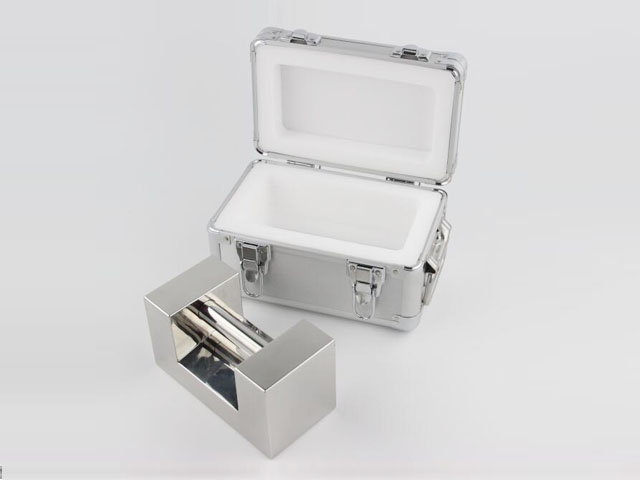
Precision Calibration Weight
Precision calibration weight stands as an essential foundational element within the entire framework of modern mass measurement and industrial metrology, serving as a tangible and reliable reference medium that bridges theoretical mass standard values and practical weighing operation scenarios. In every scenario that requires reliable and repeatable mass data output, from sophisticated laboratory analytical testing to continuous mass detection in industrial production lines, from quality control verification in daily manufacturing processes to accurate parameter debugging of precision weighing equipment, these specially crafted mass pieces undertake the core task of unifying measurement benchmarks and eliminating measurement deviations. Unlike ordinary counterweights or common weighted objects used for simple pressing and balancing purposes, precision calibration weight is designed and produced with a singular core focus on maintaining stable and consistent mass attributes over long-term use and complex environmental changes, ensuring that every comparison and adjustment operation conducted with its participation can reflect real and objective mass relationships, and provide stable and credible data support for all subsequent production testing, experimental research and quality assessment work. The essence of using precision calibration weight lies in establishing a fixed and known mass reference point, enabling various types of weighing instruments and mass detection equipment to complete the comparison between displayed measurement values and actual standard mass values, thereby realizing the fine adjustment of equipment operating parameters and the elimination of systematic errors generated during long-term equipment operation.
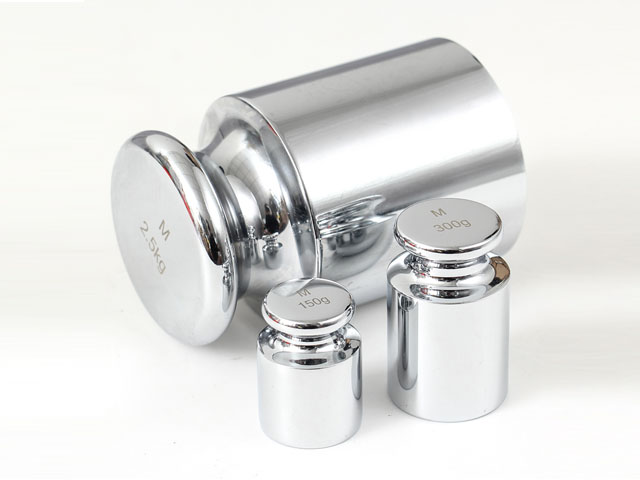
The working logic behind precision calibration weight follows the most basic physical principle of mass and gravity interaction, a simple yet profoundly reliable mechanical and physical correlation that remains stable under conventional environmental changes and conventional application conditions. When a precision calibration weight is stably placed on the weighing pan or bearing platform of any weighing instrument, the weight will exert a stable downward force on the contact surface of the equipment, and the magnitude of this force is directly proportional to the inherent mass of the weight itself and the local gravitational acceleration environment. The internal mechanical structure or electronic induction components inside the weighing instrument, including traditional mechanical lever transmission structures and modern high-sensitivity load cell sensing systems, will accurately capture the force signal transmitted by the weight, and convert the collected mechanical pressure signal into intuitive mechanical displacement changes or standardized electrical signal data. The internal processing system of the weighing equipment will then compare the converted signal data with the preset standard mass reference range stored in the equipment program, and calculate the subtle difference between the actual displayed reading of the equipment and the real mass value of the precision calibration weight placed on it. Once a measurable deviation is detected between the two data sets, professional operators can carry out targeted parameter correction and fine tuning on the weighing instrument according to the deviation range, gradually reducing the error value until the equipment’s displayed reading is completely consistent with the known mass value of the calibration weight. This entire comparison and adjustment process forms the complete closed loop of weighing equipment calibration, and precision calibration weight is the only reliable reference benchmark throughout the whole process, without which all calibration actions would lack objective evaluation criteria and practical correction basis, and the accuracy of weighing equipment would gradually lose effective control over time.
The selection of manufacturing materials for precision calibration weight is one of the core determinants of its long-term stability and consistent measurement performance, and every material selection decision focuses on balancing multiple key characteristics including density uniformity, environmental corrosion resistance, surface oxidation resistance, structural hardness stability and long-term mass retention. High-quality metal alloy materials with compact internal molecular structure and stable chemical properties are the most commonly used base materials for producing such calibration weights, as these materials can effectively avoid the common problems of ordinary metal materials such as easy surface oxidation, internal structural looseness, easy adsorption of external impurities and obvious mass loss after long-term use. In the processing and production process, the selected raw materials will undergo strict internal quality screening to eliminate raw materials with internal pores, molecular density unevenness and trace impurity residues, because even tiny internal structural defects will cause subtle mass changes in the weight during long-term use and environmental temperature and humidity changes, thereby affecting the accuracy of subsequent calibration work. After the completion of raw material screening, the materials will undergo multiple forging and pressing and fine heat treatment processes to further compact the internal molecular structure, enhance the overall structural stability of the material, and reduce the impact of external temperature changes on the volume and mass of the weight. Different application scenarios and different calibration accuracy requirements correspond to different material matching schemes, and the core selection principle is always to ensure that the weight can maintain almost no mass fluctuation under long-term storage and repeated use, and will not produce chemical reactions with the external air, moisture and common industrial chemical reagents to cause surface corrosion or material loss.
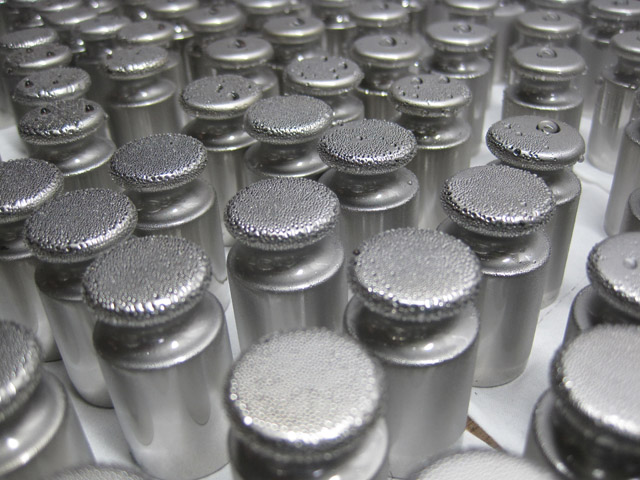
The processing and manufacturing process of precision calibration weight requires extremely fine production standards and rigorous process control links, and every processing step from initial blank forming to final surface finishing and mass fine adjustment is carried out in a strictly controlled production and processing environment to avoid processing errors caused by external environmental interference. After the base material is made into the initial blank of the weight through preliminary cutting and forging, the blank will undergo multiple precision cutting and grinding processes to ensure that the overall shape of the weight is regular, the surface flatness meets the use requirements, and the contact surface with the weighing instrument is smooth and flat without obvious protrusions, depressions or burrs. A smooth and flat contact surface can ensure that the weight is evenly stressed when placed on the weighing equipment, avoid local stress concentration caused by uneven contact surface, and prevent measurement errors caused by unstable placement of the weight during calibration. After the completion of mechanical shaping and surface grinding, all precision calibration weights will enter the fine mass adjustment stage, which is the most critical link in the entire production process. Professional processing technicians will gradually fine-tune the mass of each weight through micro-cutting and surface finishing according to the preset standard mass parameters, and repeatedly test and verify the mass value in a stable temperature and humidity measurement environment until the actual mass of each weight is within the allowable subtle deviation range of the design standard. After the mass fine adjustment is completed, the surface of the weight will be treated with special protective finishing processes to further enhance oxidation resistance and wear resistance, reduce the adhesion of dust and moisture on the surface, and extend the service life of the weight while maintaining long-term mass stability.
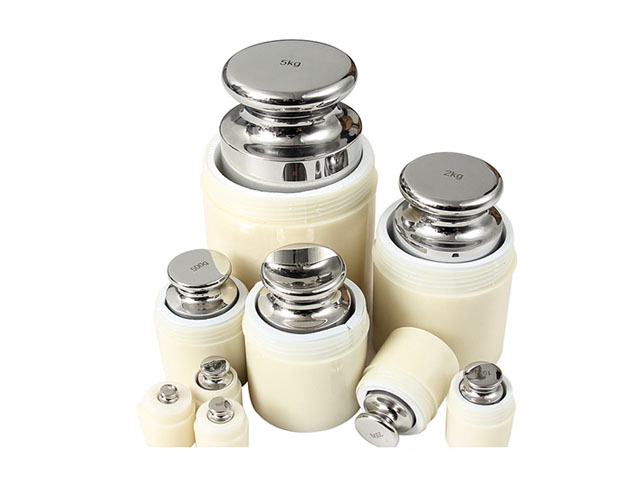
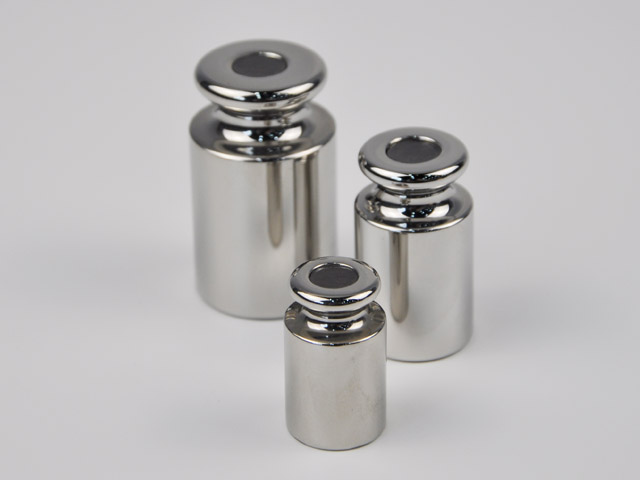
The structural design of precision calibration weight fully considers the practical convenience of actual use, storage and carrying as well as the stability of repeated placement and use, and the overall structural form is designed to be simple, compact and reasonable without redundant structural parts that may affect mass stability. Most precision calibration weights adopt a regular overall structure, which is convenient for stable placement on the weighing pans of various specifications of weighing instruments, and will not tilt or shift due to structural problems during placement, ensuring the consistency of each placement state and calibration operation effect. Some calibration weights designed for frequent handling and mobile use are equipped with reasonable carrying structural parts that do not affect the overall mass balance, making it convenient for operators to take and place the weights without directly touching the main body of the weight with hands, effectively avoiding the impact of hand sweat, grease and skin impurities on the surface of the weight on its mass stability. The internal structure of the weight is designed to be integrally formed as much as possible, reducing the use of assembled connecting parts, because long-term use of assembled structures may lead to loose connecting parts or subtle gaps, resulting in slow changes in the overall mass and structural stability of the weight. All structural designs take the core demand of maintaining long-term mass consistency as the primary premise, and on this basis, optimize the use experience and operation convenience, so that operators can complete calibration work efficiently and accurately without causing unnecessary mass loss or structural damage to the weight during operation.
Environmental adaptability is an important performance dimension that precision calibration weight must have in practical application, because calibration work is not only carried out in constant temperature and humidity laboratory environments, but also often needs to be completed in complex industrial production workshops, outdoor field detection sites and other variable environments with large temperature and humidity changes and many dust and impurity interference factors. High-quality precision calibration weight can maintain stable mass and structural performance within a conventional temperature and humidity change range, and will not produce obvious volume expansion and contraction due to temperature rise and fall, nor will it absorb a large amount of moisture in a high-humidity environment to cause temporary mass increase. The surface protective layer and stable metal material structure can effectively resist the erosion of fine dust, industrial floating particles and trace corrosive gases in the air in the working environment, avoiding surface corrosion, rust and adsorption of excessive impurities. In different regional atmospheric environments and different seasonal climate change conditions, the basic performance and mass value of the calibration weight can remain stable, ensuring that the calibration work completed in different time periods and different environmental spaces has consistent reference standards, and the measurement data obtained before and after has comparability and continuity. Even in working environments with slight vibration and minor mechanical impact, the solid structural design of the weight can avoid internal structural damage and surface wear, ensuring that the mass value will not fluctuate due to external minor mechanical interference.
Routine correct use specifications and standardized operation methods are crucial to maintaining the long-term accuracy and service life of precision calibration weight, and any irregular operation behavior may cause subtle mass changes or surface damage to the weight, thus affecting the accuracy of subsequent calibration work. During the use process, operators should avoid directly touching the surface of the precision calibration weight with bare hands at all times, and it is necessary to use special non-woven gloves or professional weight taking tools to complete the work of taking, placing and moving the weight. The grease, sweat and fine dirt on the human hand surface will adhere to the surface of the weight after contact, which will not only cause temporary slight mass increase of the weight, but also easily cause chemical corrosion and oxidation on the metal surface after long-term adhesion, resulting in permanent mass change and surface damage. When placing the calibration weight on the weighing instrument, the operation should be gentle and steady, avoiding violent throwing, dropping and collision, so as to prevent the weight from being impacted by external force to cause surface wear, edge deformation and internal structural looseness. After each calibration work is completed, the precision calibration weight should be taken down from the weighing equipment in time, and placed in a special dry and dust-proof storage container after simple surface dust removal treatment, and should not be randomly placed on the workbench or in a humid and dusty environment for a long time. In the process of use and handling, collision between multiple weights should be avoided to prevent mutual surface wear and structural deformation, and each weight should be used independently and stored separately according to different mass specifications to ensure orderly management and stable performance.
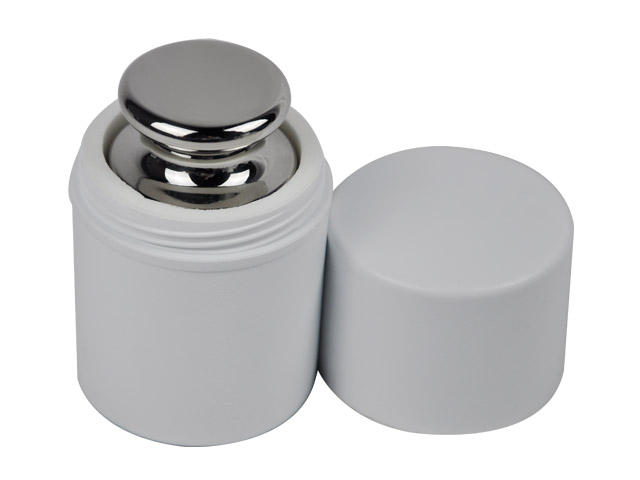
Daily maintenance and scientific long-term storage management are important links to ensure that precision calibration weight maintains stable performance for many years, and reasonable maintenance measures can effectively delay the aging and wear of the weight and avoid unnecessary mass deviation caused by poor management. The daily maintenance work of precision calibration weight is mainly concentrated on surface cleaning and environmental drying protection. For the dust and fine floating impurities adsorbed on the surface of the weight during use, it is necessary to use a soft, lint-free special cleaning cloth for gentle wiping and cleaning regularly, and rough cleaning tools such as hard brushes and abrasive cleaning cloths are prohibited to avoid scratching the surface protective layer and metal surface of the weight. For slight moisture and trace stains on the surface, it can be wiped with a slightly dampened soft cleaning cloth, and then placed in a dry and ventilated environment to dry naturally; cleaning solutions with corrosive ingredients are not allowed to clean the weight, so as to prevent chemical damage to the surface structure and affect mass stability. The storage environment of precision calibration weight needs to maintain constant temperature and dry conditions as much as possible, avoid long-term exposure to direct sunlight, and stay away from humid, high-temperature and corrosive gas accumulation areas. The special storage container for weights needs to have good dust-proof and moisture-proof functions, and the interior should be kept clean and dry all the time to prevent dust and moisture from entering and contacting the weight for a long time. Regular regular inspection of the stored precision calibration weights is also required, checking whether there is surface corrosion, wear, deformation and obvious impurity adhesion, and timely cleaning and adjustment are carried out once abnormal conditions are found to ensure that each weight is always in a usable state with stable performance.
Precision calibration weight has extremely wide application coverage in modern social production, scientific research and testing, commercial measurement and other fields, and almost all links involving accurate mass measurement and weighing equipment debugging cannot do without the support of such calibration weights. In scientific research laboratory scenarios, various analytical balances, precision electronic balances and experimental special weighing equipment need to be calibrated and verified regularly with the help of precision calibration weight to ensure the accuracy of mass data in chemical component testing, material performance research, biological sample preparation and scientific experiment data recording, and all experimental research conclusions based on mass measurement data need reliable calibration work to provide data accuracy guarantee. In industrial manufacturing and processing industries, whether it is the raw material batching link in production lines, the finished product quality inspection link, or the debugging and maintenance of production and processing weighing equipment, precision calibration weight is required to complete the calibration work of weighing equipment, ensuring that the mass data of raw material proportioning and finished product inspection are accurate and reliable, avoiding production quality problems and product performance deviations caused by inaccurate weighing data.
In the food processing and daily consumer goods production industry, the accurate control of product net content and the standardized detection of production auxiliary materials are closely related to precision calibration work. Precision calibration weight helps various production weighing and filling equipment maintain accurate measurement status, ensuring that the net content of each batch of products meets unified production standards, maintaining the consistency of product quality and specifications, and safeguarding the legitimate rights and interests of consumers while stabilizing the market reputation of production enterprises. In the pharmaceutical production and medical testing industry, the proportioning of pharmaceutical raw materials, the preparation of medical reagents and the weighing detection of medical supplies all require extremely high measurement accuracy. The use of precision calibration weight to regularly calibrate medical weighing equipment can effectively avoid measurement errors affecting the efficacy of pharmaceutical products and the accuracy of medical testing, and provide basic guarantee for medical safety and drug quality stability. In the fields of new material research and development, electronic component manufacturing and precision machinery processing, the tiny mass deviation of raw materials and parts will directly affect the performance and qualification rate of finished products. Precision calibration weight provides a stable measurement reference for the production and testing equipment in these high-precision manufacturing fields, ensuring that every production and processing link can be carried out according to accurate mass standards.
In commercial trading and market metrological supervision scenarios, precision calibration weight undertakes the important work of regular verification and calibration of various commercial weighing devices, ensuring that the weighing data of commercial transactions is fair and accurate, maintaining the good order of market trading activities, and avoiding trading disputes and market chaos caused by inaccurate weighing equipment. In outdoor engineering construction, geological exploration and field testing work, mobile weighing detection equipment often needs to be calibrated on site. Portable precision calibration weight can adapt to field complex environment use conditions, complete rapid calibration and parameter adjustment of field weighing equipment, and ensure the accuracy and validity of field detection data. In the waste recycling, material sorting and logistics packaging industries, the statistical weighing of various materials and goods also needs stable calibration support from precision calibration weight, ensuring the accuracy of material counting and weight statistics, and reducing economic losses and statistical errors caused by inaccurate weighing.
The long-term value significance of precision calibration weight lies in that it provides the most basic and unified measurement benchmark for the entire mass measurement industry, realizes the unification of measurement standards in different regions, different industries and different use scenarios, and lays a solid foundation for the standardization and standardized development of all work related to mass measurement. All weighing instruments and detection equipment will produce subtle measurement drift and parameter deviation after long-term operation, mechanical vibration, environmental changes and frequent use. This slow error accumulation is difficult to be perceived by operators in daily use, and will gradually affect the accuracy of measurement data if not corrected for a long time. Precision calibration weight acts as a reliable error detection and correction tool, regularly checking the operating status of weighing equipment, discovering subtle measurement deviations in time, and helping operators complete equipment parameter correction, so that all weighing equipment can always maintain a stable and accurate working state. The continuous and stable operation of industrial production, the accurate progress of scientific research experiments, the fair development of commercial transactions and the safe implementation of medical and health work all rely on the accurate mass measurement data guaranteed by precision calibration weight.
With the continuous progress of modern manufacturing technology and the continuous improvement of metrology and measurement requirements in various industries, the production and processing technology and performance design of precision calibration weight are also constantly optimized and upgraded, adapting to the increasingly high-precision and refined measurement work needs. The continuous optimization of new metal alloy materials further enhances the environmental adaptability and long-term mass stability of calibration weights, making them suitable for more extreme use environments and longer-term cyclic use. The continuous improvement of precision processing technology makes the mass adjustment accuracy and surface processing fineness of calibration weights higher, meeting the calibration requirements of more high-precision weighing instruments and micro-mass detection equipment. The continuous improvement of structural design and maintenance management methods makes the use and storage of precision calibration weight more convenient and efficient, reducing the maintenance cost and use difficulty for operators. No matter how the industrial production mode and scientific research and testing technology change, the core fundamental status of precision calibration weight as a mass measurement reference benchmark will never change. It will always be an indispensable basic tool in the field of metrology and measurement, escorting the accurate development of all production, scientific research and trading work that relies on mass measurement data.
Precision Calibration Weight
https://www.veidtweighing.com/calibration-weights.html
Post Date: Apr 28, 2026
https://www.supplier-manufacturer.com/calibration-weight/precision-calibration-weight.html

![Balance Calibration Weight]()
Balance Calibration Weight
In every field that relies on precise mass determination, from basic laboratory scientific research to industrial production processing, pharmaceutical ingredient preparat…![1kg Calibration Weight]()
1kg Calibration Weight
In the intricate and interconnected world of modern measurement science and industrial production, the pursuit of consistent and reliable mass measurement forms the invisi…![Rust Proof Standard Weight]()
Rust Proof Standard Weight
Rust proof standard weight represents a specialized material configuration that balances consistent structural weight distribution and reliable anti-corrosion performance,…![Stainless Steel Weight For Digital Scale Regular Calibration]()
Stainless Steel Weight For Digital Scale Regular Calibration
In the modern era of precision measurement, digital scales have become indispensable tools across countless industries and daily applications, ranging from laboratory scie…![Standard Weight For Industrial Scales]()
Standard Weight For Industrial Scales
In modern industrial production, commercial trade, and quality inspection systems, the accuracy and stability of weighing measurements serve as the fundamental guarantee f…