Moisture Analyzer For Sale
Moisture content stands as one of the most critical physical indicators that determine the quality, stability, and usability of various raw materials and finished products across industrial production, laboratory research, and daily manufacturing processes. Uncontrolled moisture levels in materials can trigger a series of undesirable outcomes, including shortened storage cycles, degraded physical and chemical properties, inconsistent product batches, and even potential safety risks during production and transportation. For enterprises and research institutions that pursue stable production standards and standardized quality inspection, reliable moisture detection equipment has become an essential part of daily operational management. A moisture analyzer serves as a professional testing instrument designed to accurately measure the moisture proportion in solid, powder, granular, and even partial viscous materials, offering efficient and intuitive detection solutions that replace traditional cumbersome testing methods and adapt to modern high-frequency detection demands.
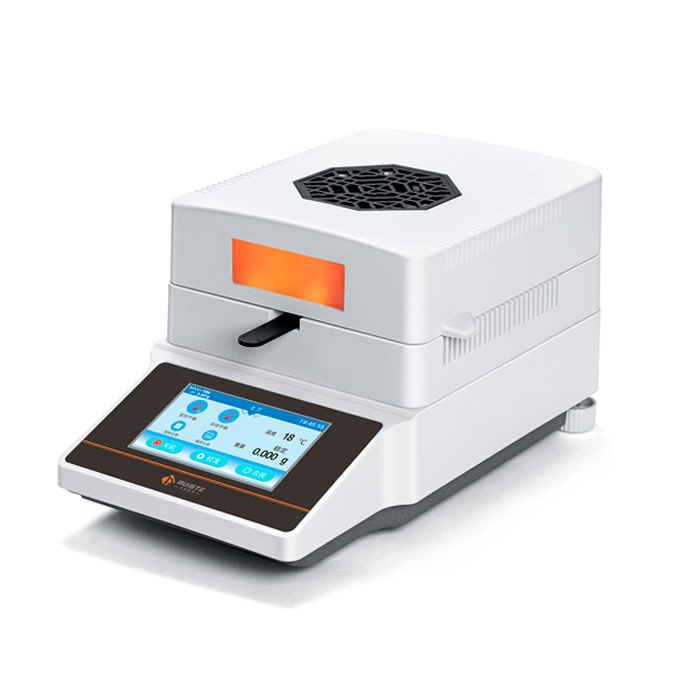
The core working logic of a moisture analyzer follows the classic thermogravimetric drying principle, a mature and widely recognized testing mechanism for moisture detection in mainstream industries. The equipment integrates a high-precision weighing system and a controllable heating module, forming an automated testing workflow that minimizes manual intervention and operational errors. Before the formal detection process, users place a processed sample on the dedicated weighing pan of the instrument, and the built-in precision balance automatically records the initial weight of the sample with stable and sensitive data capture capabilities. Subsequently, the heating module starts to work, providing uniform and adjustable thermal radiation to evaporate free water and partial bound water contained in the sample. Throughout the entire drying process, the weighing system continuously monitors and records real-time weight changes of the sample, tracking the weight loss caused by moisture evaporation dynamically.
When the sample weight tends to stabilize and no obvious weight loss is detected within a set period, the instrument automatically judges the completion of drying and calculates the moisture content of the sample based on the total weight loss data. The final result is usually presented in the form of percentage moisture content, which is convenient for users to record, compare, and archive data. Compared with traditional constant-temperature oven drying methods that require manual weighing, long waiting time, and repeated data verification, modern moisture analyzers greatly shorten the detection cycle. Traditional drying methods often take several hours to complete a single test, while standard moisture analysis equipment can finish the whole process from sample weighing to result output in a short time, significantly improving the efficiency of batch detection and real-time quality monitoring on production lines.
The internal structural design of moisture analyzers focuses on practicality, stability, and operational convenience, with every component optimized for daily high-frequency use. The heating system adopts efficient heating components that can form a uniform thermal field in the detection cavity, ensuring that the sample is heated evenly without local overheating. Uniform heating effectively avoids inaccurate detection results caused by incomplete drying of partial samples or thermal decomposition of material components due to excessive temperature. The temperature control system supports flexible parameter adjustment, allowing users to set appropriate drying temperatures and holding times according to the thermal stability and physical characteristics of different samples. This adjustable design enables the equipment to adapt to diverse testing scenarios, covering low-temperature drying of heat-sensitive materials and high-temperature rapid drying of stable industrial raw materials.
The precision weighing unit equipped in the instrument is the core guarantee of accurate detection data. With sensitive weight sensing performance, it can capture tiny weight changes in the sample during the drying process, ensuring that the calculated moisture data maintains good consistency and repeatability. Many models are equipped with an anti-interference structure inside the weighing module, which can reduce the impact of external air flow and slight vibration on weighing accuracy in conventional laboratory and production workshop environments. The humanized operation interface is matched with intuitive data display functions, enabling operators to view real-time sample weight, current temperature, drying duration, and dynamic moisture change data during the testing process, making the entire detection process transparent and controllable.
Moisture analyzers have extremely wide application coverage, penetrating almost all industries that require strict moisture control of materials. In the food processing industry, moisture detection is a key link in quality control and shelf-life management. Grain materials such as rice, wheat, and corn need stable moisture content to prevent mildew and deterioration during long-term storage and bulk transportation; excessive moisture in flour, starch, and powder food ingredients will affect processing molding effect and product taste, while insufficient moisture will lead to dry texture and poor user experience. For meat products, dairy products, dried fruits, and condiments, standardized moisture testing helps maintain consistent product texture, avoids fermentation and spoilage caused by excessive water content, and ensures batch stability of finished products in mass production.
In the chemical and new material industry, moisture content directly affects the performance and application effect of raw materials and finished products. Polymer particles, resin materials, plastic raw materials, and coating ingredients are highly sensitive to moisture; residual moisture in these materials will cause bubbles, cracks, and uneven texture during processing such as injection molding and curing, reducing the structural stability and service life of finished products. Daily detection and strict control of raw material moisture can effectively improve the yield of finished products and reduce production waste. In addition, chemical additives, powdered reagents, and detergent raw materials also require regular moisture testing to ensure the chemical stability and qualified purity of materials, avoiding component changes caused by moisture absorption that affect product efficacy.
The agricultural and feed industries also rely heavily on moisture analysis equipment for daily production and storage management. For various feed raw materials and finished feed products, stable moisture content can prevent mildew and insect infestation during storage, while ensuring the nutritional component proportion of feed meets standard requirements. Soil moisture detection through professional instruments provides accurate data support for agricultural planting, helping growers grasp soil water conditions and formulate reasonable irrigation plans, which is conducive to improving crop growth efficiency. Various agricultural by-products such as dried vegetables, tea leaves, and nuts also need moisture standard detection to meet market circulation quality requirements and extend product shelf life.
In the building materials and environmental protection industry, material moisture testing is an indispensable part of quality inspection. Cement, gypsum, sand, and other building raw materials have strict moisture control standards; excessive moisture in raw materials will affect the bonding strength and solidification effect of building materials, leading to potential quality hazards in engineering construction. In environmental monitoring and solid waste treatment, moisture detection of sludge, industrial residues, and soil samples helps staff accurately calculate material composition and formulate targeted treatment and resource utilization plans. Paper-making and textile industries also use moisture analyzers to detect paper pulp, finished paper, and textile fabrics, controlling moisture content to ensure the toughness, flatness, and texture stability of products.
In pharmaceutical and cosmetic production, moisture control is related to product safety and shelf-life stability. Traditional Chinese medicine powder, tablet raw materials, capsule fillers, and various pharmaceutical intermediates need precise moisture detection to avoid mold growth and component deterioration during storage. Cosmetic raw materials such as powder substrates and clay ingredients also require standardized moisture testing to ensure product texture uniformity and storage stability, reducing quality fluctuations in batch production.
In addition to diverse application scenarios, modern moisture analyzers have many practical functional advantages that adapt to the development needs of modern industrial detection. The equipment supports full-automatic testing operation after parameter setting, which reduces manual operation steps and lowers the threshold for use. New operators can quickly master basic operation methods through simple training, realizing independent completion of daily detection work. The built-in data storage function can record multiple groups of historical detection data, facilitating subsequent data query, statistical analysis, and quality traceability, which is very suitable for enterprises that need to establish standardized quality inspection files.
The compact and reasonable structural design makes the equipment adaptable to different placement environments. The small footprint allows it to be placed flexibly in laboratory operation tables, production line quality inspection stations, and mobile detection platforms, without occupying excessive production and office space. The closed heating cavity design can effectively reduce heat loss, improve heating efficiency, and avoid the impact of external temperature on the internal drying environment, ensuring the stability of each detection process. Meanwhile, the equipment has good anti-corrosion and high-temperature resistance performance in key components, which can adapt to long-term high-frequency use and maintain stable working performance in conventional working environments.
Standardized operation and daily maintenance are key to maintaining the long-term stable performance of moisture analyzers and ensuring accurate and reliable detection results. Before each test, operators need to check the cleanliness of the instrument cavity and weighing pan to avoid residual sample impurities affecting weighing accuracy and drying effect. It is necessary to ensure the instrument is placed on a horizontal and stable working platform to prevent detection errors caused by tilt and vibration. For different types of samples, targeted pretreatment is required: solid block samples need to be crushed and ground appropriately to increase the heating contact area and ensure uniform drying; viscous samples need to be spread evenly to avoid agglomeration and incomplete internal drying; heat-sensitive samples need to match low-temperature drying parameters to prevent sample decomposition and invalid detection results.
Regular daily maintenance includes cleaning the instrument shell, heating cavity, and weighing components to keep the equipment clean and tidy. Long-term unused equipment needs to be placed in a dry and ventilated environment to avoid moisture intrusion affecting internal circuit and sensing components. Regular parameter calibration of the weighing system and temperature control system can effectively ensure the long-term accuracy of the instrument, avoid data deviation caused by long-term use and component aging, and maintain the stability of batch detection results. Good usage habits and maintenance plans can effectively extend the service life of the equipment and reduce the frequency of failure and subsequent maintenance costs.
For enterprises and institutions with long-term moisture detection needs, equipping with professional moisture analysis equipment can effectively optimize the quality control system in the production and inspection process. Traditional manual detection methods are not only inefficient but also easily affected by human operation factors, leading to large data deviation and poor repeatability. The use of dedicated moisture analyzers can standardize the detection process, unify detection standards for different batches of samples, make product quality control more standardized and systematic, and help enterprises reduce product quality fluctuations and unnecessary material waste. In laboratory research scenarios, accurate moisture data also provides reliable basic support for material formula optimization, process improvement, and product performance research.
With the continuous upgrading of industrial production standards and quality inspection requirements, the market demand for high-stability and high-efficiency moisture detection equipment is constantly increasing. Modern moisture analyzers are gradually developing towards intelligent operation, diversified adaptation, and high-precision detection, continuously optimizing heating efficiency, data processing speed, and anti-interference ability. Whether for small-batch precise detection in scientific research laboratories or large-batch rapid screening in industrial production lines, qualified moisture analyzers can provide stable and reliable technical support. Choosing a suitable moisture analyzer according to sample characteristics, detection frequency, and industry testing standards can effectively meet the daily production and inspection needs of various industries, helping users establish a more rigorous and efficient quality management system and lay a solid foundation for stable product quality and standardized production operation.
Moisture Analyzer For Sale
https://www.pruiste.com/moisture-analyzer.html
Post Date: May 23, 2026
https://www.supplier-manufacturer.com/moisture-analyzer/moisture-analyzer-for-sale.html

![What is Electronic Balance]()
What is Electronic Balance
In the fields of modern metrology detection, industrial production, scientific research experiments and daily precision processing, electronic balances have become indispe…![Hydrostatic Balance JY SERIES]()
Hydrostatic Balance JY SERIES
The entire series of JY balances uses branded sensors to ensure high accuracy and stability of weighing results. This series of precision casting ABS Environmental protect…![Digital Viscometer Exporter]()
Digital Viscometer Exporter
Viscosity stands as one of the most fundamental physical properties of fluid materials, reflecting the internal friction and flow resistance of substances during movement.…![Digital Viscometer For Sale]()
Digital Viscometer For Sale
Viscosity serves as one of the most fundamental physical properties of fluid substances, reflecting the internal friction and flow resistance of liquids during movement. I…![Industrial Digital Viscometer]()
Industrial Digital Viscometer
Viscosity stands as one of the most critical physical properties of fluid materials, reflecting the internal frictional resistance that occurs when a fluid undergoes flow …