Automatic Moisture Analyzer
Moisture content stands as one of the most critical physical indicators that determine the quality, stability and practical performance of various raw materials and finished products across modern industrial production and laboratory research. Excess or insufficient moisture in materials can trigger changes in physical properties such as density, viscosity and texture, undermine chemical stability during storage and transportation, and even affect the safety and usability of end products. In traditional material detection systems, manual moisture testing methods rely on cumbersome operation steps, long testing cycles and frequent human intervention, which often lead to inconsistent detection data and low testing efficiency, making it difficult to adapt to the high-frequency and high-precision detection needs of modern industrial production and scientific research. The automatic moisture analyzer has gradually become a mainstream testing device in various industries by virtue of its automated operation process, stable detection performance and efficient data output, providing reliable technical support for standardized material quality control and production process optimization.
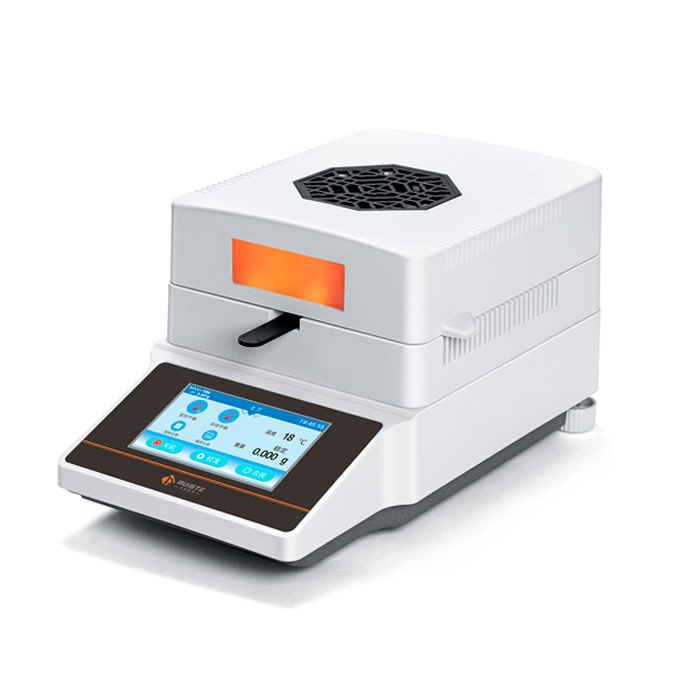
The core working mechanism of automatic moisture analyzers is based on the thermogravimetric loss-on-drying principle, a mature and universal moisture detection methodology recognized in material analysis fields. The entire testing process follows a complete and automated logical cycle including sample weighing, constant-temperature drying, real-time mass monitoring and data calculation, with minimal manual participation required. Before formal testing, the device completes self-calibration and environmental parameter adaptation according to internal program settings, eliminating the interference of ambient temperature, air flow and minor equipment deviations on test results. After the sample is placed in the testing chamber, the high-precision weighing module first records the initial mass data of the sample accurately, capturing the original weight state of the material before moisture removal. Subsequently, the intelligent heating system starts to work, delivering uniform and stable thermal energy to the testing chamber, which can quickly and gently evaporate free moisture and weakly bound moisture inside the sample without causing decomposition, deterioration or loss of effective components of the material itself.
Different from traditional manual drying equipment that relies on fixed heating duration for testing, automatic moisture analyzers adopt dynamic real-time monitoring logic throughout the drying process. The built-in high-sensitivity sensor and precision balance module continuously collect the mass change data of the sample during heating and transmit the data to the internal processing system for real-time analysis and judgment. The device will automatically identify the drying endpoint according to the preset stability threshold: when the sample mass no longer changes significantly within a set period, it is determined that the moisture evaporation process is complete, and the heating system will automatically stop working to avoid excessive drying that may cause material loss and result in biased data. After the drying process ends, the system calculates the moisture content of the sample through the mass difference between the initial state and the constant-weight state, and forms intuitive and traceable test data. The whole process realizes full-process automation from sample detection to result output, effectively avoiding data errors caused by manual weighing, timing judgment and result calculation in traditional detection methods.
The structural design and functional configuration of modern automatic moisture analyzers fully cater to the diversified detection demands of different materials and scenarios, with prominent advantages in operational stability and applicability. In terms of heating design, the optimized thermal radiation structure enables uniform heat distribution in the testing chamber, ensuring consistent heating of all parts of the sample. This design effectively solves the problem of uneven drying of block, powdery and granular materials in traditional heating equipment, ensuring the comprehensiveness of moisture removal and the accuracy of detection results. Meanwhile, the intelligent temperature control system supports adjustable heating parameters, which can adapt to the thermal stability characteristics of different materials. For heat-sensitive materials such as food raw materials and biological preparations, low-temperature constant-speed heating can be set to protect material activity; for stable industrial raw materials such as chemical particles and building materials, efficient heating modes can be adopted to shorten the testing cycle and improve detection efficiency.
The high-precision sensing and weighing system is the core guarantee for the reliable performance of automatic moisture analyzers. The integrated high-resolution weighing unit can capture tiny mass changes of samples, meeting the detection requirements of materials with different moisture content ranges, from trace moisture detection of high-purity raw materials to conventional moisture testing of bulk industrial materials. In addition, the device is equipped with an intelligent data processing and storage module, which can automatically record each test parameter including heating temperature, drying duration, sample mass change curve and final moisture data. These stored data can be called and sorted at any time, which is convenient for enterprises and research institutions to establish material quality archives, track production quality changes, and provide effective data support for production process adjustment and product quality optimization. The humanized interactive interface simplifies operation steps, enabling operators to complete parameter setting, sample detection and data viewing through simple operations, reducing professional threshold and improving operational convenience.
Automatic moisture analyzers have been widely applied in multiple core industries, playing an irreplaceable role in quality control and process optimization. In the food and agricultural industry, moisture content directly affects the shelf life, taste and storage stability of products. Grain, flour, dried fruits, spices and feed materials are all affected by moisture changes: excessive moisture will cause mildew and deterioration of grain and feed during storage, while low moisture will affect the processing texture and edible taste of food products. Regular moisture detection with automatic analyzers helps food and agricultural production enterprises control raw material quality, optimize processing technology, and ensure the stability and safety of finished products. The efficient and fast detection feature of the device is also suitable for batch sampling detection in production lines, realizing real-time monitoring of production links and reducing the risk of unqualified products entering the market.
In the chemical and new material industry, moisture content is a key indicator affecting the performance of polymer materials, resin raw materials, chemical additives and powdered chemical products. Residual moisture in chemical raw materials may affect the reaction efficiency of chemical synthesis, cause product performance attenuation, and even trigger unstable chemical changes during material storage. Automatic moisture analyzers can accurately detect trace moisture in chemical raw materials and finished materials, helping chemical enterprises strictly control raw material incoming quality and finished product delivery standards, and maintain the stability of material application performance. In the processing of plastic particles, rubber raw materials and polymer composites, real-time moisture detection can effectively avoid product defects such as bubbles and cracks caused by excessive moisture during molding processing, improving the yield and quality consistency of industrial products.
The pharmaceutical and biological industry also puts forward high requirements for moisture detection accuracy and stability, and automatic moisture analyzers have become important testing equipment in pharmaceutical quality control laboratories. For pharmaceutical raw materials, auxiliary materials, traditional Chinese medicine granules and tablet preparations, moderate moisture content is crucial to maintaining the stability of pharmaceutical components and ensuring the efficacy and safety of drugs. Excessive moisture may cause drug deterioration and component hydrolysis, while too low moisture may lead to drug fragmentation and performance changes during production and transportation. The automatic detection mode of the device avoids cross-contamination and manual operation errors in the detection process, meets the high-standard testing requirements of the pharmaceutical industry for experimental data repeatability and traceability, and provides reliable guarantees for drug quality supervision and standardized production.
In the construction and environmental testing fields, automatic moisture analyzers also show strong application value. Building materials such as cement, gypsum, sand and coating raw materials have strict moisture control standards, as moisture content affects the bonding performance, strength stability and construction effect of building materials. Accurate moisture detection can guide construction units to screen qualified raw materials and optimize construction processes to ensure the engineering quality stability. In environmental monitoring, the device can be used for moisture detection of soil samples, sediment samples and environmental detection samples, providing basic data support for environmental quality analysis, soil improvement research and ecological environment monitoring.
Compared with traditional manual moisture detection methods and semi-automatic testing equipment, automatic moisture analyzers have obvious comprehensive advantages in detection efficiency, data stability and operation cost control. Traditional oven drying methods require manual timing, repeated weighing and cooling placement, with long single detection cycle and many manual operation links, which are easily affected by subjective operation habits and environmental changes, resulting in large data fluctuation. Semi-automatic equipment still needs manual intervention in key links such as drying endpoint judgment and data calculation, with limited improvement in efficiency and accuracy. Automatic moisture analyzers realize full-process closed-loop automatic control, with unified detection standards for each test link, effectively improving the repeatability and consistency of test data. Meanwhile, the automated operation mode reduces the demand for professional operators, shortens the single test cycle, and can meet the needs of large-batch and high-frequency detection in industrial production, greatly improving the overall efficiency of quality detection work.
With the continuous upgrading of industrial intelligent production and laboratory standardized construction, the technical performance of automatic moisture analyzers is also constantly optimized and upgraded. Modern devices are gradually developing towards intelligent parameter adaptation, multi-scene compatibility and data intelligent management. More flexible parameter setting functions enable the equipment to adapt to the detection characteristics of special materials such as high-viscosity materials, porous materials and volatile materials. The optimized data transmission function can realize the docking of detection data with production management systems and laboratory data platforms, realizing automatic collection, sorting and analysis of detection data, which is convenient for enterprises to carry out refined quality management and production data analysis. In addition, the optimized structural design improves the stability and durability of the equipment, reduces daily maintenance costs, and enables the equipment to maintain stable detection performance in long-term continuous working scenarios.
The popularization and application of automatic moisture analyzers have effectively promoted the standardized development of material quality detection in various industries. In the past, many small and medium-sized production enterprises were restricted by cumbersome detection processes and low-efficiency testing equipment, and could not carry out comprehensive and real-time moisture detection of raw materials and finished products, resulting in unstable product quality. The emergence of automatic moisture detection equipment simplifies the detection process, reduces the technical threshold of daily quality detection, and enables enterprises to integrate moisture monitoring into conventional production management links. Through long-term stable moisture data monitoring, enterprises can accurately grasp the quality change rules of materials, adjust production parameters in a targeted manner, reduce product quality fluctuations caused by moisture factors, and enhance the overall market competitiveness of products.
In scientific research fields such as material science, agricultural research and chemical research, automatic moisture analyzers also provide accurate and reliable basic data support for experimental research and technological innovation. Many material performance experiments and formula research need to take moisture content as a fixed control variable. Accurate and stable moisture detection data can ensure the controllability and repeatability of experimental results, avoid experimental errors caused by inaccurate moisture control, and provide reliable basis for new material research and development, process formula optimization and agricultural planting technology improvement. The high-precision and automated detection characteristics of the equipment make it an indispensable basic testing tool in modern scientific research laboratories.
In conclusion, as a professional and efficient material testing device, the automatic moisture analyzer relies on mature thermogravimetric detection principles, intelligent automatic control technology and high-precision sensing systems to solve many pain points of traditional moisture detection methods such as low efficiency, large error and cumbersome operation. It covers the detection needs of multiple industries and multiple types of materials, and provides strong technical support for industrial production quality control, laboratory scientific research and industry standardized development. With the continuous progress of industrial intelligence and detection technology, automatic moisture analyzers will further optimize functional performance, expand application scenarios, and play a more important role in promoting the high-quality development of various industries and the progress of material detection technology.
Automatic Moisture Analyzer
https://www.pruiste.com/moisture-analyzer.html
Post Date: May 23, 2026
https://www.supplier-manufacturer.com/moisture-analyzer/automatic-moisture-analyzer.html

![Platform Scale TCS SERIES]()
Platform Scale TCS SERIES
TCS platform scale series adopts steel strong tube double-layer carbon steel base, and the bearing base is stable and solid. The whole series platform scale adopts foot-st…![Analytical Balance FA Series]()
Analytical Balance FA Series
FA series electromagnetic force balance adopts key structure. The whole series balance adopts high-performance single-chip microprocessor to control high-speed CPU and spe…![Digital Viscometer Vender In China]()
Digital Viscometer Vender In China
The manufacturing and supply of digital viscometers in China have witnessed steady and progressive development over the past decades, forming a complete and mature industr…![High-shear Digital Viscometer]()
High-shear Digital Viscometer
Viscosity serves as one of the most fundamental physical properties of fluid materials, reflecting the internal friction and flow resistance generated during fluid deforma…![Rotational Digital Viscometer]()
Rotational Digital Viscometer
Viscosity stands as one of the most fundamental physical properties of fluid materials, reflecting the internal frictional resistance that occurs when a fluid undergoes de…