Crane Scales
In modern industrial production and material handling processes, accurate weight measurement serves as a fundamental guarantee for operational standardization, safety management and cost control. Among various weighing devices, crane scales stand out as a unique and practical overhead weighing solution, widely applied in scenarios where heavy-duty, suspended and dynamic weight detection is required. Different from traditional platform scales that rely on flat bearing surfaces, crane scales are designed for suspended weighing, perfectly matching the working mode of cranes, hoists and other lifting equipment, filling the gap of weight measurement in overhead handling operations. This kind of weighing equipment has gradually become an indispensable auxiliary tool in heavy manufacturing, port logistics, energy development and agricultural production, bringing standardized and efficient weighing support for complex industrial scenarios.
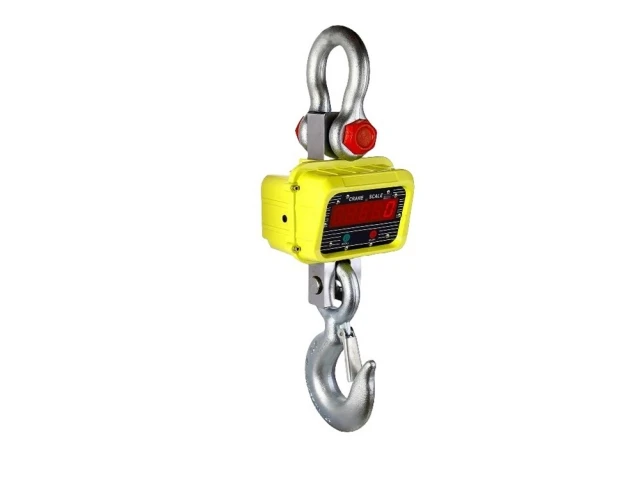
The core working logic of crane scales originates from the basic physical principle of force conversion, and the continuous upgrading of internal structures has promoted the improvement of their weighing stability and accuracy. The key component of every crane scale is the load cell, a precision sensing element responsible for converting mechanical tension generated by suspended loads into detectable electrical signals. Inside the load cell are delicate strain gauges, thin metal components that produce tiny elastic deformation when bearing tension. When the crane lifts goods through the crane scale, the gravity of the load acts vertically on the scale body, causing slight stretching changes in the strain gauges. These physical deformations will directly trigger changes in the electrical resistance of the strain gauges, and the built-in electronic module of the scale can capture and amplify these subtle signal changes in real time. After filtering, analog-to-digital conversion and data calibration processing by the internal microcontroller, the mechanical weight information of the load is finally converted into intuitive digital data, which is presented on the display screen for operators to read and record.
From the perspective of development evolution, crane scale has experienced a gradual upgrade from mechanical structure to digital intelligent structure. Early crane scales mainly adopted mechanical spring structures, which relied on the elastic deformation of springs to drive pointer rotation and complete weight reading. Such mechanical weighing methods have obvious limitations in practical use. Affected by spring fatigue, environmental temperature change and manual reading deviation, the weighing error is relatively large, and the stability of long-term continuous use is insufficient. In addition, mechanical crane scales cannot store weighing data, nor can they adapt to complex working conditions such as vibration and wind force in industrial sites, so they can only meet the most basic rough weighing needs. With the progress of electronic sensing and microprocessing technology, digital crane scales have gradually replaced mechanical products and become the mainstream of the market. The optimized structural design and high-precision sensing components greatly reduce the impact of external environmental factors on weighing results. At the same time, the digital processing system realizes automatic data calculation and real-time display, eliminating manual reading errors and effectively improving the overall weighing reliability.
The structural design of modern crane scales fully considers the practical needs of industrial site operation, balancing structural firmness, operation convenience and environmental adaptability. The whole scale body is made of high-strength metal materials, with good compression resistance, tensile resistance and impact resistance, which can adapt to frequent lifting operations and heavy-load working environments. The upper and lower ends of the scale body are equipped with standard shackles and hooks, which are used to connect lifting equipment and fixed loads respectively. The modular connection structure ensures the stability of force transmission during lifting and avoids weighing deviation caused by loose connection or force deviation. Most scale bodies adopt integrated sealing technology, which can resist the interference of dust, moisture and fine particles in the air, adapting to harsh working conditions such as outdoor ports, mining sites and manufacturing workshops. In terms of operation configuration, mainstream products are equipped with high-definition digital display screens, which can clearly present weight data in various light environments. Some optimized designs support unit switching between different measurement standards, meeting the diversified weighing habits of different industries and regions.
With the continuous improvement of industrial operation efficiency requirements, crane scales have added many practical functional designs on the basis of basic weighing, further expanding their application value. Real-time data locking is a basic practical function, which can fix the final weighing data on the screen after the load is stably lifted, avoiding data jitter caused by slight shaking of the load and facilitating operators to accurately record data. The automatic zero-clearing function can eliminate the influence of the self-weight of auxiliary tools such as slings and shackles, ensuring that the measured data truly reflects the net weight of the load. In addition, many crane scales are equipped with anti-overload protection mechanisms. When the load weight exceeds the safe bearing range of the equipment, the system will trigger a prompt mechanism to remind operators to stop operation, effectively avoiding equipment damage and safety risks caused by overload lifting. The emerging wireless transmission function also enables weighing data to be remotely transmitted to terminal equipment, realizing remote viewing, data storage and statistical analysis, which provides convenient conditions for enterprise inventory management and production data recording.
The application scenarios of crane scales cover almost all industrial fields involving heavy-load lifting and weighing, showing strong scene adaptability. In the heavy manufacturing industry including machinery manufacturing, shipbuilding and aerospace, crane scales are used for weighing large parts, semi-finished products and finished equipment during the production and assembly process. Accurate weight detection can help production teams check the assembly quality of equipment, judge whether the internal component configuration is complete, and avoid product quality problems caused by missing parts or irregular assembly. In the port and marine logistics industry, crane scales assist in weighing container goods and bulk materials, providing effective data support for cargo volume statistics and shipping arrangement, and ensuring the standardized management of cargo transportation. The wind energy and new energy industry also relies heavily on crane scales, which are used for weighing and handling large turbine components and power equipment parts, ensuring the stability and safety of component hoisting and installation.
In mining and engineering construction scenarios, crane scales undertake the weighing work of ore, building materials and engineering equipment. In open-pit mining and underground operation sites, real-time weighing of mined ore can help enterprises count production output and optimize mining scheduling. In construction sites, the weighing of steel structures, concrete components and mechanical equipment can standardize the use of building materials and avoid waste or insufficient material preparation. The agricultural field also has a certain demand for crane scales, which are suitable for weighing bulk agricultural products, feed and large livestock, helping agricultural producers complete fair transaction settlement and inventory quantity statistics. In the waste management and environmental protection industry, crane scales are used for weighing waste materials and recycled resources, providing accurate data basis for waste classification, recycling and transportation volume accounting.
The core value of crane scales in industrial operations is reflected in safety guarantee, efficiency improvement and standardized management. In terms of operational safety, accurate weighing data can effectively avoid blind lifting of overload loads. Overload operation is one of the main causes of lifting equipment failure and on-site safety accidents. Crane scales can intuitively feed back load weight, helping operators control lifting load within a safe range and protect on-site personnel and equipment safety. In terms of production efficiency, the integrated design of lifting and weighing saves the independent weighing link of traditional processes. It is no longer necessary to transfer goods to a fixed weighing platform for measurement, which simplifies the operation process, shortens the operation cycle and effectively improves the turnover efficiency of goods handling. In terms of standardized management, continuous and accurate weighing data can form effective production and operation records, help enterprises optimize inventory management, control production costs, and provide reliable data support for operational decision-making and process optimization.
Scientific daily maintenance and standardized operation are crucial to maintaining the service performance and service life of crane scales. In daily use, operators need to conduct regular visual inspection of the scale body, focusing on checking whether the hook, shackle and scale body have deformation, wear or crack defects, and ensuring the integrity of the structural stress parts. The surface and internal gap of the equipment should be cleaned regularly to prevent dust, dirt and sundries from accumulating, so as to avoid affecting the sensitivity of internal sensors and the clarity of the display screen. During the operation process, violent collision and sudden tension impact should be avoided. Sudden lifting and sudden stop will cause instantaneous impact load on the scale body, which is easy to cause fatigue damage of internal sensing components and affect the long-term weighing accuracy. It is also necessary to avoid long-term exposure to extreme high and low temperature environments and corrosive gas environments, so as to prevent material aging and circuit damage of the equipment.
Regular calibration is an essential link to ensure the weighing accuracy of crane scales. After long-term use, the internal sensing components will have slight performance changes due to mechanical fatigue and environmental influence, resulting in small weighing errors. Regular professional calibration can correct these errors, restore the weighing accuracy of the equipment, and ensure the consistency and authenticity of measured data. In addition, the equipment should be placed in a dry and ventilated environment when not in use for a long time, and the power supply should be cut off to avoid long-term standby power consumption and circuit aging. For wireless functional modules, regular inspection of signal transmission stability is required to ensure the smooth transmission of data in remote operation scenarios.
Looking at the development trend of industrial weighing equipment, crane scales are evolving towards higher precision, stronger adaptability and more intelligent functions. With the continuous innovation of sensor technology and intelligent control technology, the anti-interference ability of crane scales in complex working conditions such as strong vibration and variable wind speed is constantly improved, and the weighing accuracy and stability are further optimized. The intelligent data management function is becoming more perfect, realizing automatic recording, sorting and uploading of weighing data, which is more compatible with the digital management system of modern enterprises. At the same time, the lightweight and portable structural design makes the equipment more flexible in mobile operation, adapting to more diversified and complex lifting and weighing scenarios.
As a professional overhead weighing device, crane scales break through the limitations of traditional weighing equipment in suspended load measurement. Its unique structural design and working mode make it highly adaptable to heavy-load and mobile industrial operation scenarios. From basic weight detection to auxiliary production management and safety control, crane scales play an irreplaceable role in all links of industrial operation. Standardized operation and scientific maintenance can give full play to the performance advantages of the equipment, create safer, more efficient and more standardized working conditions for material handling and production operation in various industries, and provide solid basic support for the stable development of modern industrial production.
https://www.veidtweighing.com/IndustrialScale/CraneScale
Post Date: Jun 7, 2026
https://www.supplier-manufacturer.com/weight-balance-scale/crane-scales.html

![F2 Class Standard Weight]()
F2 Class Standard Weight
In the intricate and interconnected world of modern metrology, the consistency and reliability of mass measurement form the invisible foundation of countless professional …![Waterproof Scales]()
Waterproof Scales
In daily life and various industrial operation scenarios, weighing equipment often faces harsh environmental challenges that traditional weighing tools cannot cope with. O…![Maintenance of Cast Iron Weight]()
Maintenance of Cast Iron Weight
Cast iron weights serve as foundational components in a wide range of weighing operations, industrial calibration processes, and daily measurement verification work, offer…![Luggage Scales]()
Luggage Scales
Traveling, whether for business, leisure, or long-distance relocation, always comes with the hassle of managing luggage weight. Many travelers have experienced the awkward…![Cast Iron Weight Production]()
Cast Iron Weight Production
Cast iron weights serve as essential foundational components across a wide spectrum of industrial and commercial operational scenarios, fulfilling core functional needs fo…