Pallet Scales
Pallet scales have become a fundamental piece of auxiliary equipment in modern industrial logistics, warehousing, and cargo handling operations, serving as a practical solution for weighing palletized goods efficiently and conveniently. Unlike traditional weighing devices that require goods to be unloaded and placed flat for measurement, this type of weighing equipment is designed specifically for pallet-based cargo transportation and storage scenarios, enabling seamless integration of weighing and handling processes. Its core design concept focuses on simplifying the heavy-load weighing workflow, reducing redundant operational steps, and improving the overall efficiency of cargo management in various commercial and industrial environments. Adaptable to standard pallet sizes commonly used in global logistics, the equipment fits perfectly into daily cargo turnover work, making it a staple tool for enterprises involved in raw material warehousing, finished product delivery, and cargo transit statistics.
The basic working mechanism of pallet scale relies on mature mechanical and electronic induction technology, ensuring stable and consistent weighing performance in long-term industrial use. The core sensing components inside the equipment are responsible for capturing mechanical pressure generated by palletized loads. When a pallet loaded with goods is placed on the scale platform or lifted by an integrated pallet truck structure, external pressure acts on the internal sensing units, causing slight elastic deformation of the sensitive components. This subtle deformation triggers changes in internal resistance parameters, which are then captured and converted into continuous electrical signals through a built-in circuit system. These original electrical signals are relatively weak and require professional amplification and filtering processing to eliminate interference from external environmental factors such as equipment vibration and ground friction. After digital conversion and algorithm calculation by the internal control module, the signals are finally converted into intuitive weight data, which is presented on the display terminal for operators to read and record.
In terms of structural design, pallet scales adopt robust and practical industrial-grade configurations to adapt to complex and harsh working environments. The main body is usually constructed with thickened metal materials, which can withstand long-term pressure from heavy loads and frequent collision friction during cargo handling. The overall structure features stable bearing points and a balanced force-bearing design, which effectively disperses the pressure of palletized goods and avoids local stress concentration that may affect weighing stability or damage the equipment structure. Different from precision laboratory weighing instruments, pallet scales prioritize structural durability and environmental adaptability, with anti-slip and shockproof designs added to the contact surface and bottom. These designs prevent cargo sliding during weighing and reduce the impact of ground unevenness on measurement stability. The internal circuit and sensing components are equipped with protective structures to resist dust accumulation, moisture erosion, and minor mechanical impact, ensuring continuous normal operation in dusty warehouse, humid logistics transit, and high-frequency operation scenarios.
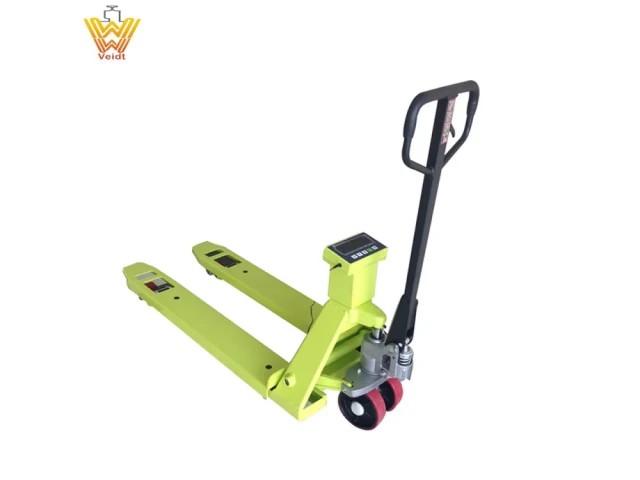
Pallet scales can be divided into two mainstream forms according to structural styles and usage modes, meeting the differentiated needs of fixed and mobile operation scenarios. One is the fixed floor-type pallet scale, which is placed on flat ground in fixed work areas such as warehouse entry and exit ports and cargo inspection areas. This type of equipment features a large and flat weighing platform that matches standard pallet dimensions, allowing integral placement of various standard and slightly non-standard palletized goods. It is suitable for centralized weighing and statistical work of large-volume cargo, with stable bearing performance and good anti-interference ability, adapting to long-term fixed-point operation. The other is the integrated mobile pallet scale combined with a pallet truck structure, which integrates the weighing sensing system into the manual or electric pallet handling equipment. Operators can directly insert the fork body under the pallet, lift the cargo, and complete weighing during the handling process, realizing synchronous completion of cargo movement and weight measurement. This mobile structure eliminates the need for fixed weighing stations, greatly expanding the operating range and making it suitable for scattered cargo weighing, temporary sampling detection, and flexible operation in multi-area warehouses.
The application value of pallet scales runs through the entire link of enterprise cargo management, bringing comprehensive optimization to operational processes and cost control. In warehouse management scenarios, enterprises need to conduct regular inventory checks of raw materials, semi-finished products, and finished products. Traditional inventory weighing requires multiple handling, stacking, and measurement steps, which consume a lot of labor and time costs and easily cause cargo displacement and stacking confusion. The use of pallet scales allows staff to complete weight verification directly based on pallet units during inventory, realizing rapid batch counting of goods, greatly improving inventory efficiency, and ensuring the accuracy of inventory data. At the same time, accurate weight data helps enterprises maintain reasonable inventory levels, avoiding capital occupation caused by excessive inventory or production stagnation caused by insufficient stock, and realizing refined inventory cost management.
In production and manufacturing links, pallet scales provide reliable data support for raw material proportioning and finished product inspection. Many industrial production processes require accurate weighing of bulk raw materials to ensure the stability of product quality and production formula standards. Workers can weigh palletized raw materials through the equipment before feeding materials, accurately controlling the input amount of raw materials for each production batch. For finished products after production, pallet weighing can be used for batch sampling and overall weighing inspection to check whether the product batch weight meets the standard range, effectively avoiding unqualified products from flowing into the market due to substandard single-batch weight. This standardized weighing method forms an effective quality control barrier for production enterprises and reduces product quality risks caused by inaccurate material measurement.
In logistics and transportation industries, pallet scales play an important role in standardizing cargo delivery and improving transit efficiency. In the process of cargo delivery, distribution, and forwarding, weight data is an important basis for cargo statistics, freight settlement, and transportation vehicle scheduling. The mobile operation capability of pallet scales enables staff to complete weight confirmation at the first time of cargo loading, avoiding the efficiency loss caused by transferring goods to special weighing equipment. For cross-regional distribution and batch cargo transportation, unified pallet weighing standards ensure consistent cargo weight statistical caliber, reduce data errors caused by manual estimation or repeated weighing, and facilitate efficient docking between upstream and downstream enterprises in the supply chain. In addition, accurate weight data can help transportation enterprises reasonably arrange vehicle loads, avoid unreasonable load distribution, and improve the safety and economy of cargo transportation.
Modern pallet scales are equipped with rich auxiliary functions to further adapt to diversified industrial operation needs, breaking through the single weighing function of traditional equipment. The common tare clearing function can automatically deduct the weight of empty pallets, packaging boxes, and auxiliary handling tools, directly obtaining the net weight of goods and simplifying manual calculation steps. The cumulative counting function can record the total weight of multiple batches of palletized goods continuously weighed, which is convenient for batch statistical work in warehouse outgoing and incoming operations. Most digital pallet scale models support real-time data storage and output, which can be connected with enterprise inventory management systems and logistics management platforms. The automatically recorded weighing data can be directly uploaded to the system, realizing digital filing of cargo weight information, avoiding data deviation and loss caused by manual entry, and improving the overall informatization level of enterprise cargo management.
Daily maintenance and standardized operation are key factors to maintain the long-term stable performance of pallet scales. In daily use, operators need to keep the equipment surface clean and tidy, regularly remove dust, debris, and residual materials on the weighing platform and fork body, to prevent foreign matter from affecting the contact balance between the load and the equipment and ensuring accurate measurement data. The equipment should be placed on a flat and solid ground as much as possible; long-term use on uneven soft ground will cause unbalanced force on the bearing structure and affect weighing stability. During the handling and weighing process, violent impact, sudden heavy pressure, and unilateral overload placement of goods should be avoided, to prevent irreversible deformation of internal sensing components and structural parts. Regular inspection of the equipment’s circuit connections and display terminal sensitivity is also essential, ensuring timely detection and handling of minor faults and avoiding equipment failure affecting operational progress.
With the continuous development of industrial logistics towards intensification, digitization, and high efficiency, pallet scales are also constantly upgraded and optimized in design and performance. The continuous optimization of structural materials makes the equipment more lightweight while maintaining bearing capacity, reducing operational labor intensity. The upgrading of sensing technology improves the stability and consistency of long-term repeated weighing, adapting to high-frequency and high-intensity industrial operation scenarios. The continuous enrichment of data interaction functions enables the equipment to better adapt to the intelligent management system of modern factories and logistics parks, realizing seamless docking of on-site weighing data and background management data. As an indispensable basic weighing equipment in the industrial field, pallet scales will continue to play an important role in reducing operational costs, improving work efficiency, and standardizing cargo management, providing solid basic support for the stable operation and efficient development of enterprise logistics and production links.
https://www.veidtweighing.com/IndustrialScale/PalletScale
Post Date: Jun 7, 2026
https://www.supplier-manufacturer.com/weight-balance-scale/pallet-scales.html

![Stainless Steel Test Weight]()
Stainless Steel Test Weight
In the vast and intricate landscape of modern industrial production, laboratory scientific research, commercial weighing operations, and quality inspection management, the…![5kg Calibration Weight]()
5kg Calibration Weight
Within the comprehensive framework of modern measurement operations across all industrial, laboratory, commercial, and daily operational fields, the stability and reliabil…![10 Kg Calibration Weight]()
10 Kg Calibration Weight
In every field that relies on accurate mass measurement to maintain operational stability, product consistency, and data reliability, the 10 kg calibration weight stands a…![Stainless Steel Test Weight For Metrology Institute Inspection]()
Stainless Steel Test Weight For Metrology Institute Inspection
Stainless steel test weights serve as core precision tools for daily inspection, calibration and verification work carried out by professional metrology institutes, laying…![Standard Weight For Crane Scales]()
Standard Weight For Crane Scales
In modern industrial production, logistics transportation, engineering construction and material detection fields, crane scales have become indispensable core weighing equ…