Mechanical Balances
The mechanical balance stands as one of the most fundamental and time-tested instruments in the field of physical measurement, serving as a core tool for determining mass through pure mechanical principles without reliance on electronic components, digital sensors, or external power sources. Rooted in the classic law of lever moments, this device has accompanied the development of scientific exploration, industrial production, and experimental education for centuries, retaining irreplaceable practical value despite the emergence of various modern measuring instruments. Its core operating logic revolves around mechanical equilibrium, a physical state where the sum of clockwise and counterclockwise torques acting on a horizontal beam reaches zero, enabling the comparison of unknown object mass with standard calibrated masses to complete accurate measurement.
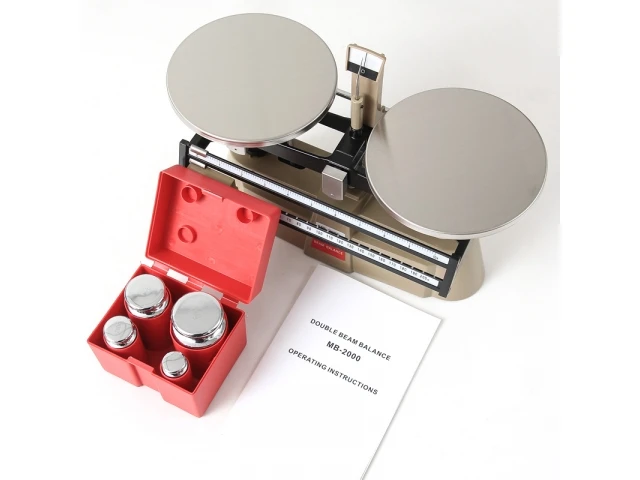
At its core structure, a typical mechanical balance consists of a rigid horizontal beam, a central fulcrum, hanging weighing pans, calibrated counterweights, and precision pointer and scale components. The central fulcrum, usually designed with a sharp knife-edge structure, acts as the pivotal support point for the beam, minimizing friction during beam oscillation to ensure sensitive response to subtle mass differences. The two ends of the beam are equipped with parallel and symmetric auxiliary knife-edges, from which weighing pans are suspended through flexible bearings. This structural design ensures that the pressure exerted by objects and standard weights on the beam remains vertical and uniform, avoiding measurement deviations caused by lateral force or tilting displacement. The overall structural symmetry of the beam is meticulously calibrated during production, ensuring equal arm lengths on both sides of the central fulcrum, which forms the basic structural guarantee for accurate mass comparison.
The working mechanism of the mechanical balance is entirely derived from the physical law of torque equilibrium. When an object with unknown mass is placed on one weighing pan, the gravitational force generated by the object produces a downward torque on the corresponding side of the beam, causing the beam to tilt toward the loaded side. To restore the beam to a horizontal balanced state, standard masses of known fixed values are placed on the opposite pan, and fine adjustments are made through sliding small weight riders along the graduated scale on the beam. Each position on the graduated scale corresponds to a specific tiny mass value, allowing for gradual and precise correction of torque differences. When the pointer fixed at the center of the beam stably aligns with the zero-scale mark and the beam maintains a horizontal static state, the torques on both sides of the fulcrum achieve complete balance. At this point, the total mass of the standard weights and the rider reading equals the mass of the measured object, completing the entire measurement process.
Long-term application and structural evolution have given rise to multiple common forms of mechanical balances, adapting to diverse measurement scenarios and mass ranges. The equal-arm double-pan balance is the most traditional and classic type, featuring strictly symmetrical beam arms and two identical weighing pans. It relies entirely on matching standard weights to complete measurement and is widely used in basic experimental teaching and conventional mass comparison work. The single-pan unequal-arm balance adopts an asymmetric beam structure, with a short arm fitted with a weighing pan and a long arm equipped with a precision graduated scale and movable sliding weights. This structure reduces the number of standard weights required for operation, with fine measurement completed by adjusting the position of sliding weights, offering higher operational efficiency for routine detection. The triple-beam balance, another widely used variant, integrates three groups of graduated scales with different precision ranges on the beam, covering coarse, medium, and fine measurement intervals, achieving a balance between wide measurement range and subtle detection capability.
Compared with modern electronic measuring equipment, mechanical balances possess unique inherent advantages that make them indispensable in many professional scenarios. Since their measurement relies purely on mechanical physical equilibrium, they are completely immune to electromagnetic interference, static electricity accumulation, voltage fluctuations, and signal drift, common interference factors that affect electronic instruments. This stability allows mechanical balances to work normally in complex environments with unstable power conditions, strong electromagnetic fields, or dusty spaces, delivering consistent and reliable measurement results. Additionally, the mechanical structure features simple working logic and intuitive measurement principles, enabling operators to clearly understand the physical changes in the measurement process, which is particularly important for physics and chemistry experimental teaching, as it helps learners build a solid understanding of lever principles and torque equilibrium concepts.
The accuracy of mechanical balance measurement depends heavily on standardized operating procedures and environmental control, and subtle irregular operations can lead to non-negligible deviations. Before each use, the instrument must be placed on a stable horizontal platform, and the horizontal calibration and zero-point adjustment must be completed. External vibration and inclination of the placement surface will directly affect the beam’s horizontal state, disrupting torque balance and causing inaccurate readings. During the weighing process, objects with excessive temperature differences from the ambient environment should be avoided for immediate measurement, as hot or cold objects will generate convective air currents around the weighing pan, producing subtle upward or downward airflow resistance that interferes with beam stability. Standard weights must be handled with care, avoiding direct contact with hands to prevent fingerprint grease, dust, or oxidation from changing their calibrated mass, which would affect the final measurement accuracy.
In practical operation, the measurement process follows a gradual and rigorous sequence to ensure reliable data. First, check the integrity and flexibility of all components, confirming that the beam can oscillate freely without jamming, the weighing pans are stably suspended, and the pointer swings smoothly. After zero calibration, place the measured object gently on the center of one weighing pan to avoid eccentric placement that causes unilateral stress. Then add standard weights to the opposite pan in the order from large to small, observing the beam’s tilting state continuously. After completing the coarse balancing with fixed weights, fine-tune the sliding riders on the graduated scale until the pointer swings symmetrically on both sides of the zero mark and finally stabilizes at the zero position. After recording the total mass data obtained from the weights and scale reading, remove the measured object and standard weights in sequence, and restore the instrument to its initial state to avoid long-term unilateral stress causing structural deformation of the beam.
Mechanical balances find extensive application across multiple industries and academic fields, covering basic education, chemical analysis, agricultural detection, and industrial raw material measurement. In middle school and university laboratory teaching, they serve as essential teaching tools to help students understand basic mechanical principles and master standard weighing operation specifications, cultivating rigorous experimental thinking and operational proficiency. In chemical gravimetric analysis, mechanical balances are used for the accurate weighing of solid reagents and precipitates, providing stable mass data for chemical formulation proportioning and reaction yield calculation. In agricultural production, they are applied to the weighing of seed samples, soil samples, and agricultural product detection samples, supporting agricultural quality inspection and experimental planting data recording. In industrial production, they are used for routine sampling and weighing of bulk raw materials and auxiliary materials, offering stable measurement support for production process control.
Daily maintenance and proper storage are critical to extending the service life and maintaining the measurement stability of mechanical balances. The instrument should be placed in a dry, clean, and well-ventilated environment to prevent long-term exposure to humid air that causes metal component oxidation, rust, or scale corrosion. Dust accumulation on the knife-edge fulcrum, beam, and weighing pans should be regularly removed with soft cleaning tools, as fine dust particles will increase friction at the fulcrum and affect the sensitivity of beam oscillation. The beam structure, precision knife-edges, and graduated scales are precision fragile parts, so severe vibration, collision, and heavy pressure must be avoided during use and movement. Standard weights should be stored in a sealed dry box when not in use, classified and placed to prevent friction and collision between weights, and regular calibration should be conducted to ensure the consistency of their mass parameters.
Although modern electronic balances and digital weighing equipment have been widely popularized with the advancement of science and technology, the value of mechanical balances has not diminished. Their pure mechanical working mode eliminates the risk of data distortion caused by electronic component aging, program failure, or signal interference, providing stable and traceable measurement results for high-reliability required scenarios. Moreover, their simple structural design and intuitive working principles make them ideal carriers for popularizing basic physical knowledge and training basic experimental skills. In scientific research experiments that require anti-interference performance, field detection with insufficient power conditions, and basic teaching scenarios focusing on principle demonstration, mechanical balances still exert irreplaceable practical effects.
The inheritance and application of mechanical balances also reflect the continuity and rigor of physical measurement technology. From ancient lever weighing tools to modern precision mechanical balances, the core principle of torque equilibrium has remained unchanged, while continuous optimization of structural design, processing precision, and operational details has steadily improved measurement accuracy and operational convenience. This evolution process embodies the perfect combination of basic physical theory and practical engineering application. In future basic scientific research, experimental teaching, and conventional precision weighing work, mechanical balances will continue to serve as a basic and reliable measuring instrument, maintaining its unique technical value and practical significance in the field of mass measurement.
https://www.veidtweighing.com/Balance/MechanicalBalance
Post Date: Jun 7, 2026
https://www.supplier-manufacturer.com/weight-balance-scale/mechanical-balances.html

![Stainless Steel Standard Weight For Weighing Instrument Verification]()
Stainless Steel Standard Weight For Weighing Instrument Verification
Stainless steel standard weights serve as fundamental precision tools for the verification and calibration of all types of weighing instruments, laying a solid foundation …![Standard Weight For Hanging Scales]()
Standard Weight For Hanging Scales
Standard weights for hanging scales are fundamental metrological reference tools that underpin the accuracy, consistency, and reliability of suspended weighing operations …![Standard Weight For Analytical Balances]()
Standard Weight For Analytical Balances
In precision laboratory measurement, analytical balances stand as foundational instruments that deliver highly accurate mass readings for chemical analysis, pharmaceutical…![Oiml F2 Calibration Standard Weight]()
Oiml F2 Calibration Standard Weight
Mass measurement forms the foundational backbone of all quantitative scientific research, industrial production, and commercial transaction activities. Every data result o…![Analytical Balance Calibration Weight]()
Analytical Balance Calibration Weight
Analytical balance calibration weights serve as fundamental reference tools in precision weighing operations, forming the core foundation for maintaining the accuracy and …