Hooked Standard Weight
Hooked standard weights are essential foundational tools widely utilized in experimental research, teaching demonstrations, and routine mechanical calibration scenarios. Designed with a specialized hooked structure integrated with standard mass specifications, these weights stand out from ordinary flat weights due to their unique structural advantages and stable physical properties. They have become indispensable auxiliary equipment in physics teaching, laboratory testing, and mechanical debugging work, offering stable and consistent mass reference support for various force measurement and balance calibration tasks. The core value of hooked standard weights lies in their standardized mass attributes and flexible structural design, which can adapt to diverse experimental operation modes and meet the basic precision requirements of conventional scientific research and teaching activities.
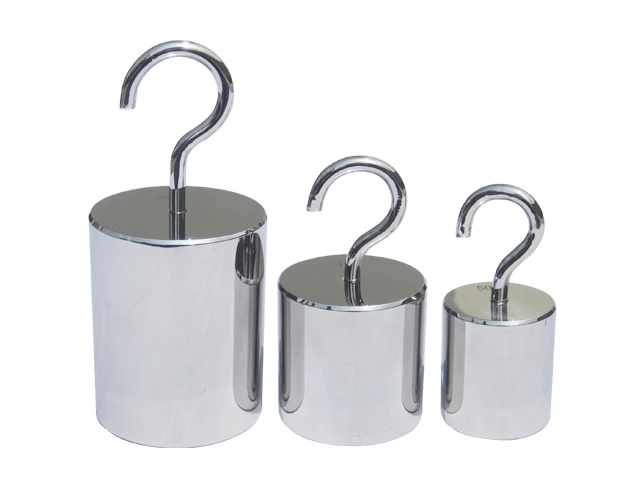
The production and manufacturing of hooked standard weights follow unified dimensional and mass specifications, with every finished unit undergoing fine adjustment to maintain stable mass parameters within a reasonable tolerance range. Most of these weights are crafted from high-density, wear-resistant metal materials that deliver excellent structural stability and anti-deformation performance. The selected materials are processed through fine polishing and surface protection treatments, which effectively isolate external factors such as air oxidation, moisture erosion, and daily friction wear. This meticulous processing method ensures that the mass and shape of the weights remain stable during long-term repeated use, avoiding significant parameter changes that could affect experimental accuracy. Meanwhile, the surface treatment eliminates rough edges and sharp corners, optimizing the safety of daily operation and storage.
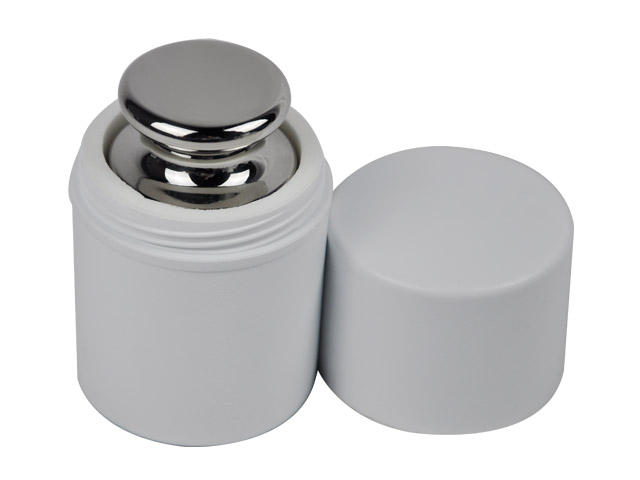
The most distinctive feature of hooked standard weights is the integrated hook structure designed for flexible connection and suspension operations. Different from traditional weights that can only be placed flat on weighing platforms or balance surfaces, the reserved hook structure allows the weight to be stably suspended on thin lines, brackets, experimental supports, and other auxiliary equipment. This structural design expands the application scope of standard weights, enabling them to adapt to tension testing, gravity demonstration, force transmission verification, and other experimental scenarios that require vertical stress application. The hook and the weight body are forged into a single integrated structure, avoiding loose connection or relative displacement between parts during use. The overall structural integrity ensures that the stress is uniform during suspension and tension bearing, preventing structural deformation or mass deviation caused by local stress concentration.
In basic physics teaching scenarios, hooked standard weights play a vital role in helping learners intuitively understand basic mechanical principles. Many core mechanical experiments, including the verification of the relationship between gravity and mass, the exploration of balance conditions of lever force moments, and the observation of object static friction and tension changes, rely heavily on these standard weights. By suspending weights of different specifications, teachers can create stable and controllable force conditions, allowing learners to observe and record experimental data in real time. The standardized mass of each weight ensures that experimental variables are controllable, making the derivation of physical laws more rigorous and intuitive. For beginners in physics learning, the intuitive application of hooked standard weights simplifies abstract mechanical concepts and builds a solid practical foundation for in-depth learning of mechanical knowledge.
In professional laboratory environments, hooked standard weights undertake more precise calibration and testing work. Many mechanical testing instruments, tension sensors, and balancing equipment need regular parameter calibration to maintain working stability. Hooked standard weights provide reliable mass references for these calibration works. Through standardized suspension and loading operations, staff can check the accuracy of instrument readings, correct systematic deviations in equipment operation, and ensure the authenticity and validity of experimental test data. In repeated loading and unloading tests, the stable structural performance of the weights can withstand continuous mechanical stress, without structural fatigue or mass attenuation in conventional use environments, ensuring the consistency of long-term calibration results.
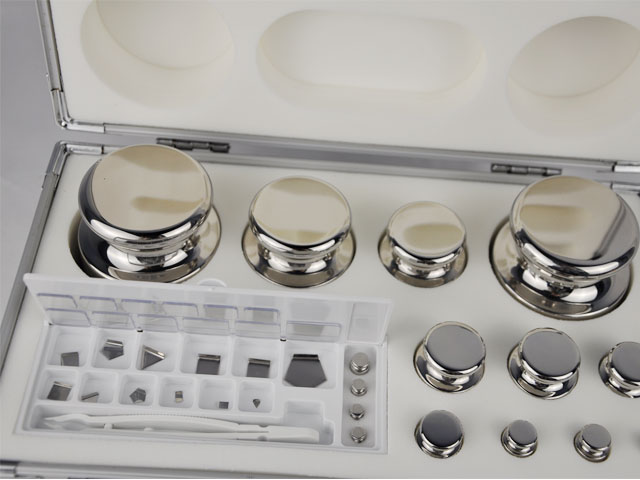
The specification setting of hooked standard weights follows hierarchical design logic, covering multiple mass gradients from small to large to meet the matching needs of different experimental scenarios. Small-specification weights are suitable for precise micro-force testing and subtle mechanical demonstration experiments, while medium and large-specification weights are applied to conventional mechanical verification and large-load equipment calibration. The clear mass marking on the surface of each weight enables quick identification and flexible combination by operators. In complex experiments that require multi-group force grading tests, multiple weights can be superimposed and suspended according to experimental requirements to form graded and adjustable load values, greatly improving the flexibility and applicability of experimental operation schemes.
Reasonable daily maintenance and standardized storage methods are key to maintaining the long-term performance stability of hooked standard weights. Although the surface protection layer of the weights can resist daily oxidation and wear, long-term exposure to humid air, corrosive gas environments, or contact with chemical reagents will still cause irreversible damage to the surface structure and internal mass stability. Daily maintenance work mainly includes regular surface cleaning, using dry and soft cleaning tools to remove surface dust and stains, keeping the weight surface dry and clean. When not in use for a long time, the weights need to be placed in a dry, ventilated, and stable storage environment, avoiding stacking and collision with hard objects to prevent surface scratches and structural deformation.
In the process of use, standardized operation norms also help extend the service life of hooked standard weights and maintain parameter accuracy. Operators should avoid throwing, knocking, or applying excessive impact force to the weights, as sudden impact may cause internal structural changes and tiny mass deviations. During suspension operation, the connection position of the hook should be kept stable to avoid long-term eccentric stress, which may lead to local fatigue deformation of the hook structure. After each use, the weights should be cleaned and sorted in a timely manner, and placed in a fixed storage position to prevent loss and random placement caused by mixing with other experimental tools. Good operating habits can effectively maintain the physical stability of the weights and ensure that each use can provide accurate and reliable mass reference data.
Compared with auxiliary weight tools of other structural types, hooked standard weights have obvious advantages in operational flexibility and scenario adaptability. Flat weights are limited by their placement mode and can only adapt to horizontal bearing and balance experiments, while counterweight tools without fixed hooks are prone to slipping and position deviation during suspension use, affecting experimental stability. The integrated hook structure of hooked standard weights perfectly solves the above problems, realizing the dual applicability of flat placement and suspension use. Whether it is horizontal balance calibration or vertical tension testing, it can maintain stable working conditions, reducing the tool replacement frequency in experimental processes and improving the overall efficiency of teaching and experimental work.
In industrial debugging and mechanical equipment maintenance scenarios, hooked standard weights also have wide application space. Many mechanical transmission structures, lifting equipment, and balance devices need regular load detection and balance adjustment during operation. Hooked standard weights can be used as stable load reference tools to assist staff in completing equipment static balance detection, tension bearing verification, and operating parameter debugging. The stable mass and reliable structural strength of the weights ensure that the load simulation state is consistent with the actual working state of the equipment, providing accurate reference basis for equipment maintenance and parameter adjustment, and helping mechanical equipment maintain stable operating performance.
The design iteration and optimization of hooked standard weights have always centered on practical application demands. With the continuous upgrading of experimental teaching and laboratory testing standards, the structural precision and material performance of the weights have been continuously improved. The integrated forging process adopted by mainstream products effectively reduces structural gaps and unstable factors, while the optimized hook radian design makes the connection with experimental lines and accessories more fitting, reducing the risk of slipping and disconnection during use. The moderate weight and volume design also balances portability and structural stability, making it convenient for staff to carry, assemble and operate in different experimental spaces.
In scientific research and teaching work that pursues rigorous experimental logic and accurate data results, the value of hooked standard weights is reflected in their stable and controllable basic performance. All experimental conclusions and test data are based on accurate mass reference standards, and any tiny deviation of weight parameters may affect the final experimental results. Hooked standard weights eliminate unstable factors caused by structural defects and material attenuation through standardized production and strict parameter control, providing a reliable basic guarantee for the smooth progress of various mechanical experiments and calibration work. As a basic and universal experimental tool, it has always maintained irreplaceable practical value in the fields of basic science education and professional laboratory testing.
In future application scenarios, with the continuous development of experimental teaching reform and precision testing technology, the application fields of hooked standard weights will be further expanded. While maintaining the basic standardized mass and structural characteristics, related products will be further optimized in terms of material durability, structural ergonomics and scenario adaptability to adapt to more diversified and refined experimental and testing demands. As a basic supporting tool for mechanical research and teaching, hooked standard weights will continue to undertake the important task of providing stable and accurate mass reference, and support the steady development of basic scientific research and practical teaching work.
Hooked Standard Weight
https://www.veidtweighing.com/standard-weights.html
Post Date: Jun 7, 2026
https://www.supplier-manufacturer.com/standard-weight/hooked-standard-weight.html

![Rust Proof Standard Weight]()
Rust Proof Standard Weight
Rust proof standard weight represents a specialized material configuration that balances consistent structural weight distribution and reliable anti-corrosion performance,…![Stainless Steel Weight For Digital Scale Regular Calibration]()
Stainless Steel Weight For Digital Scale Regular Calibration
In the modern era of precision measurement, digital scales have become indispensable tools across countless industries and daily applications, ranging from laboratory scie…![Standard Weight For Industrial Scales]()
Standard Weight For Industrial Scales
In modern industrial production, commercial trade, and quality inspection systems, the accuracy and stability of weighing measurements serve as the fundamental guarantee f…![Oiml Calibration Weight Set]()
Oiml Calibration Weight Set
In the field of precision measurement and industrial metrology, accurate mass reference serves as the fundamental foundation for all quantitative weighing operations, and …![Calibration Weight For Laboratory Balance]()
Calibration Weight For Laboratory Balance
In every modern laboratory that relies on quantitative measurement, consistent and reliable weighing data forms the foundation of credible experimental results, industrial…