Cash Register Scales
In modern commercial retail operations, the integration of weighing and settlement functions has become an indispensable part of daily business workflows, and cash register scales have emerged as a core functional device to meet this market demand. Designed for scenarios where goods are sold by weight, this type of equipment combines precision weighing technology with intelligent data processing and settlement functions, effectively connecting product weighing, unit price matching, total amount calculation, transaction record storage and receipt output into a complete operational process. It has gradually replaced traditional separate weighing tools and manual accounting methods, bringing standardized and streamlined management to various physical retail industries. Unlike professional industrial weighing devices that focus solely on weight detection accuracy, cash register scales are developed centered on commercial transaction scenarios, taking both weighing stability and settlement efficiency into account, and adapting to the fast-paced, high-frequency operation needs of frontline retail counters.
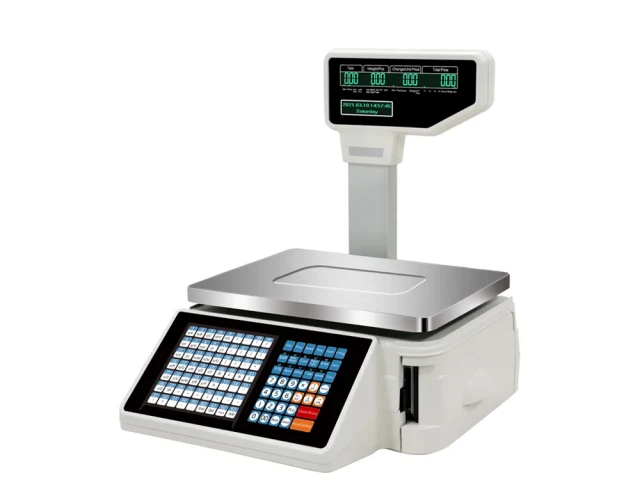
The internal working mechanism of cash register scale follows mature electromechanical sensing principles, relying on high-sensitivity load cell components to complete weight collection and signal conversion. The core weighing structure adopts elastic body materials with high toughness and stable physical properties. When goods are placed on the weighing platform, the elastic body produces slight and regular deformation under pressure. The strain gauges attached to the surface of the elastic body will generate corresponding resistance changes following the deformation degree, and the internal circuit system converts these physical resistance changes into measurable electrical signals. After being filtered, amplified and calibrated by the built-in chip program, these electrical signals are finally converted into accurate weight data and displayed on the device’s screen. The whole sensing and conversion process is completed in a short time, realizing real-time weight feedback of measured items. Meanwhile, the built-in data storage module of the device can pre-store the unit price information of various conventional goods, which lays a foundation for automatic subsequent pricing calculation.
In actual business operations, the use logic of cash register scales is simple and logical, suitable for long-term repetitive operation by staff. Before formal business use, operators only need to input and store the unit price information of different goods in the system in advance, and the system will form a corresponding product data database. During the transaction process, after placing the bulk goods that need to be weighed on the horizontal weighing platform, the device will immediately capture the weight data and match the corresponding preset unit price information according to the manually selected product category. The internal intelligent system automatically completes the multiplication calculation of weight and unit price, and synchronously displays the net weight of the goods and the calculated transaction amount on the dual display screens for both operators and customers to view. After confirming the data is correct, the operator can complete the transaction binding, and the device will automatically record the complete transaction information including product category, weight, transaction time and amount. Finally, the supporting printing module can output standardized transaction receipts, forming credible transaction vouchers for both merchants and customers.
The functional advantages of cash register scales are fully reflected in solving the pain points of traditional retail weighing and settlement modes. In the past, merchants needed to use independent weighing tools to measure goods manually, then record the weight data, calculate the total price artificially, and register the transaction information one by one. This whole process involves multiple manual operations, which not only consumes a lot of time and human resources, but also easily causes calculation deviations and data omissions due to human fatigue or operational negligence. In contrast, the integrated design of cash register scales integrates weighing, pricing, calculation, recording and receipt printing, which reduces intermediate manual operation links. The unified data calculation logic set by the system avoids errors caused by manual calculation, ensuring the consistency and accuracy of each transaction data. For daily bulk and high-frequency weighing transactions, this operational optimization greatly improves the overall checkout efficiency of retail counters and reduces the waiting time of customers during peak business hours.
Cash register scales have a wide range of application scenarios, covering almost all retail fields involving weighted commodity transactions. In fresh retail scenarios such as fruit stores, vegetable markets and deli counters, most fresh agricultural products and cooked food are sold by weight, and the real-time weighing and fast settlement functions of cash register scales can perfectly adapt to the flexible sales characteristics of such commodities. In bulk commodity retail scenarios such as candy shops, nut stores and bulk grain sales outlets, the device can adapt to the weighing and settlement needs of different specifications of bulk goods, and the adjustable weighing range meets the sales requirements of small-batch and large-batch purchases. In addition, some professional industries also apply cash register scales for auxiliary business processing. In jewelry retail, the precise weighing performance of the device can meet the measurement needs of precious commodities and ensure the fairness of transaction measurement. In daily chemical and hardware retail, it can also be used for the settlement of bulk daily chemical supplies and small hardware accessories sold by weight.
In terms of equipment design and performance optimization, cash register scales fully consider the practical needs of commercial scenarios. The external structure adopts a stable and compact design, with a smooth and easy-to-clean weighing platform, which can effectively adapt to the complex and easily polluted working environment of fresh retail counters, and facilitate daily cleaning and maintenance by staff. The internal program system supports multi-product data storage and fast switching, which can meet the simultaneous sales needs of dozens or even hundreds of commodities in physical stores. At the same time, the device is equipped with a temperature compensation mechanism, which can avoid the deviation of weighing data caused by ambient temperature changes, ensuring stable and accurate measurement results in different seasonal and environmental conditions. The dual-screen display design enables customers to clearly view the weighing data and transaction amount, improving the transparency of the transaction process and enhancing customer consumption trust.
With the continuous development of commercial informatization, the connection and expansion functions of cash register scales have been further improved. Most modern cash register scales support data interconnection with background management systems through network transmission protocols. The transaction data generated daily can be automatically uploaded to the merchant’s background management terminal, realizing real-time statistics and sorting of transaction volume, commodity sales volume and other business data. This intelligent data synchronization function saves the manual entry and sorting work of business data for merchants, provides accurate data support for merchants’ inventory management, sales analysis, commodity stocking and business strategy adjustment. For chain retail stores, the unified data transmission function can also realize the centralized management of transaction data of multiple stores, facilitating the overall operation and scheduling of the brand.
In terms of daily operation and maintenance, cash register scales have strong practicability and durability. The mechanical structure of the equipment is firm and wear-resistant, which can adapt to long-term high-frequency start-stop and weighing operation without easy failure. The system program has a self-checking function. It can automatically identify abnormal weighing data and prompt operational errors during use, helping staff eliminate faults in a timely manner and ensure the continuity of business. The zero-setting and peeling functions equipped with the device can also solve the weighing interference problems caused by packaging boxes, packaging bags and other auxiliary tools in the transaction process, further improving the accuracy of commodity net weight measurement. Simple daily maintenance such as regular cleaning of the weighing platform and regular zero calibration can maintain the stable working performance of the equipment for a long time.
For modern small and medium-sized retail enterprises and individual merchants, the popularization and application of cash register scales have important practical significance for standardized business operation. On the one hand, it standardizes the transaction measurement and settlement process, avoids transaction disputes caused by inaccurate measurement and inconsistent manual calculation standards, and maintains a good consumption environment. On the other hand, the automatic data recording and statistical functions help merchants realize refined operation management, grasp the sales rules of various commodities in a timely manner, and reduce operational risks caused by data confusion and inventory errors. While improving operational efficiency, it also optimizes the customer’s checkout experience, helps merchants stabilize customer resources, and provides solid basic support for the long-term stable operation of physical retail businesses.
As the retail industry continues to move towards intelligence and standardization, cash register scales, as basic terminal equipment integrating multiple practical functions, are also constantly iterating and upgrading in performance and functions. The continuous optimization of weighing accuracy, the expansion of data interaction functions, and the simplification of operation processes all make the equipment more adaptable to the changing market business needs. In the future, with the further integration of retail scenarios and digital technology, cash register scales will play a more core basic role in offline physical retail, helping more merchants realize efficient, accurate and standardized daily transaction operations and promote the overall standardized development of the weighted commodity retail industry.
https://www.veidtweighing.com/CommercialScale/CashRegisterScale
Post Date: Jun 7, 2026
https://www.supplier-manufacturer.com/weight-balance-scale/cash-register-scales.html

![Stainless Steel Test Weight For Metrology Institute Inspection]()
Stainless Steel Test Weight For Metrology Institute Inspection
Stainless steel test weights serve as core precision tools for daily inspection, calibration and verification work carried out by professional metrology institutes, laying…![Standard Weight For Crane Scales]()
Standard Weight For Crane Scales
In modern industrial production, logistics transportation, engineering construction and material detection fields, crane scales have become indispensable core weighing equ…![Standard Weight For Digital Scales]()
Standard Weight For Digital Scales
Digital scales have become indispensable precision measuring tools across civilian, commercial, industrial, and scientific research fields, valued for their high sensitivi…![Laboratory Calibration Weight Kit]()
Laboratory Calibration Weight Kit
Laboratory calibration weight kits serve as foundational metrological tools in all sectors that rely on precise mass measurement, forming an indispensable part of daily la…![Astm Standard Calibration Weight]()
Astm Standard Calibration Weight
Precision mass measurement serves as a foundational pillar across scientific research, industrial production, pharmaceutical manufacturing, and material testing industries…