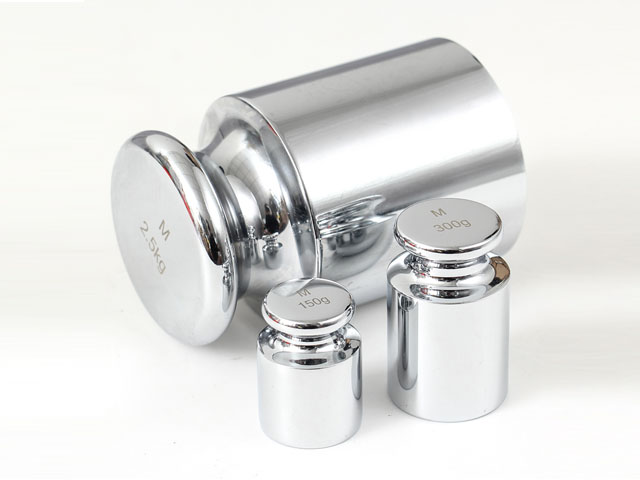
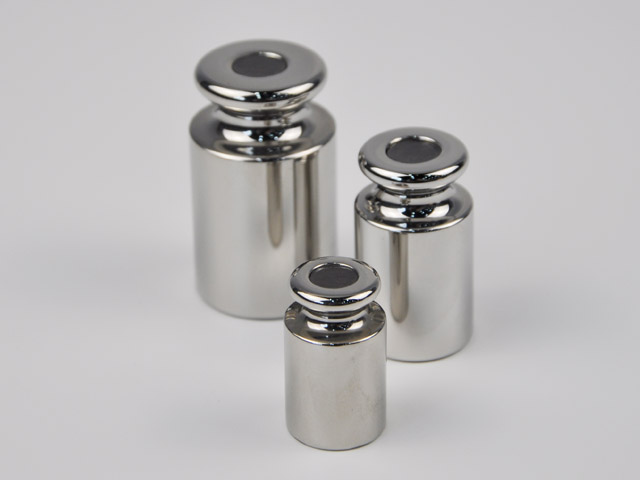
Precision Calibration Weight For Weighing Scale
In every industry and laboratory setting that relies on accurate mass measurement, precision calibration weights serve as foundational tools to sustain the functional reliability of weighing scales. Weighing scales, whether compact desktop digital models for laboratory analysis or large platform devices for industrial bulk measurement, gradually develop subtle measurement deviations during long-term operation. These deviations stem from multiple uncontrollable factors, including continuous mechanical vibration, minor component wear, ambient temperature and humidity fluctuations, and even subtle electromagnetic interference in the working environment. Without regular calibration and verification, these tiny errors will accumulate over time, leading to inconsistent measurement data, flawed experimental results, or inaccurate product quality inspection, which can ultimately affect production processes, research conclusions, and operational standardization. Precision calibration weights address this core demand by providing stable, known mass references, enabling users to detect, adjust, and eliminate scale measurement deviations effectively and maintain long-term weighing consistency.
The core working logic of precision calibration weights lies in mass comparison and error correction, a basic principle that underpins all professional weighing calibration work. Each precision calibration weight is fabricated with strict dimensional and mass tolerance control, with its actual mass maintained within a narrow fixed range relative to its nominal value. When calibrating a weighing scale, users place these standard weights with definite mass values on the scale’s weighing surface, and the scale’s internal sensing system converts the pressure signal generated by the weight’s gravity into a digital or analog reading. By comparing the scale’s displayed reading with the weight’s standard nominal mass, users can directly identify the magnitude of measurement deviation. If the deviation exceeds the allowable range of daily use, targeted parameter adjustment can be performed on the scale to restore its measurement accuracy. This comparison-based calibration method is universally applicable to almost all types of electronic and mechanical weighing equipment, forming the most fundamental and reliable means of scale accuracy maintenance.
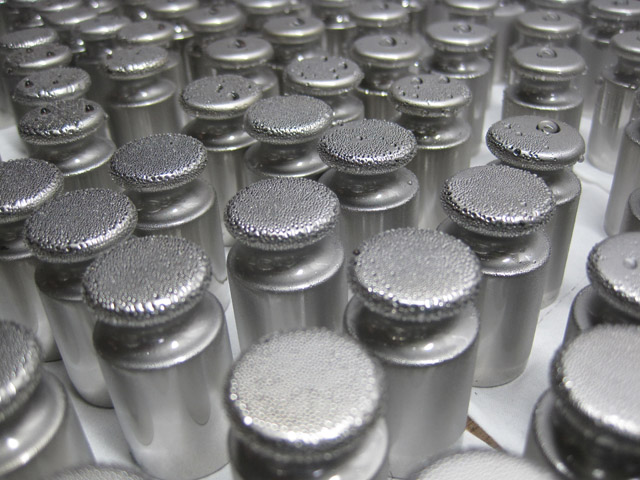
Material selection is a critical factor that determines the stability and service performance of precision calibration weights, directly influencing their calibration accuracy and service life. High-quality precision calibration weights are mostly crafted from dense, stable materials with low environmental sensitivity, among which stainless steel and refined cast metal are the most widely used. Stainless steel calibration weights feature smooth surface finish, strong oxidation resistance, and excellent corrosion resistance, effectively avoiding mass changes caused by surface rust, oxidation, or chemical contamination. This material is particularly suitable for high-precision calibration scenarios such as pharmaceutical laboratories, chemical analysis rooms, and jewelry testing environments, where strict cleanliness and long-term accuracy stability are required. Refined cast metal weights, by contrast, offer higher overall structural stability and stronger resistance to mechanical impact, making them ideal for frequent industrial calibration work and harsh production environments with inevitable friction and collision risks. Both materials undergo rigorous surface treatment processes to reduce surface porosity, preventing dust, moisture, and fine impurities from adhering to the surface and altering the weight’s actual mass.
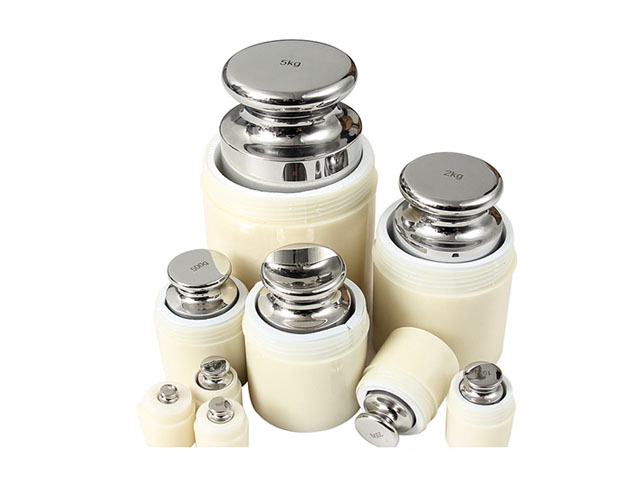
The structural design of precision calibration weights is optimized to adapt to diverse calibration scenarios and ensure standardized operation. Conventional calibration weights adopt a compact solid structure with regular geometric shapes, mostly cylindrical or square, which ensures uniform force distribution when placed on the scale and avoids tilting or unstable placement that may affect measurement results. Some multi-specification weight sets are equipped with matched tweezers and storage boxes to support standardized handling and storage. Professional operation tools avoid direct hand contact with the weight surface, preventing sweat, oil stains, and fine dirt from attaching to the weights and causing cumulative mass errors. The overall structure of precision calibration weights is compact and wear-resistant, with no fragile parts, ensuring stable performance during repeated handling, placement, and use. Different mass specifications of calibration weights cover the full range of scale calibration needs, from micro-weight specifications for high-precision analytical balances to large-mass specifications for industrial platform scales, meeting the calibration requirements of different weighing ranges.
Precision calibration weights are applied across a wide spectrum of industries and scenarios, covering fine laboratory research, commercial detection, industrial production, and daily precision measurement. In scientific research laboratories, accurate mass data is the prerequisite for chemical component analysis, physical property testing, and experimental data verification. Regular calibration of analytical balances and precision scales with standard weights ensures the repeatability and credibility of experimental data, laying a solid foundation for academic research and technological innovation. In the pharmaceutical and food processing industries, weighing accuracy is closely linked to product quality and safety. Precise calibration of production weighing equipment guarantees accurate proportioning of raw materials, stable product component content, and consistent product quality, avoiding quality fluctuations caused by weighing errors.
In industrial manufacturing fields such as machinery, electronics, and new materials, weighing scales are widely used in raw material incoming inspection, production process batching, and finished product quality testing. Long-term continuous operation of industrial equipment makes scales prone to parameter drift and mechanical fatigue, making regular calibration with precision weights an essential part of daily equipment maintenance. In commercial fields including jewelry appraisal, precious metal trading, and precision commodity sales, accurate weighing results directly relate to transaction fairness and economic benefits. Calibration weights help maintain scale accuracy, standardize transaction measurement, and avoid disputes caused by inaccurate weighing data. Even in educational institutions and daily precision testing scenarios, calibration weights provide reliable reference standards for teaching experiments and routine equipment debugging.
Standardized operation methods are essential to maximize the calibration effect and protect the performance of precision calibration weights and weighing scales. Before formal calibration, it is necessary to place both the weighing scale and calibration weights in the working environment for a period of time to achieve consistent temperature and humidity adaptation with the environment. Sudden environmental temperature differences may cause slight thermal expansion and contraction of the scale’s sensing components and the weights themselves, resulting in temporary measurement errors. Meanwhile, the weighing surface of the scale and the surface of the calibration weights need to be thoroughly cleaned with soft, lint-free tools to remove floating dust, residual stains, and fine particles, ensuring a clean contact surface for accurate mass transmission.
During the calibration process, the scale should be powered on and preheated according to operational norms to ensure the internal circuit and sensing system reach a stable working state. It is advisable to select calibration weights of appropriate specifications based on the scale’s maximum weighing range. In conventional calibration work, weights matching 50% of the full scale range are used for main calibration verification, supplemented by tests at 10% and 90% of the full range to detect linear measurement errors of the scale in different weighing intervals. When placing the weights, slow and stable operation is required to avoid impact force on the scale’s weighing platform, which may damage the scale’s internal sensors or cause displacement of the weights. After the scale’s reading stabilizes, record the data carefully and compare it with the standard mass of the calibration weight to judge the scale’s accuracy status and complete parameter adjustment if needed.
Scientific daily maintenance and storage directly extend the service life of precision calibration weights and sustain their long-term accuracy stability. After each use, the weights should be cleaned again to remove residual dust and impurities, then placed in a dry, sealed dedicated storage box to isolate moisture, corrosive gases, and dust in the air. The storage environment should maintain constant temperature and low humidity, avoiding placement in high-temperature, humid, or strongly electromagnetic interference areas, as long-term adverse environmental exposure will cause material aging, surface corrosion, or subtle mass changes of the weights. It is strictly prohibited to drop, collide, or stack calibration weights at will, as mechanical damage and surface scratches will destroy the original structural uniformity and mass stability, leading to irreversible calibration errors.
In addition, regular routine inspection and verification of calibration weights are necessary. During long-term repeated use, even high-stability weights may produce tiny mass changes due to subtle surface wear and environmental erosion. Regular self-inspection and comparative verification can promptly identify abnormal mass deviation and eliminate hidden dangers of inaccurate calibration. For scales used in high-precision scenarios, matching calibration frequency should be formulated based on usage intensity and environmental conditions to ensure that the weighing equipment is always in a qualified working state.
In the entire precision measurement system, precision calibration weights act as a bridge connecting standard mass values and practical weighing applications. They transform abstract mass measurement standards into operable, practical reference tools, providing basic guarantees for the accuracy, consistency, and traceability of all weighing work. With the continuous improvement of industrial production precision and scientific research standards, the requirements for weighing accuracy in various fields are constantly rising, making the role of precision calibration weights increasingly prominent. Adhering to standardized use and scientific maintenance of calibration weights can effectively reduce weighing errors, improve the overall level of precision measurement work, and provide reliable technical support for stable production, accurate research, and standardized measurement in various industries. Every link from material manufacturing, structural design, standardized use to daily maintenance determines the final calibration effect, and standardized management of each link is the key to giving full play to the value of precision calibration weights.
Precision Calibration Weight For Weighing Scale
https://www.veidtweighing.com/calibration-weights.html
Post Date: Jun 19, 2026

![Stainless Steel Flat Test Weight For Platform Scale Calibration]()
Stainless Steel Flat Test Weight For Platform Scale Calibration
Stainless steel flat test weights serve as essential precision tools for the routine calibration and accuracy verification of platform scales across diverse industrial and…![Standard Weight For Platform Scales]()
Standard Weight For Platform Scales
In industrial production, commercial trading, logistics warehousing, and quality inspection industries, platform scales serve as one of the most fundamental and indispensa…![Calibration Weight For Laboratory Instrument Factory Calibration Use]()
Calibration Weight For Laboratory Instrument Factory Calibration Use
In the rigorous operational system of modern laboratory instrument manufacturing and daily calibration practices, calibration weights stand as one of the most fundamental …![Calibration Weight For Mechanical Balance Scale]()
Calibration Weight For Mechanical Balance Scale
Mechanical balance scales remain a foundational tool in precision weighing operations across laboratories, industrial workshops, educational institutions, and quality insp…![200g F2 Precision Calibration Weight Quality Control Lab]()
200g F2 Precision Calibration Weight Quality Control Lab
In modern quality control laboratory operations, accurate and repeatable mass measurement serves as the foundational pillar of reliable experimental data, product testing,…