Axle Scales
In modern transportation, logistics, and industrial operation management, accurate vehicle weight measurement serves as a fundamental link to ensure road safety, standardize cargo transportation, and optimize operational efficiency. As a practical and adaptable weighing device, axle scales have gradually become an essential tool in weight detection scenarios, differing from traditional integral vehicle weighing equipment in structural design and working logic. This type of equipment completes weight statistics by measuring the load of each vehicle axle separately and then accumulating data, forming a flexible and efficient weighing mode that adapts to diverse complex usage environments. With the continuous development of industrial informatization and standardized transportation management, the application scope of axle scales keeps expanding, and their functional maturity and operational stability are continuously improved, providing reliable data support for the standardized operation of multiple industries.
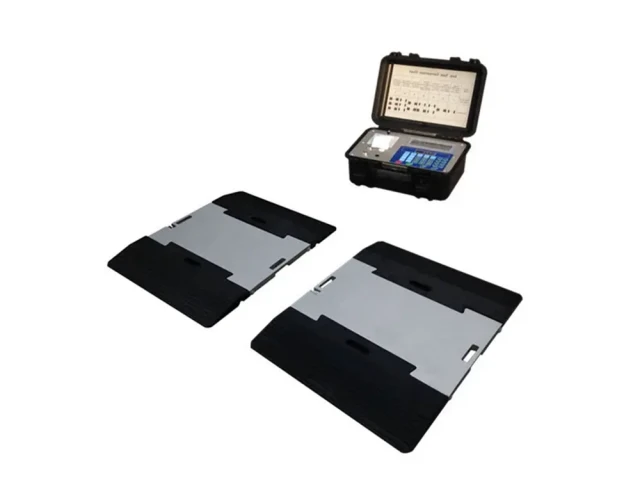
The core working logic of axle scale originates from the basic principle of mechanical force conversion and digital signal processing. The main body of the equipment is equipped with high-sensitivity induction components that can perceive the pressure generated by vehicle axles acting on the weighing platform. When a vehicle passes through or stays on the weighing area, the pressure generated by each axle will cause slight deformation of the induction components inside the equipment. This tiny mechanical deformation will be converted into continuous and stable digital signals through the internal sensing system. The built-in data processing program can capture and sort these signals in real time, independently calculate the load data of each passing axle, and automatically accumulate all axle weight data to obtain the total weight of the entire vehicle. This segmented weighing method based on axle load not only realizes the acquisition of total vehicle weight but also clearly records the load distribution state of each axle, which is a core advantage that distinguishes axle scales from other integral weighing equipment.
In actual operation scenarios, axle scales support two mainstream weighing modes: static weighing and dynamic weighing, which can freely adapt to different operational efficiency and accuracy requirements. Static weighing requires the vehicle to keep a stable stationary state when each axle is parked on the weighing platform. Without the interference of inertial force and running vibration, the collected data is stable and consistent, suitable for scenarios that require high data reference accuracy, such as cargo settlement, inventory checking, and precise load detection. Dynamic weighing allows vehicles to pass through the weighing area at a low and stable speed without stopping midway. The equipment’s high-frequency data acquisition system can complete signal capture and calculation in the instant the axle passes through the platform, realizing uninterrupted weighing of moving vehicles. This mode greatly improves the overall weighing efficiency, effectively avoiding vehicle queuing and congestion, and is widely used in high-traffic road detection and rapid vehicle inspection scenarios. The switching and application of the two modes make the equipment highly adaptable, which can meet the refined management needs of different links in industrial and transportation scenarios.
Structural design flexibility is a prominent feature of axle scales, enabling them to adapt to various site conditions that are not suitable for large-scale fixed weighing equipment. Different from bulky integral weighing platforms that require fixed foundation construction and large space occupation, most axle scale devices adopt a compact and modular structure. Some styles support flexible placement and mobile use, without the need for complex foundation pouring and long-term construction and debugging. This feature makes the equipment applicable to temporary weighing scenarios such as seasonal cargo transportation, temporary road inspection, and short-term project logistics management. At the same time, the main body of the equipment is made of high-strength and wear-resistant materials, which can resist the impact of vehicle rolling, friction of gravel and sundries, and erosion of rainy and snowy weather in outdoor working environments. The stable structural performance ensures long-term continuous operation in harsh industrial and road environments, reducing the frequency of equipment maintenance and replacement, and bringing stable operational support for daily work.
The application value of axle scales runs through multiple links of road transportation and industrial production. In road traffic management, axle load detection is a key means to standardize vehicle driving behavior. Excessive load of a single axle will cause serious damage to road surfaces, bridges and other infrastructure, and also easily lead to vehicle braking failure, tire burst and other safety hazards, bringing hidden dangers to road traffic safety. Axle scales can accurately capture the load data of each axle of the vehicle, helping management personnel judge whether the vehicle has uneven load distribution or local overload problems, so as to standardize vehicle loading specifications, reduce road infrastructure loss, and maintain orderly road traffic operation.
In the logistics and cargo transportation industry, axle scales provide reliable data basis for cargo measurement and transportation management. For waste recycling, construction material transportation, bulk grain and other bulk cargo transportation scenarios, weight data is an important basis for cargo statistics and settlement. The efficient weighing mode of axle scales can quickly complete vehicle weight detection, improve the passing efficiency of transport vehicles, and avoid long-time parking waiting affecting transportation progress. Meanwhile, accurate axle load and total weight data can help logistics enterprises optimize cargo loading schemes, balance the load of each axle of the vehicle, avoid safety risks caused by excessive local load, and also make full use of vehicle load capacity to improve the economic benefits of single transportation. In addition, the equipment can automatically record and store weighing data, forming complete transportation weight records, which is convenient for enterprises to carry out cargo inventory statistics, transportation cost accounting and daily operation management, realizing standardized and traceable logistics operation.
In industrial production and port terminal scenarios, axle scales also play an important auxiliary role in operational management. Many industrial enterprises need to strictly control the weight of outgoing and incoming materials to ensure that the material dosage matches the production plan and avoid material waste or insufficient supply. The flexible layout of axle scales can meet the weighing needs of vehicles at different material handling points in the factory area, realizing real-time monitoring of material transportation weight. Port and terminal scenarios have dense vehicle traffic and frequent cargo handling, and the efficient dynamic weighing function of axle scales can adapt to high-intensity continuous operation, ensuring the smooth progress of vehicle inspection and cargo statistics without affecting the overall transportation efficiency of the terminal.
With the continuous progress of intelligent technology, the functional system of axle scales is also constantly upgraded and optimized. Modern axle scale equipment is equipped with intelligent data processing and transmission modules, which can realize automatic collection, sorting, storage and uploading of weighing data. The data information obtained by weighing can be connected with the enterprise management system and traffic monitoring system, realizing remote viewing, data statistics and information sharing. Management personnel can master the vehicle weight data and transportation operation status in real time through the terminal, which is convenient for overall scheduling and standardized management. At the same time, the equipment has a stable anti-interference ability, which can resist the interference of external environmental factors such as electromagnetic signals and temperature changes on weighing data, ensuring the stability and authenticity of monitoring results in different working environments.
In terms of daily operation and maintenance, axle scales have obvious practical advantages. The modular structure design makes the equipment failure rate low, and the daily maintenance work is simple and convenient. Operators only need to keep the weighing platform clean and flat regularly to avoid the impact of sundry accumulation on induction accuracy. The equipment has a long service life and stable operating performance, and can adapt to long-term high-frequency use, reducing the operational cost investment of enterprises and management departments. Compared with large fixed weighing equipment, axle scales have lower requirements on site and construction, shorter deployment cycle and stronger flexibility, which can quickly respond to temporary weighing demands and scenario changes, and provide convenient and efficient weight detection solutions for various industries.
Looking at the overall industrial development trend, as road transportation management becomes more standardized and industrial operation management becomes more refined, the market demand for high-efficiency and high-adaptability weighing equipment will continue to rise. Axle scales, with their unique segmented weighing mode, flexible use form and stable working performance, can well meet the diversified weight detection needs of transportation, logistics, industrial production and other fields. In the future, with the further integration of intelligent sensing, big data analysis and other technologies, axle scale equipment will realize more refined data monitoring and more intelligent operation management, further expand its application scenarios, and provide more solid technical support for the standardized, efficient and safe operation of the modern transportation and industrial system.
https://www.veidtweighing.com/IndustrialScale/AxleScale
Post Date: Jun 7, 2026
https://www.supplier-manufacturer.com/weight-balance-scale/axle-scales.html

![Stainless Steel Test Weight For Metrology Institute Inspection]()
Stainless Steel Test Weight For Metrology Institute Inspection
Stainless steel test weights serve as core precision tools for daily inspection, calibration and verification work carried out by professional metrology institutes, laying…![Standard Weight For Crane Scales]()
Standard Weight For Crane Scales
In modern industrial production, logistics transportation, engineering construction and material detection fields, crane scales have become indispensable core weighing equ…![Standard Weight For Digital Scales]()
Standard Weight For Digital Scales
Digital scales have become indispensable precision measuring tools across civilian, commercial, industrial, and scientific research fields, valued for their high sensitivi…![Laboratory Calibration Weight Kit]()
Laboratory Calibration Weight Kit
Laboratory calibration weight kits serve as foundational metrological tools in all sectors that rely on precise mass measurement, forming an indispensable part of daily la…![Astm Standard Calibration Weight]()
Astm Standard Calibration Weight
Precision mass measurement serves as a foundational pillar across scientific research, industrial production, pharmaceutical manufacturing, and material testing industries…